Produktbild: Soil Science Working for a Living

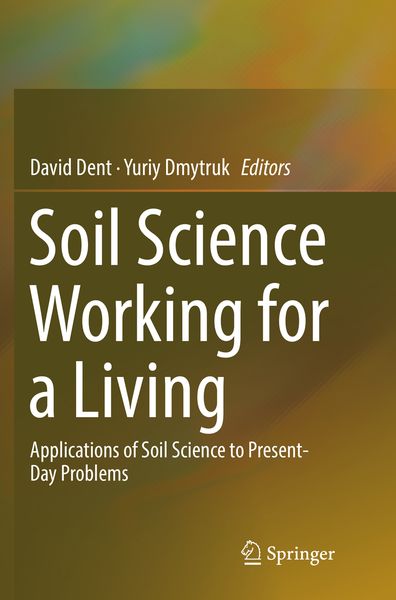
Soil Science Working for a Living Applications of soil science to present-day problems

Fr. 192.00

inkl. gesetzl. MwSt., Versandkostenfrei


Beschreibung

Produktdetails

Einband

Taschenbuch

Erscheinungsdatum

29.04.2018

Abbildungen

XIII, 89 illus., 50 illus. in color., farbige Illustrationen, schwarz-weiss Illustrationen

Herausgeber

David Dent + weitere

Verlag

Springer

Seitenzahl

290

Maße (L/B/H)

23.5/15.5/1.6 cm

Gewicht

519 g

Auflage

Softcover reprint of the original 1st edition 2017

Sprache

Englisch

ISBN

978-3-319-83288-3

Beschreibung

Produktdetails

Einband

Taschenbuch

Erscheinungsdatum

29.04.2018

Abbildungen

XIII, 89 illus., 50 illus. in color., farbige Illustrationen, schwarz-weiss Illustrationen

Herausgeber

Verlag

Springer

Seitenzahl

290

Maße (L/B/H)

23.5/15.5/1.6 cm

Gewicht

519 g

Auflage

Softcover reprint of the original 1st edition 2017

Sprache

Englisch

ISBN

978-3-319-83288-3

Herstelleradresse

Springer-Verlag KG
Sachsenplatz 4-6
1201 Wien
AT

Email: GPSR Kontakt

Noch keine Bewertungen vorhanden

Verfassen Sie die erste Bewertung zu diesem Artikel

Helfen Sie anderen Kundinnen und Kunden durch Ihre Meinung.

Kundinnen und Kunden meinen

Bewertungen (0)

  • Produktbild: Soil Science Working for a Living
  • Editors' introduction.- Part I: Soil development: properties and qualities.- Chapter 1. The factors and conditions of soil formation: a critical analysis of equivalence.- Chapter 2. Redoximorphic features in Albeluvisols from south-western Ukraine.- Chapter 3. Fractal properties of coarse/fine-related distribution in forest soils on colluvium.- Part II: Assessment of resources and risks.-  Chapter 4. The last steppes: new perspectives on an old challenge.- Chapter 5. Using multispectral satellite imagery for parameterization of eroded Chernozem.- Chapter 6. Pedo-geochemical assessment of a Holsteinian occupation site.- Chapter 7. Using geostatistics, DEM and remote sensing to clarify soil cover maps of Ukraine.- Chapter 8. Making better soil maps using models of tangential curvature.- Chapter 9. Determination of soil-loss tolerance for Chernozem of right-bank Ukraine.- Chapter 10. Assessment of problems of soil contamination using environmental indicators.- Chapter 11.Mathematical tools to assess soil contamination by deposition of technogenic emissions.- Part III: Soil fertility, degradation and improvement.- Chapter 12. Theoretical problems of improving agrochemical terminology.- Chapter 13. Criteria and parameters for forecasting the direction of irrigated soil evolution.- Chapter 14. Sustainability of soil fertility in the southern steppe of the Ukraine depending on fertilizers and irrigation.- Chapter 15. Evolution of potassium reserves in Chernozem under different fertilizer strategies, and indicators of potency.- Chapter 16. Ecological reclamation of acid soils.- Chapter 17. Composition of mobile phosphate fractions in soils of the Pre-Carpathians influenced by drainage, lime and phosphate fertilizer.- Part IV: Soil contamination, monitoring and remediation.- Chapter 18. Toxic soil contamination and its mitigation in Ukraine.- Chapter 19. Heavy metals in soils under the heel of heavy industry.- Chapter 20. Dangerous mercury contamination around the former Radikal chemicals factory in Kyiv and possible ways of rehabilitating this area.- Chapter 21. Comparison of groundwater and surface water quality in the area of the Bilanovo iron deposit.- Chapter 22. Estimation of soil radiation in the country around the Bilanovo iron and Kremenchug uranium deposits.- Chapter 23. Estimation of soil radiation in the country around the Dibrova uranium-thorium-rare earth deposit.- Chapter 24. Lead and zinc speciation in soils and their transfer in vegetation.- Chapter 25. Copper and zinc in the soils of the Olviya archaeological site.- Chapter 26. Environmental assessment of soil based on fractional-group composition of heavy metals.- Chapter 27. Regularity of transformations of oil-contaminated microbial ecosystems by super-oxidation technology and subsequent bio-remediation.- Chapter 28. Transformation of non-polar hydrocarbons in soils.