• Produktbild: Identifying Emerging Issues in Disaster Risk Reduction, Migration, Climate Change and Sustainable Development
  • Produktbild: Identifying Emerging Issues in Disaster Risk Reduction, Migration, Climate Change and Sustainable Development

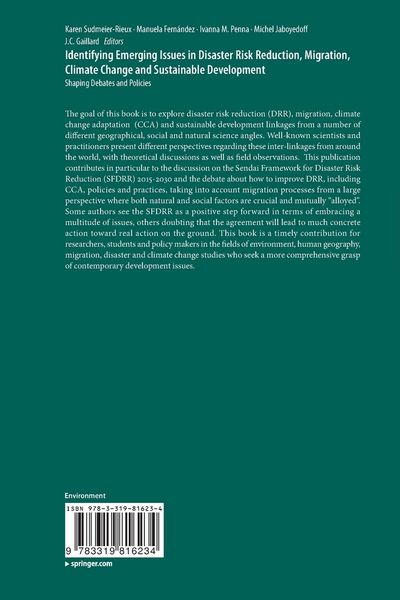
Identifying Emerging Issues in Disaster Risk Reduction, Migration, Climate Change and Sustainable Development Shaping Debates and Policies

Fr. 192.00

inkl. gesetzl. MwSt., Versandkostenfrei


Beschreibung

Produktdetails

Einband

Taschenbuch

Erscheinungsdatum

12.06.2018

Abbildungen

XXI, 38 illus., 33 illus. in color., farbige Illustrationen, schwarz-weiss Illustrationen

Herausgeber

Karen Sudmeier-Rieux + weitere

Verlag

Springer

Seitenzahl

281

Maße (L/B/H)

23.5/15.5/1.7 cm

Gewicht

464 g

Auflage

Softcover reprint of the original 1st edition 2017

Sprache

Englisch

ISBN

978-3-319-81623-4

Beschreibung

Portrait

Dr. Michel Jaboyedoff is a geologist and has a degree in physics and a PhD degree in clay mineralogy. Since 2005, he is a full professor at the University of Lausanne, focusing his research on natural hazards and related risks. He is working on integrated risk analysis in Switzerland and developing countries, looking at the impact of hazards on society. Ms. Manuela Fernandez has a degree in political science from the University of Buenos Aires (Argentina) and a Master’s degree in Geography from the University of Lausanne (Switzerland). She is currently completing a PhD at the University of Lausanne. Prof. J. C. Gaillard is Associate Professor at The University of Auckland in New Zealand. His present work focuses on developing participatory tools for disaster risk reduction and in involving marginalized groups in disaster-related activities with an emphasis on ethnicity, gender, prisoners and homeless people. JC Gaillard also collaborates in participatory mapping and community-based DRR trainings with NGOs, local governments and community-based organizations in Asia and the Pacific. Dr. Ivanna M. Penna is a researcher at the University of Lausanne, Centre for Research on Terrestrial Environments of the University of Lausanne. She completed her PhD at the Department of Geological Sciences from the University of Buenos Aires (Argentina), on large landslide occurrence in the Southern Central Andes of Argentina, with a specialization on assessment and management of geological and climate related risk, at the University of Geneva (Switzerland). Dr. Karen Sudmeier-Rieux is a senior researcher at the University of Lausanne, Centre for Research on Terrestrial Environment where she manages two research projects on landslide risk, bio-engineering, migration, resilience and vulnerability of mountain communities in Western Nepal.

Produktdetails

Einband

Taschenbuch

Erscheinungsdatum

12.06.2018

Abbildungen

XXI, 38 illus., 33 illus. in color., farbige Illustrationen, schwarz-weiss Illustrationen

Herausgeber

Verlag

Springer

Seitenzahl

281

Maße (L/B/H)

23.5/15.5/1.7 cm

Gewicht

464 g

Auflage

Softcover reprint of the original 1st edition 2017

Sprache

Englisch

ISBN

978-3-319-81623-4

Herstelleradresse

Springer-Verlag GmbH
Tiergartenstr. 17
69121 Heidelberg
DE

Email: ProductSafety@springernature.com

Kundinnen und Kunden meinen

0 Bewertungen

Informationen zu Bewertungen

Zur Abgabe einer Bewertung ist eine Anmeldung im Konto notwendig. Die Authentizität der Bewertungen wird von uns nicht überprüft. Wir behalten uns vor, Bewertungstexte, die unseren Richtlinien widersprechen, entsprechend zu kürzen oder zu löschen.

Die Bewertungen sind nach Format, Anzahl Sterne und Datum sortiert.

Verfassen Sie die erste Bewertung zu diesem Artikel

Helfen Sie anderen Kund*innen durch Ihre Meinung

Kundinnen und Kunden meinen

0 Bewertungen filtern

  • Produktbild: Identifying Emerging Issues in Disaster Risk Reduction, Migration, Climate Change and Sustainable Development
  • Produktbild: Identifying Emerging Issues in Disaster Risk Reduction, Migration, Climate Change and Sustainable Development
  • 1. Exploring linkages between disaster risk reduction, climate change adaptation, migration and sustainable development.- 2. Human mobility in a socio-environmental context: complex effects on environmental risk.- Part 1. Disaster risk reduction.- 3. Disaster risk reduction in the era of ‘homeland security’; the struggle for precautionary, preventive, and non-violent approaches.- 4. Water related risks in the area of Dakar, Senegal: coastal aquifers exposed to climate change and rapid urban development.- 5. Dike Risk: Revealing the academic links between disaster risk reduction, sustainable development, climate change and migration.- 6. Jakarta – Mumbai: Two Megacities Facing Floods Engaged In A Marginalization Process Of Slum Areas.- 7. The Necessity of Early Warning Articulated Systems (EWASs): Critical Issues Beyond Response.- Part 2. Migration.- 8. Applications of disaster risk reduction principles and operational mechanisms to migration in contexts of instability.- 9. Linking migration, mobility and development for strengthening adaptation to climate and disaster risks.  Reflections from Nepal.- 10. Overcoming Land Tenure Barriers in Shelter and other Reconstruction Activities in Post-Disaster Settings.- 11. Impacts of Outmigration on Land Management in a Nepali Mountain Area.- Part 3. Climate change adaptation.- 12. Reflections on disaster diplomacy for climate change and migration.- 13. Local Knowledge For Addressing Climate Change Risks At Local Level – A Case Study from Nepal.- 14. Building Farm Resilience in a Changing Climate: Challenges, Potentials, and Ways Forward for Smallholder Cocoa Production in Bolivia.- 15. The role of traditional knowledge to frame understanding of migration as adaptation to the “slow disaster” of sea level rise in the South Pacific.- 16. Conclusions – linking sustainable development, disaster risk reduction, climate change adaptation, migration and resilience – policy implications.