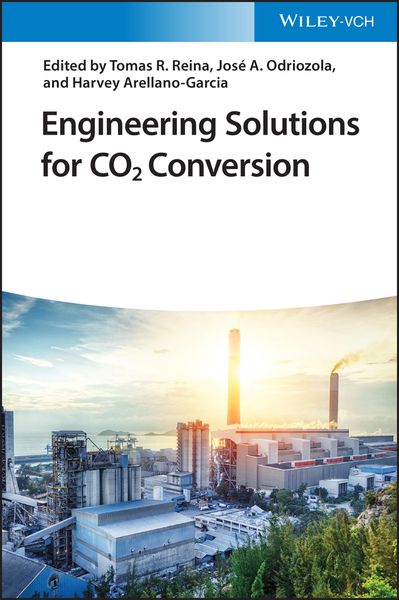
Produktbild: Engineering Solutions for CO2 Conversion

Engineering Solutions for CO2 Conversion

Fr. 205.00

inkl. gesetzl. MwSt., Versandkostenfrei


Beschreibung

Produktdetails

Einband

Gebundene Ausgabe

Erscheinungsdatum

24.03.2021

Abbildungen

schwarz-weiss Illustrationen, Tabellen, schwarz-weiss, farbige Illustrationen

Herausgeber

Tomas R. Reina + weitere

Verlag

Wiley-VCH

Seitenzahl

496

Maße (L/B/H)

25/17.5/3.1 cm

Gewicht

1064 g

Auflage

1. Auflage

Sprache

Englisch

ISBN

978-3-527-34639-4

Beschreibung

Produktdetails

Einband

Gebundene Ausgabe

Erscheinungsdatum

24.03.2021

Abbildungen

schwarz-weiss Illustrationen, Tabellen, schwarz-weiss, farbige Illustrationen

Herausgeber

Verlag

Wiley-VCH

Seitenzahl

496

Maße (L/B/H)

25/17.5/3.1 cm

Gewicht

1064 g

Auflage

1. Auflage

Sprache

Englisch

ISBN

978-3-527-34639-4

Herstelleradresse

Wiley-VCH GmbH
Boschstrasse 12
69469 Weinheim
DE
product_safety@wiley.com

Kundinnen und Kunden meinen

0 Bewertungen

Informationen zu Bewertungen

Zur Abgabe einer Bewertung ist eine Anmeldung im Konto notwendig. Die Authentizität der Bewertungen wird von uns nicht überprüft. Wir behalten uns vor, Bewertungstexte, die unseren Richtlinien widersprechen, entsprechend zu kürzen oder zu löschen.

Die Bewertungen sind nach Format, Anzahl Sterne und Datum sortiert.

Verfassen Sie die erste Bewertung zu diesem Artikel

Helfen Sie anderen Kund*innen durch Ihre Meinung

Kundinnen und Kunden meinen

0 Bewertungen filtern

Die Leseprobe wird geladen.
  • Produktbild: Engineering Solutions for CO2 Conversion
  • 1 CO2 Capture - A Brief Review of Technologies and Its Integration 1
    Mónica García, Theo Chronopoulos, and Rubén M. Montañés

    1.1 Introduction: The Role of Carbon Capture 1

    1.2 CO2 Capture Technologies 2

    1.3 Integration of Post-combustion CO2 Capture in the Power Plant and Electricity Grid 17

    1.4 CO2 Capture in the Industrial Sector 21

    1.5 Conclusions 22

    2 Advancing CCSU Technologies with Computational Fluid Dynamics (CFD): A Look at the Future by Linking CFD and Process Simulations 29
    Daniel Sebastia-Saez, Evgenia Mechleri, and Harvey Arellano-García

    2.1 Sweep Across the General Simulation Techniques Available 29

    2.2 Multi-scale Approach for CFD Simulation of Amine Scrubbers 32

    2.3 Eulerian, Eulerian-Lagrangian, and Discrete Element Methods for the Simulation of Calcium Looping, Mineral Carbonation, and Adsorption in Other Solid Particulate Materials 38

    2.4 CFD for Oxy-fuel Combustion Technologies: The Application of Single-Phase Reactive Flows and Particle Tracking Algorithms 41

    2.5 CFD for Carbon Storage and Enhanced Oil Recovery (EOR): The Link Between Advanced Imaging Techniques and CFD 41

    2.6 CFD for Carbon Utilization with Chemical Conversion: The Importance of Numerical Techniques on the Study of New Catalysts 44

    2.7 CFD for Biological Utilization: Microalgae Cultivation 46

    2.8 What Does the Future Hold? 47

    3 Membranes Technologies for Efficient CO2 Capture-Conversion 55
    Sonia Remiro-Buenamañana, Laura Navarrete, Julio Garcia-Fayos, Sara Escorihuela, Sonia Escolastico, and José M. Serra

    3.1 Introduction 55

    3.2 Polymer Membranes 56

    3.3 Oxygen Transport Membranes for CO2 Valorization 60

    3.4 Protonic Membranes 65

    3.5 Membranes for Electrochemical Applications 69

    3.6 Conclusions and Final Remarks 78

    4 Computational Modeling of Carbon Dioxide Catalytic Conversion 85
    Javier Amaya Suárez, Elena R. Remesal, Jose J. Plata, Antonio M. Márquez, and Javier Fernández Sanz

    4.1 Introduction 85

    4.2 General Methods for Theoretical Catalysis Research 85

    4.3 Characterizing the Catalyst and Its Interaction with CO2 Using DFT Calculations 87

    4.4 Microkinetic Modeling in Heterogeneous Catalysis 89

    4.5 New Trends: High-Throughput Screening, Volcano Plots, and Machine Learning 92

    5 An Overview of the Transition to a Carbon-Neutral Steel Industry 105
    Juan C. Navarro, Pablo Navarro, Oscar H. Laguna, Miguel A. Centeno, and José A. Odriozola

    5.1 Introduction 105

    5.2 Global Relevance of the Steel Industry 106

    5.3 Current Trends in Emission Policies in the World's Leading Countries in Steel Industry 109

    5.4 Transition to a Carbon-Neutral Production. A Big Challenge for the Steel Industry 110

    5.5 CO2 Methanation: An Interesting Opportunity for the Valorization of the Steel Industry Emissions 114

    5.6 Relevant Projects Already Launched for the Valorization of the CO2 Emitted by the Steel Industry 116

    5.7 Concluding Remarks 119

    6 Potential Processes for Simultaneous Biogas Upgrading and Carbon Dioxide Utilization 125
    Francisco M. Baena-Moreno, Mónica Rodríguez-Galán, Fernando Vega, Isabel Malico, and Benito Navarrete

    6.1 Introduction 125

    6.2 Overview of Biogas General Characteristics and Upgrading Technologies to Bio-methane Production 127

    6.3 CCU Main Technologies 131

    6.4 Potential Processes for Biogas Upgrading and Carbon Utilization 133

    6.5 Conclusions 138

    7 Biogas Sweetening Technologies 145
    Nikolaos D. Charisiou, Savvas L. Douvartzides, and Maria A. Goula

    7.1 Introduction 145

    7.2 Biogas Purification Technologies 146

    7.3 Biogas Upgrading Technologies 157

    7.4 Conclusions 166

    8 CO2 Conversion to Value-Added Gas-Phase Products: Technology Overview and Catalysts Selection 175
    Qi Zhang, Laura Pastor-Pérez, Xiangping Zhang, Sai Gu, and Tomas R Reina

    8.1 Chapter Overview 175

    8.2 CO2 Methanation 176

    8.3 RWGS Reaction 183

    8.4 CO2 Reforming Reactions 188

    8.5 Conclusions and Final Remarks 195

    9 CO2 Utilization Enabled by Microchannel Reactors 205
    Luis F. Bobadilla, Lola Azancot, and José A. Odriozola

    9.1 Introduction 205

    9.2 Transport Phenomena and Heat Exchange in Microchannel Reactors 207

    9.3 Application of Microreactors in CO2 Capture, Storage, and Utilization Processes 212

    9.4 Concluding Remarks and Future Perspectives 221

    10 Analysis of High-Pressure Conditions in CO2 Hydrogenation Processes 227
    Andrea Álvarez Moreno, Esmeralda Portillo, and Oscar Hernando Laguna

    10.1 Introduction 227

    10.2 Thermodynamic Aspects 229

    10.3 Overview of Some Industrial Approaches Focused on the Production of Valuable Compounds form CO2 Using a Carbon Capture and Utilization (CCU) Approach 234

    10.4 Techno-Economic Considerations for the Methanol Production from a CCU Approach with the Use of High Pressure 238

    10.5 Concluding Remarks 248

    11 Sabatier-Based Direct Synthesis of Methane and Methanol Using CO2 from Industrial Gas Mixtures 253
    K. Müller, J. Israel, F. Rachow, and D. Schmeisser

    11.1 Overview 253

    11.2 Methane Synthesis of Gas Mixtures 255

    11.3 Applications 260

    11.4 Methanol Synthesis 274

    12 Survey of Heterogeneous Catalysts for the CO2 Reduction to CO via Reverse Water Gas Shift 281
    Thomas Mathew, Simi Saju, and Shiju N. Raveendran

    12.1 Introduction 281

    12.2 RWGS Catalysts 281

    12.3 Mechanism of RWGS Reaction 306

    13 Electrocatalytic Conversion of CO2 to Syngas 317
    Manuel Antonio Díaz-Pérez, A. de Lucas Consuegra, and Juan Carlos Serrano-Ruiz

    13.1 Introduction 317

    13.2 Production of Syngas 319

    13.3 Electroreduction of CO2/Water Mixtures to Syngas 320

    13.4 Conclusions 329

    14 Recent Progress on Catalyst Development for CO2 Conversion into Value-Added Chemicals by Photo- and Electroreduction 335
    Luqman Atanda, Mohammad A. Wahab, and Jorge Beltramini

    14.1 Introduction 335

    14.2 CO2 Catalytic Conversion by Photoreduction 336

    14.3 CO2 Catalytic Conversion by Electroreduction 346

    15 Yolk@Shell Materials for CO2 Conversion: Chemical and Photochemical Applications 361
    Cameron Alexander Hurd Price, Laura Pastor-Pérez, Tomas Ramirez-Reina, and Jian Liu

    15.1 Overview 361

    15.2 Key Benefits of Hierarchical Morphology 363

    15.3 Materials for Chemical CO2 Recycling Reactions 366

    15.4 Synthesis Techniques for CS/YS: A Brief Overview 372

    15.5 Future Advancement 375

    16 Aliphatic Polycarbonates Derived from Epoxides and CO2 385
    Sebastian Kernbichl and Bernhard Rieger

    16.1 Introduction 385

    16.2 Aliphatic Polycarbonates 386

    16.3 Catalyst Systems for the CO2/Epoxide Copolymerization 392

    16.4 Conclusion 402

    17 Metal-Organic Frameworks (MOFs) for CO2 Cycloaddition Reactions 407
    Ignacio Campello, Antonio Sepúlveda-Escribano, and Enrique V. Ramos-Fernández

    17.1 Introduction to MOF 407

    17.2 MOFs as Catalysts 407

    17.3 CO2 Cycloadditions 414

    17.4 Oxidative Carboxylation 420

    18 Plasma-Assisted Conversion of CO2 429
    Kevin H. R. Rouwenhorst, Gerard J. van Rooij, and Leon Lefferts

    18.1 Introduction 429

    18.2 Plasma-catalytic CO2 Conversion 437

    18.3 Perspective 448

    18.4 Conclusion 450

    References 451

    Index 463