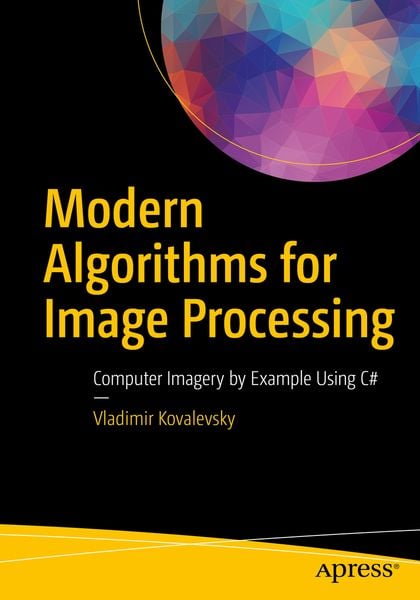
Modern Algorithms for Image Processing Computer Imagery by Example Using C#
-
- Taschenbuch ausgewählt
- eBook
-
Sprache:Englisch
Fr. 87.90
inkl. gesetzl. MwSt.,
Beschreibung
Produktdetails
Einband
Taschenbuch
Erscheinungsdatum
11.12.2018
Abbildungen
XIV, 88 illus., 53 illus. in color., farbige Illustrationen, schwarz-weiss Illustrationen
Verlag
ApressSeitenzahl
274
Maße (L/B/H)
25.4/17.8/1.6 cm
Gewicht
547 g
Auflage
1st ed.
Sprache
Englisch
ISBN
978-1-4842-4236-0
Utilize modern methods for digital image processing and take advantage of the many time-saving templates provided for all of the projects in this book.
Modern Algorithms for Image Processing approaches the topic of image processing through teaching by example. Throughout the book, you will create projects that resolve typical problems that you might encounter in the world of digital image processing. Some projects teach you methods for addressing the quality of images, such as reducing random errors or noise and suppressing pulse noise (salt and pepper), a method valuable for improving the quality of historical images. Other methods detail how to correct inhomogeneous illumination, not by means of subtracting the mean illumination, but through division, a far more efficient method. Additional projects cover contrasting, and a process for edge detection, more efficient than Canny's, for detecting edges in color images directly, without converting them into black and white images.
What You'll Learn
- Apply innovative methods for suppressing pulse noise, enhancing contrast, and edge detection
- Know the pros and cons of enlisting a particular method
- Use new approaches for image compression and recognizing circles in photos
- Utilize a valuable method for straightening photos of paintings taken at an oblique angle, a critical concept to understand when using flash at a right angle
- Understand the problem statement of polygonal approximation of boundaries or edges and its solution
- Use a new method for detecting bicycles in traffic
- Access complete source code examples in C# for all of the projects
Who This Book Is For
C# developers who work with digital image processing or are interested in informatics. The reader should have programming experience and access to an integrated development environment (IDE), ideally .NET.
This book does not prove or disprove theorems, but suggests methods for learning valuable concepts that will enable you to customize your own image processing projects.
Noch keine Bewertungen vorhanden
Verfassen Sie die erste Bewertung zu diesem Artikel
Helfen Sie anderen Kundinnen und Kunden durch Ihre Meinung.