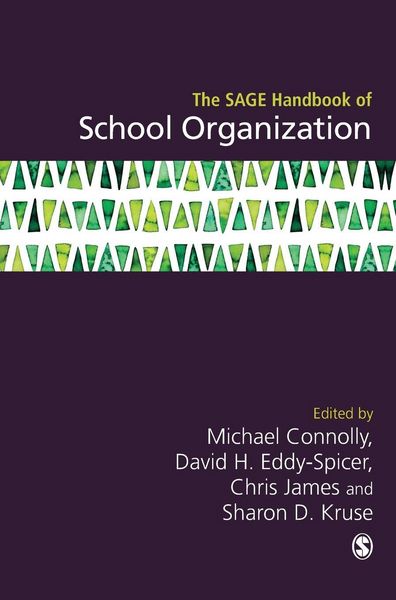
• Produktbild: The SAGE Handbook of School Organization
  • Produktbild: The SAGE Handbook of School Organization

The SAGE Handbook of School Organization

Fr. 273.00

inkl. gesetzl. MwSt., Versandkostenfrei


Beschreibung

Produktdetails

Einband

Gebundene Ausgabe

Erscheinungsdatum

29.12.2018

Herausgeber

Michael Connolly + weitere

Verlag

Sage Publications

Seitenzahl

752

Maße (L/B/H)

25/17.5/5.2 cm

Gewicht

1470 g

Sprache

Englisch

ISBN

978-1-5264-2066-4

Beschreibung

Rezension

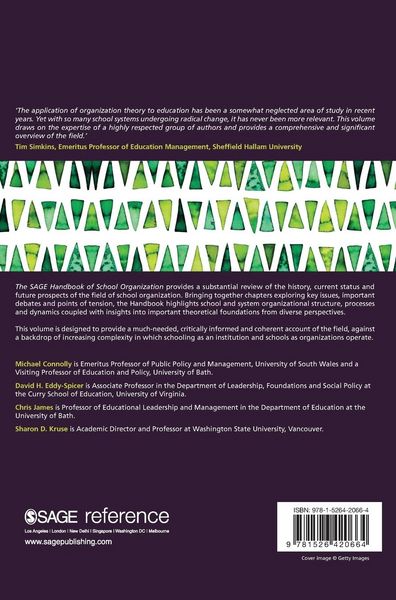
The application of Organization Theory to Education has been a somewhat neglected area of study in recent years. Yet with so many school systems undergoing radical change it has never been more relevant. This volume draws on the expertise of a highly respected group of authors and promises to be a comprehensive and significant overview of the field. Professor Tim Simkins 20180807

Produktdetails

Einband

Gebundene Ausgabe

Erscheinungsdatum

29.12.2018

Herausgeber

Verlag

Sage Publications

Seitenzahl

752

Maße (L/B/H)

25/17.5/5.2 cm

Gewicht

1470 g

Sprache

Englisch

ISBN

978-1-5264-2066-4

EU-Ansprechpartner

Zeitfracht Medien GmbH
Ferdinand-Jühlke-Straße 7|99095|Erfurt|DE

Herstelleradresse

SAGE Publications
1 Oliver's Yard 55 City Road|EC1Y 1SP|London|GB

Kundinnen und Kunden meinen

0 Bewertungen

Informationen zu Bewertungen

Zur Abgabe einer Bewertung ist eine Anmeldung im Konto notwendig. Die Authentizität der Bewertungen wird von uns nicht überprüft. Wir behalten uns vor, Bewertungstexte, die unseren Richtlinien widersprechen, entsprechend zu kürzen oder zu löschen.

Die Bewertungen sind nach Format, Anzahl Sterne und Datum sortiert.

Verfassen Sie die erste Bewertung zu diesem Artikel

Helfen Sie anderen Kund*innen durch Ihre Meinung

Kundinnen und Kunden meinen

0 Bewertungen filtern

Die Leseprobe wird geladen.
  • Produktbild: The SAGE Handbook of School Organization
  • Produktbild: The SAGE Handbook of School Organization
  • Chapter 1: Introduction to the handbook - Michael Connolly, David Eddy-Spicer, Chris James & Sharon Kruse
    Part 1: Schools as organizations
    Chapter 2: Organizations, organizing, and schools: Accessing Theoretical Tools and Models in Organization Theory - Bob L. Johnson Jr.
    Chapter 3: Historical Perspectives on Schools as Organizations - Daniel L. Duke
    Part 2: The leadership, management and governance of schools as organizations
    Chapter 4: Conceptions of the leadership and management of schools as organizations - Tony Bush
    Chapter 5: Managing the School Organization - Stephen L. Jacobson
    Chapter 6: Competing Narratives of Leadership in Schools: The Institutional and Discursive Turns in Organizational Theory - Gary L. Anderson& Ethan Chang
    Chapter 7: Governing and Governance of Schools as Organizations - Catherine Farrell
    Part 3: Theoretical perspectives on schools as organizations
    Chapter 8: Structural perspectives on schools as organizations - Scott C. Bauer & S. David Brazer
    Chapter 9: Too Legit to Quit: Institutional Perspectives on the Study of Schools as Organizations - Ebony N. Bridwell-Mitchell
    Chapter 10: School Organisation: Authority, Status and the Role of Love as an Integrative Power - Philip A. Woods
    Chapter 11: Organizational Culture in Schools: A Review of Widely Misunderstood Concept - Michael Connolly & Sharon D. Kruse
    Chapter 12: Inter-Organizational Networks in Education - Priscilla Wohlstetter & Angela Gargaro Lyle
    Chapter 13: Feelings, moods, and emotion in schools: Affective perspectives - Izhak Berkovich & Ori Eyal
    Chapter 14: Boundary perspectives on schools as organizations - David H. Eddy-Spicer & Chris James
    Chapter 15: Systems Thinking in School Organization - Chen Schechter & Haim Shaked
    Chapter 16: The Interactional Nature of Schools as Social Organizations: Three Theoretical Perspectives - Peter Sleegers, Nienke Moolenaar & Alan J. Daly
    Chapter 17: School Effectiveness and School Organization - Jaap Scheerens
    Chapter 18: Inequality in Education: What Educators Can and Cannot Change - Kathleen Lynch
    Chapter 19: Theorising schools as organisations from a feminist perspective - Jill Blackmore
    Chapter 20: Queer theory perspectives on schools as organizations - Katherine Cumings Mansfield
    Part 4: Organizing in Schools
    Chapter 21: Organizing in schools: A matter of trust - Megan Tschannen-Moran
    Chapter 22: Understanding schools as organisations and the role of organised teachers: Perspectives on teachers¿ work and teacher unions - Howard Stevenson
    Chapter 23: Schools as organizations: Accountability concerns - Melanie Ehren
    Chapter 24: Organizational performance metrics for schools - Daniel Muijs
    Chapter 25: National and transnational influences on school organization - Chen Yong Tan & Clive Dimmock
    Chapter 26: Decision-making and the school organization - Stephanie Chitpin & Colin W. Evers
    Chapter 27: Lesson Study: Curriculum Management for 21st Century Skills - Eric C.K. Cheng & John Chi-kin Lee
    Chapter 28: Beyond Ritualized Rationality: Organizational Dynamics of Instructionally-Focused Continuous Improvement - Donald J. Peurach, William R. Penuel & Jennifer Lin Russell
    Chapter 29: Parental Involvement in Schools as Organizations: Examining Consistent Benefits, Persistent Challenges, and Emerging Issues - Julie W. Dallavis & Mark Berends
    Chapter 30: Assembling schools as organisations: On the limits and contradictions of neoliberalism - Andrew Wilkins
    Chapter 31: The digital age: Exploring the relationship between technology and schools organization - Vincent Cho, Virginia Snodgrass Rangel, Anna Noble
    Chapter 32: School-to-School Collaboration: Building collective capacity through collaborative enquiry - Christopher Chapman
    Chapter 33: Achieving Education for All: Organizational Issues in African Primary Schools - Daniel N. Sifuna
    Chapter 34: The School Building as Organizational Agent: Leveraging Physical Learning Environments to Advance the Educational Enterprise - Pamela Woolner and Cynthia L. Uline
    Part 5: Researching schools as organizations
    Chapter 35: Defining Schools as Social Spaces: A Social Network Approach to Researching Schools as Organizations - Joelle Rodway & Alan J. Daly
    Chapter 36: Research use in schools: Theory and Evidence - A framework for understanding research use in school-level decision making - Alice Huguet, Lok-Sze Wong, Christopher W. Harrison, Cynthia E. Coburn, & James P. Spillane
    Chapter 37: Practitioner research in schools as organizations - Andrew Townsend
    Chapter 38: Critical issues for the study of school improvement: Contributions from a research program in Chile - Cristian Bellei, Liliana Morawietz, Juan Pablo Valenzuela & Xavier Vann
    Chapter 39: Design-Based School Improvement and Research for Education Leaders - Rick Mintrop, Elizabeth Zumpe, & Mahua Baral
    Chapter 40: Summary and reflections - Michael Connolly, David H. Eddy-Spicer, Chris James & Sharon Kruse