
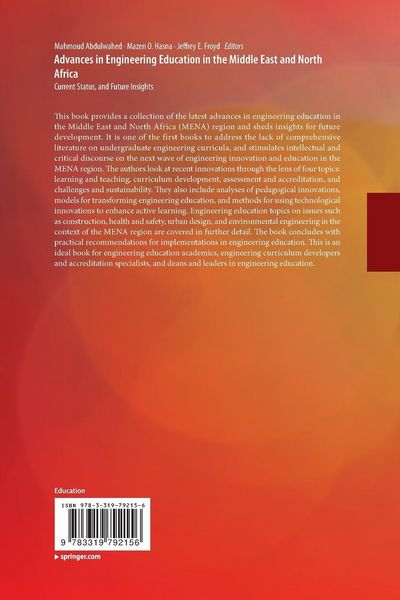
• Produktbild: Advances in Engineering Education in the Middle East and North Africa
  • Produktbild: Advances in Engineering Education in the Middle East and North Africa

Advances in Engineering Education in the Middle East and North Africa Current Status, and Future Insights

Fr. 138.00

inkl. gesetzl. MwSt., Versandkostenfrei


Beschreibung

Produktdetails

Einband

Taschenbuch

Erscheinungsdatum

28.03.2019

Abbildungen

XXVI, 106 illus., 57 illus. in color., schwarz-weiss Illustrationen, farbige Illustrationen

Herausgeber

Mahmoud Abdulwahed + weitere

Verlag

Springer

Seitenzahl

454

Maße (L/B/H)

23.5/15.5/2.6 cm

Gewicht

721 g

Auflage

Softcover reprint of the original 1st edition 2016

Sprache

Englisch

ISBN

978-3-319-79215-6

Beschreibung

Produktdetails

Einband

Taschenbuch

Erscheinungsdatum

28.03.2019

Abbildungen

XXVI, 106 illus., 57 illus. in color., schwarz-weiss Illustrationen, farbige Illustrationen

Herausgeber

Verlag

Springer

Seitenzahl

454

Maße (L/B/H)

23.5/15.5/2.6 cm

Gewicht

721 g

Auflage

Softcover reprint of the original 1st edition 2016

Sprache

Englisch

ISBN

978-3-319-79215-6

Herstelleradresse

Springer-Verlag GmbH
Tiergartenstr. 17
69121 Heidelberg
DE

Email: ProductSafety@springernature.com

Kundinnen und Kunden meinen

0 Bewertungen

Informationen zu Bewertungen

Zur Abgabe einer Bewertung ist eine Anmeldung im Konto notwendig. Die Authentizität der Bewertungen wird von uns nicht überprüft. Wir behalten uns vor, Bewertungstexte, die unseren Richtlinien widersprechen, entsprechend zu kürzen oder zu löschen.

Die Bewertungen sind nach Format, Anzahl Sterne und Datum sortiert.

Verfassen Sie die erste Bewertung zu diesem Artikel

Helfen Sie anderen Kund*innen durch Ihre Meinung

Kundinnen und Kunden meinen

0 Bewertungen filtern

  • Produktbild: Advances in Engineering Education in the Middle East and North Africa
  • Produktbild: Advances in Engineering Education in the Middle East and North Africa
  • Part I: Background, Editorship, and Global Perspectives.- Purpose of the Book and Editorial Perspectives.- Developments in Engineering Education and Engineering Education Research in Europe.- Engineering Education in Southeast Asia: Practice and Research.- Part II: Innovations in Learning, Teaching, and Engineering Education.- Leveraging Pedagogical Innovations for STEM Education in the Middle East Context.- Model for Transforming Engineering Education using Technology-Enhanced Learning.- Using Forums and Simulation Exercises to Enhance Active Learning in Lean Construction Education.- A Framework for Developing Innovative Problem Solving and Creativity Skills for Engineering Undergraduates.- Active Blended Learning to Improve Students Motivation in Computer Programming Courses: A Case Study.- Part III: Curriculum Development.- Women's Spicific Needs And Urban Planning Practices In The Middle East The Case Of Palestine.- Improving and Expanding Engineering Education in the Middle East  And Africa Using Mobile Learning Technology and Innovative Pedagogy.- Inclusion of Construction Health and Safety in Engineering Programs in the MENA Region: Assessment and Potential Enhancement.-Environmental Engineering Education in the UAE.- Part IV: Assessment and Accreditation.- Potential and Challenges of Project Based Learning in Engineering Education at the United Arab Emirates University.- Effective Alignment of Disciplinary and Institutional Accreditation and Assessment: A UAE Computing Case Study.- Part V: Challenges and Sustainability Perspectives.- Engineering Education in Northwest Africa MENA Countries: Challenges and Opportunities for the 21st Century.- : Perspectives on Engineering Education Quality in Tunisia after Fifty Years of Statehood.- : Social Justice and the Engineering Profession: Challenging Engineering Education to Move beyond the Technical.-  Part VI: Industry Perspectives, Future Insights, and Conclusions.- Engineering Education in the Middle East and North Africa: An Industry Perspective.- An Insight on the Future of Engineering Education, Recommendations for Implementations, and Conclusions.