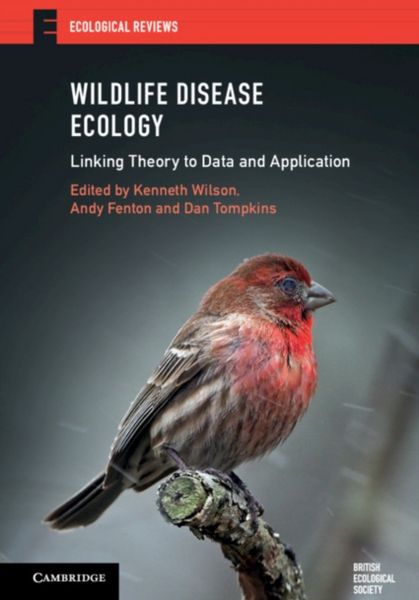
Produktbild: Wildlife Disease Ecology

Wildlife Disease Ecology Linking Theory to Data and Application

Fr. 93.90

inkl. gesetzl. MwSt., Versandkostenfrei


Beschreibung

Produktdetails

Einband

Taschenbuch

Erscheinungsdatum

02.01.2020

Herausgeber

Kenneth Wilson + weitere

Verlag

Cambridge University Press

Seitenzahl

690

Maße (L/B/H)

24.4/17.6/3.5 cm

Gewicht

1458 g

Sprache

Englisch

ISBN

978-1-316-50190-0

Beschreibung

Produktdetails

Einband

Taschenbuch

Erscheinungsdatum

02.01.2020

Herausgeber

Verlag

Cambridge University Press

Seitenzahl

690

Maße (L/B/H)

24.4/17.6/3.5 cm

Gewicht

1458 g

Sprache

Englisch

ISBN

978-1-316-50190-0

Herstelleradresse

Libri GmbH
Europaallee 1
36244 Bad Hersfeld
DE

Email: gpsr@libri.de

Kundinnen und Kunden meinen

0 Bewertungen

Informationen zu Bewertungen

Zur Abgabe einer Bewertung ist eine Anmeldung im Konto notwendig. Die Authentizität der Bewertungen wird von uns nicht überprüft. Wir behalten uns vor, Bewertungstexte, die unseren Richtlinien widersprechen, entsprechend zu kürzen oder zu löschen.

Die Bewertungen sind nach Format, Anzahl Sterne und Datum sortiert.

Verfassen Sie die erste Bewertung zu diesem Artikel

Helfen Sie anderen Kund*innen durch Ihre Meinung

Kundinnen und Kunden meinen

0 Bewertungen filtern

  • Produktbild: Wildlife Disease Ecology
  • Preface: wildlife disease ecology; Glossary of terms; Part I. Understanding Within-Host Processes: 1. Pollinator diseases: the Bombus-Crithidia system; 2. Genetic diversity and disease spread: epidemiological models and empirical studies of a snail-trematode system; 3. Wild rodents as a natural model to study within-host parasite interactions; 4. From population to individual host scale and back again: testing theories of infection and defence in the Soay sheep of St Kilda; 5. The causes and consequences of parasite interactions: African buffalo as a case study; 6. Effects of host lifespan on the evolution of age-specific resistance: a case study of anther-smut disease on wild carnations; 7. Sexually transmitted infections in natural populations: what have we learnt from beetles and beyond?; Part II. Understanding Between-Host Processes: 8. Using insect baculoviruses to understand how population structure affects disease spread; 9. Infection and invasion: study cases from aquatic communities; 10. Parasite mediated selection in red grouse - consequences for population dynamics and mate choice; 11. Emergence, transmission and evolution of an uncommon enemy: Tasmanian devil facial tumour disease; 12. Bovine tuberculosis in badgers: sociality, infection and demography in a social mammal; 13. Mycoplasma ovipneumoniae in bighorn sheep: from exploration to action; 14. Manipulating parasites in an Arctic herbivore: gastrointestinal nematodes and the population regulation of Svalbard reindeer; Part III. Understanding Wildlife Disease Ecology at the Community and Landscape Level: 15. The ecological and evolutionary trajectory of oak powdery mildew in Europe; 16. Healthy herds or predator spreaders? Insights from the plankton into how predators suppress and spread disease; 17. Multi-trophic interactions and migration behaviour determine the ecology and evolution of parasite infection in monarch butterflies; 18. When chytrid fungus invades: integrating theory and data to understand disease- induced amphibian declines; 19. Ecology of a marine ectoparasite in farmed and wild salmon; 20. Mycoplasmal conjunctivitis in house finches: the study of an emerging disease; 21. Heterogeneities in infection and transmission in a parasite-rabbit system: key issues for understanding disease dynamics and persistence; 22. Sylvatic plague in Central Asia: a case study of abundance thresholds.