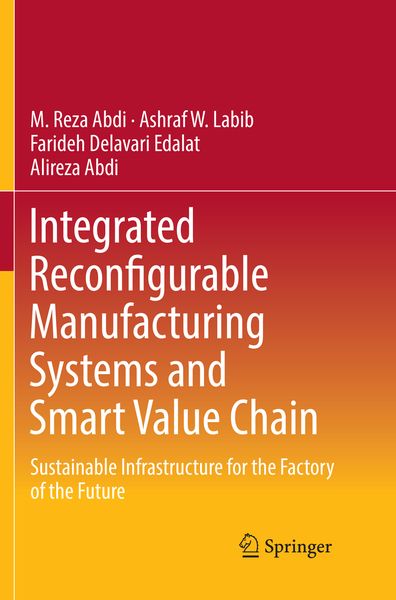
Integrated Reconfigurable Manufacturing Systems and Smart Value Chain Sustainable Infrastructure for the Factory of the Future
-
- Hardcover
- Taschenbuch ausgewählt
- eBook
-
Sprache:Englisch
Fr. 242.00
inkl. gesetzl. MwSt.,
Beschreibung
Produktdetails
Einband
Taschenbuch
Erscheinungsdatum
08.02.2019
Abbildungen
XXVIII, 122 illus., 68 illus. in color., farbige Illustrationen, schwarz-weiss Illustrationen
Verlag
SpringerSeitenzahl
289
Maße (L/B/H)
23.5/15.5/1.8 cm
Gewicht
492 g
Auflage
Softcover reprint of the original 1st ed. 2018
Sprache
Englisch
ISBN
978-3-030-08307-6
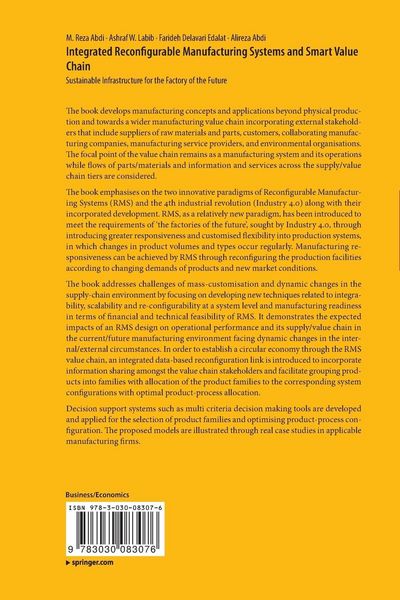
The book develops manufacturing concepts and applications beyond physical production and towards a wider manufacturing value chain incorporating external stakeholders that include suppliers of raw materials and parts, customers, collaborating manufacturing companies, manufacturing service providers, and environmental organisations. The focal point of the value chain remains as a manufacturing system and its operations whiles flows of parts/materials and information and services across the supply/value chain tiers are taken into account.
The book emphasises on the two innovative paradigms of Reconfigurable Manufacturing Systems (RMS) and the 4th industrial revolution (Industry 4.0) along with their incorporated development. RMS, as a relatively new paradigm, has been introduced to meet the requirements of ‘the factories of the future’, which is aimed by Industry 4.0, though introducing greater responsiveness and customised flexibility into production systems, in which changes in product volumes and types occur regularly. Manufacturing responsiveness can be achieved by RMS through reconfiguring the production facilities according to changing demands of products and new market conditions. The book addresses challenges of mass-customisation and dynamic changes in the supply-chain environment by focusing on developing new techniques related to integrability, scalability and re-configurability at a system level and manufacturing readiness in terms of financial and technical feasibility of RMS. It demonstrate the expected impacts of an RMS design on operational performance and its supply/value chain in the current/future manufacturing environment facing dynamic changes in the internal/external circumstances. In order to establish a circular economy through the RMS value chain, an integrated data-based reconfiguration link is introduced to incorporate information sharing amongst the value chain stakeholders and facilitate grouping products into families with allocation of the product families to the corresponding system configurations with optimal product-process allocation.Decision support systems such as multi criteria decision making tools are developed and applied for the selection of product families and optimising product-process configuration. The proposed models are illustrated through real case studies in applicable manufacturing firms.
Noch keine Bewertungen vorhanden
Verfassen Sie die erste Bewertung zu diesem Artikel
Helfen Sie anderen Kundinnen und Kunden durch Ihre Meinung.