Gutscheinbedingungen

*Gültig bis 21.06.2026 auf (fast) alles. Ausgeschlossen sind Smartboxen, Zeitschriften, Tickets, Lebensmittel, Gaming-Elektroartikel, Tinte/Toner, Gutscheine, Geschenkkarten, Blumen und Abos | Einlösbar in allen Buchhandlungen von Orell Füssli, Barth Bücher, Buchladen Rapunzel, Schuler Orell Füssli, Stauffacher und ZAP unter Vorweisung des Gutscheins, auf www.orellfüssli.ch durch Eingabe des Gutscheincodes. Beim Service „eBooks verschenken“ und bei eBook-Käufen via eReader nicht einlösbar | Mindesteinkaufswert: Fr. 30.- | Nicht mit anderen Rabatten kumulierbar.

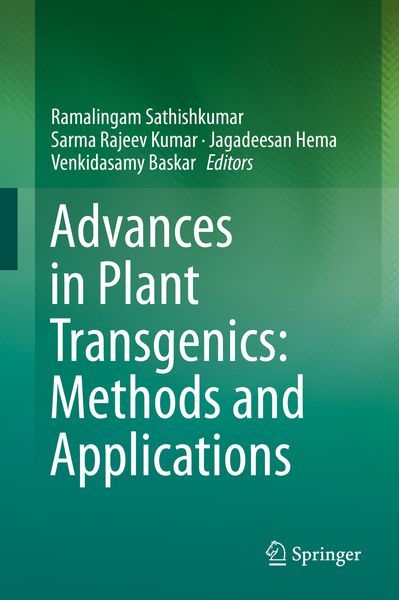
Produktbild: Advances in Plant Transgenics: Methods and Applications

Advances in Plant Transgenics: Methods and Applications

Fr. 192.00

inkl. gesetzl. MwSt., Versandkostenfrei


Beschreibung

Produktdetails

Einband

Gebundene Ausgabe

Erscheinungsdatum

25.11.2019

Abbildungen

XXII, 26 illus., 23 illus. in color., schwarz-weiss Illustrationen, farbige Illustrationen

Herausgeber

Ramalingam Sathishkumar + weitere

Verlag

Springer Singapore

Seitenzahl

366

Maße (L/B/H)

24.1/16/2.6 cm

Gewicht

790 g

Auflage

1st ed. 2019

Sprache

Englisch

ISBN

978-981-13-9623-6

Beschreibung

Portrait

Dr. R. Sathishkumar is currently a Professor of Biotechnology at Bharathiar University, India. He holds PhD from School of Biological Sciences, Madurai Kamaraj University, India and gained Post- doctoral training from The University of Hong Kong, Hong Kong. The thrust area of his research includes Plant Molecular Farming, Plant Metabolic Engineering and DNA Barcoding. He has supervised 12 PhD’s and mentored 4 Post-doctoral fellows till now. He has secured both national and international funding for his research. He has a US patent and filed an Indian patent.  To his credit he has 70 peer reviewed journal and 22 book chapter publications. Recently, he was elected as a subcommittee member on DNA barcoding by Indian Pharmacopeia Commission (IPC), Government of India. He is a consultant for many of the Indian herbal industries.

Dr. Rajeev Kumar is working as Scientist in String Bio Private Limited, India after completing 5 years of post-doctoral research in CSIR- Central Institute of Medicinal and Aromatic Plants, Lucknow and Research Centre Bangalore. He received fellowships like Senior Research Associateship from Council of Scientific and Industrial Research, Govt. of India and Research Associateship from Department of Biotechnology, Govt. of India. During his PhD tenure, he was awarded one year fellowship from Foundation for Science and Technology, Portugal to work with Prof. Birgit Arnholdt-Schmitt, University of Evora, Portugal.  He has published 15 research papers in international peer-reviewed journals and authored 14 book chapters.

 Dr. Hema Jagadeesan is currently an Associate Professor in Biotechnology at PSG College of Technology, India and actively pursuing research in the area of environmental biotechnology, especially plant-microbe interactions in remediation. She holds a PhD in Plant Sciences from Madurai Kamaraj University, Madurai, India and MSc. in Environmental Sciences from Jawaharlal Nehru University, New Delhi, India. She is the recipient of Council of Scientific and Industrial Research (CSIR) Junior and Senior research Fellowships for her doctoral research. She has eight international journal articles and more than eleven conference publications. She has worked as Programme Officer (Scientist C) in “The Centre for Environment Education”, (Supported by the Ministry of Environment and Forests, Government of India, India).

Dr. Baskar Venkidasamy is working as a consultant in Texcity Biosciences Pvt Ltd., India. He   completed his post-doctoral research in Bharathiar University, India in the DST-SERB N-PDF scheme. He received fellowship from Konkuk University, S. Korea for doing PhD in Molecular biotechnology. His area of expertise is genetic engineering of plants for improved traits such as stress tolerance, enhanced health and nutritive values. He obtained his master’s degree in Biotechnology from Bharathidasan University and bachelor’s degree in Microbiology from Madurai Kamaraj University. He has published 20 peer reviewed publications in internationally reputed journals and 3 book chapters in international publishers.

Produktdetails

Einband

Gebundene Ausgabe

Erscheinungsdatum

25.11.2019

Abbildungen

XXII, 26 illus., 23 illus. in color., schwarz-weiss Illustrationen, farbige Illustrationen

Herausgeber

Verlag

Springer Singapore

Seitenzahl

366

Maße (L/B/H)

24.1/16/2.6 cm

Gewicht

790 g

Auflage

1st ed. 2019

Sprache

Englisch

ISBN

978-981-13-9623-6

Herstelleradresse

Springer-Verlag GmbH
Tiergartenstr. 17
69121 Heidelberg
DE

Email: ProductSafety@springernature.com

Kundinnen und Kunden meinen

0 Bewertungen

Informationen zu Bewertungen

Zur Abgabe einer Bewertung ist eine Anmeldung im Konto notwendig. Die Authentizität der Bewertungen wird von uns nicht überprüft. Wir behalten uns vor, Bewertungstexte, die unseren Richtlinien widersprechen, entsprechend zu kürzen oder zu löschen.

Die Bewertungen sind nach Format, Anzahl Sterne und Datum sortiert.

Verfassen Sie die erste Bewertung zu diesem Artikel

Helfen Sie anderen Kund*innen durch Ihre Meinung

Kundinnen und Kunden meinen

0 Bewertungen filtern

  • Produktbild: Advances in Plant Transgenics: Methods and Applications
  • Chapter 1. Plant Tissue Culture and DNA Delivery Methods.- Chapter 2. Cell Cultures and Hairy Roots as Platform for Production of High Value Metabolites: Current Approaches, Limitations and Future Prospects.- Chapter 3. Integrating Bioinformatics and Omics tools for systems analysis of abiotic stress tolerance in Oryza sativa (L.).- Chapter 4. Green Biotechnology: A brief update on Plastid Genome Engineering.- Chapter 5. New Generation Transformation Vectors.- 6 Recent Developments in Generation of Marker Free Transgenic Plants.- Chapter 7. Applications of Genome Engineering/Editing Tools in Plants.- Chapter 8. High Throughput Analytical Techniques to Screen Plant Transgenics.- Chapter 9. Transgenic Technologies and their Potential Application in Horticultural Crop Improvement.- Chapter 10. Commercial Application of Transgenic Plants in Virus Management.- Chapter 11. Application of Reed Beds in Wastewater Treatment: Scope for Transgenic Plants.- Chapter 12. Inspection of Crop Wild Relative ( Cicer microphyllum ) as Potential Genetic Resource in Transgenic Development.- Chapter 13. Genome Modification Approaches to Improve Performance, Quality and Stress Tolerance of Mediterranean Fruit Species.- Chapter 14. Key Challenges in Developing Products from Transgenic Plants.- Chapter 15. Enhanced Production of Therapeutic Proteins in Plants: Novel Expression Strategies.- Chapter 16. Transcriptional Engineering for Enhancing Valuable Metabolites in Photosynthetic Microalgae.