• Produktbild: Ecological Engagement
  • Produktbild: Ecological Engagement

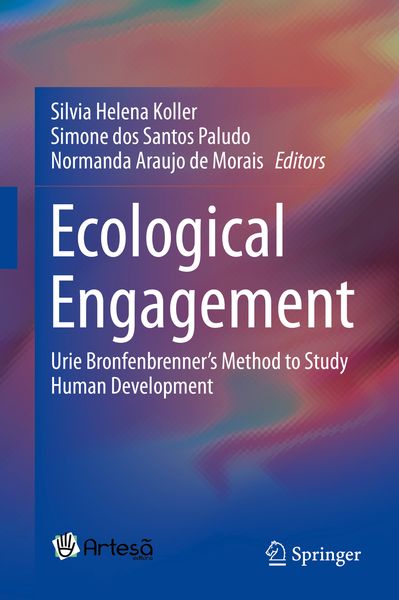
Ecological Engagement Urie Bronfenbrenner’s Method to Study Human Development

Fr. 138.00

inkl. gesetzl. MwSt., Versandkostenfrei


Beschreibung

Produktdetails

Einband

Gebundene Ausgabe

Erscheinungsdatum

13.11.2019

Abbildungen

XXIII, 7 illus., 1 illus. in color., schwarz-weiss Illustrationen, farbige Illustrationen

Herausgeber

Silvia Helena Koller + weitere

Verlag

Springer

Seitenzahl

267

Maße (L/B/H)

24.1/16/2.2 cm

Gewicht

590 g

Auflage

1st ed. 2019

Originaltitel

Inserção ecológica: um método de estudo do desenvolvimento humano

Sprache

Englisch

ISBN

978-3-030-27904-2

Beschreibung

Portrait

Silvia Helena Koller is Full Professor and Chair of the Center for Psychological Studies of At-Risk Populations in the Department of Psychology at the Federal University of Rio Grande do Sul, Porto Alegre, Brazil, and Extraordinary Professor at North West University, in Vanderbijlpark, South Africa. She was also a Visiting Scholar at Harvard Graduate School of Education and a Visiting Scientist at Harvard T.H. Chan School of Public Health between 2016 and 2017. Dr. Koller has focused her investigations on at-risk populations based on a bioecological theoretical perspective, having developed the Ecological Engagement method to apply Urie Bronfenbrenner’s Bioecological Theory of Human Developed to empirical studies of child and adolescent development. She has lectured at different universities around the world, such as North-West University (South Africa), University of Zurich (Switzerland), Harvard University, UIUC, UNL, UNC, and ASU (USA), Universidad del Valle, Universidad Nacionalde Colombia, Pontificia Universidad Católica Javeriana, and Universidad de Baranquilla (Colombia), Universidad San Marco, Pontificia Universidad Católica, Universidad Autónoma, and Universidad de Chiclayo (Peru), Pontificia Universidad Católica (Chile), among others, and has advised and mentored many students who are now important researchers in Brazil, Colombia, Portugal and the USA.

Simone dos Santos Paludo is Associate Professor in the Department of Education and Behavioral Sciences at the Federal University of Rio Grande, Rio Grande, Brazil, where she coordinates the local branch of the Center for Psychological Studies of At-Risk Populations. She holds a PhD in Psychology from the Federal University of Rio Grande do Sul and her main research interests are violations of child, adolescent and youth rights, violence against women, positive development, moral emotions and resilience.   

Normanda Araujo de Morais is Full Professor in the Graduate Programin Psychology at the University of Fortaleza, Fortaleza, Brazil, where she coordinates the Laboratory of Complex Systems Studies: Couples, Family and Community. Dr. Morais holds a PhD in Psychology from the Federal University of Rio Grande do Sul and her main research interests are human development in contexts of social vulnerability, children and adolescents living in the streets, family and community resilience, positive psychology and families formed by same sex couples.  


Produktdetails

Einband

Gebundene Ausgabe

Erscheinungsdatum

13.11.2019

Abbildungen

XXIII, 7 illus., 1 illus. in color., schwarz-weiss Illustrationen, farbige Illustrationen

Herausgeber

Verlag

Springer

Seitenzahl

267

Maße (L/B/H)

24.1/16/2.2 cm

Gewicht

590 g

Auflage

1st ed. 2019

Originaltitel

Inserção ecológica: um método de estudo do desenvolvimento humano

Sprache

Englisch

ISBN

978-3-030-27904-2

Herstelleradresse

Springer-Verlag GmbH
Tiergartenstr. 17
69121 Heidelberg
DE

Email: ProductSafety@springernature.com

Kundinnen und Kunden meinen

0 Bewertungen

Informationen zu Bewertungen

Zur Abgabe einer Bewertung ist eine Anmeldung im Konto notwendig. Die Authentizität der Bewertungen wird von uns nicht überprüft. Wir behalten uns vor, Bewertungstexte, die unseren Richtlinien widersprechen, entsprechend zu kürzen oder zu löschen.

Die Bewertungen sind nach Format, Anzahl Sterne und Datum sortiert.

Verfassen Sie die erste Bewertung zu diesem Artikel

Helfen Sie anderen Kund*innen durch Ihre Meinung

Kundinnen und Kunden meinen

0 Bewertungen filtern

  • Produktbild: Ecological Engagement
  • Produktbild: Ecological Engagement
  • Part I: Ecological Engagement

    1. Ecological Engagement: promotion of knowledge production

    2. Ecological Engagement in the community: a methodological proposal for the study of families at risk

    3. Revising the Ecological Engagement: New Aspects and New Research Examples

    4. Ecological Engagement: Systematic Review on the Use of the Research Method 

    Part II: Ecological Engagement in Different Contexts  

    5. Ecological Engagement in Research on Trajectories of Adolescent Life in Situations of Social Vulnerability: Identifying Risk Factors and Protection

    6. Ecological Engagement in a Children’s Shelter in Espírito Santo, Brazil 

    7. Ecological Engagement in Institutional Care Context: An Experience Report with Adolescents in Pernambuco

    8. Ecological Engagement in Studying Adolescents Undergoing the Process of Family Reunification

    9. The School as a Development Context: An Ecological Study in a Riverine Community on the Marajó Island

    10. Sexual Exploitation of Children and Adolescent: The Ecological Engagement as a Pathway to Research

    11. The Method in Context: Ecological Engagement in Angola

    12. The Ecological Engagement Method and Its Application on the Field of Disaster, Crisis and Trauma Psychology

    Part III: Possibilities of Theoretical-Methodological Dialogues

    13. Creating Ecological Contexts of Development and Human Rights for Adolescents

    14. Ecological Engagement and Educational Practices: An Experience in the Context of a Public Policy Implementation on the Protection of Children of Victims of Sexual Abuse and Ill-treatment

    15. Analysis of the Familiar Functioning of Amazonian Riverside Communities - Ecological Engagement, Naturalistic Observations and Use of Structured Situations

    16. The Ecological Engagement, the Role of the Research Group and the Collective Construction of Knowledge

    17. The Use of Field Journal in the Ecological Engagement Process