Gutscheinbedingungen

*Gültig bis 05.07.2026 auf (fast) alles. Ausgeschlossen sind Smartboxen, Zeitschriften, Tickets, Lebensmittel, Gaming-Elektroartikel, Tinte/Toner, Gutscheine, Geschenkkarten, Blumen und Abos | Einlösbar in allen Buchhandlungen von Orell Füssli, Barth Bücher, Buchladen Rapunzel, Papeterie Köhler, Schuler Orell Füssli, Stauffacher und ZAP unter Vorweisung des Gutscheins, auf www.orellfüssli.ch durch Eingabe des Gutscheincodes. Beim Service „eBooks verschenken“ und bei eBook-Käufen via eReader nicht einlösbar | Mindesteinkaufswert: Fr. 30.- | Nicht mit anderen Rabatten kumulierbar.

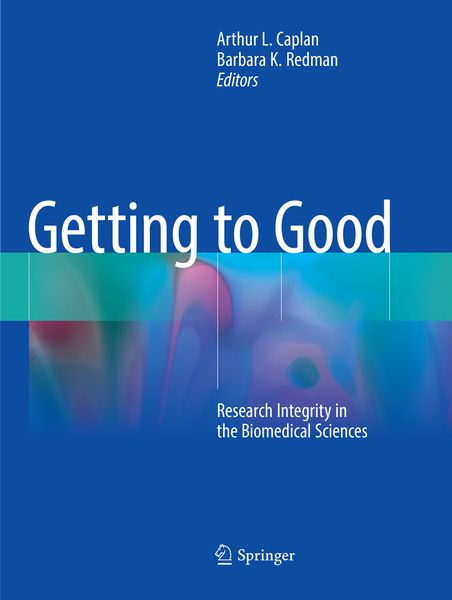
Produktbild: Getting to Good

Getting to Good Research Integrity in the Biomedical Sciences

Fr. 59.90

inkl. gesetzl. MwSt., Versandkostenfrei


Beschreibung

Produktdetails

Einband

Taschenbuch

Erscheinungsdatum

15.01.2019

Abbildungen

XI, 488 illus., 298 illus. in color., schwarz-weiss Illustrationen, farbige Illustrationen

Herausgeber

Arthur L. Caplan + weitere

Verlag

Springer

Seitenzahl

583

Maße (L/B/H)

27.9/21/3 cm

Gewicht

1626 g

Auflage

Softcover reprint of the original 1st ed. 2018

Sprache

Englisch

ISBN

978-3-030-09598-7

Beschreibung

Portrait

Arthur L Caplan, PhD

 Currently the Drs. William F and Virginia Connolly Mitty Professor and founding head of the Division of Bioethics at New York University Langone Medical Center in New York City.  He is the head of the ethics program in the Global Institute for Public Health at NYU.

 Prior to coming to NYU he was the Sidney D. Caplan Professor of Bioethics at the University of Pennsylvania Perelman School of Medicine in Philadelphia where he created the Center for Bioethics and the Department of Medical Ethics.  Caplan has also taught at the University of Minnesota, where he founded the Center for Biomedical Ethics, the University of Pittsburgh, and Columbia University.  He received his PhD from Columbia University. Caplan is the author or editor of thirty-two books and over 600 papers in peer reviewed journals.  His most recent book is Replacement Parts: The Ethics of Procuring and Replacing Organs in Humans (GeorgetownUniversity Press, 2015).He has served on a number of national and international committees including as the Chair, National Cancer Institute Biobanking Ethics Working Group; the Chair of the Advisory Committee to the United Nations on Human Cloning; the Chair of the Advisory Committee to the Department of Health and Human Services on Blood Safety and Availability; a member of the Presidential Advisory Committee on Gulf War Illnesses; the special advisory panel to the National Institutes of Mental Health on human experimentation on vulnerable subjects, the Wellcome Trust advisory panel on research in humanitarian crises, and the Co-Director of the Joint Council of Europe/United Nations Study on Trafficking in Organs and Body Parts. 

He is currently the ethics advisor to DOD/DARPA on synthetic biology, a member of the University of Pennsylvania’s External Advisory Committee for its Orphan Disease Center and a member of the Ethics and Ebola Working Group of the World Health Organization. Dr. Caplan also serves as the Chairperson of the Compassionate Use Advisory Committee (CompAC), an independent group of internationally recognized medical experts, bioethicists and patient representatives which advises Janssen/J&J about requests for compassionate use of some of its investigational medicines.

Caplan is the recipient of many awards and honors including the McGovern Medal of the American Medical Writers Association and the Franklin Award from the City of Philadelphia.  He received the Patricia Price Browne Prize in Biomedical Ethics for 2011.  He was a person of the Year-2001 from USA Today.  He was described as one of the ten most influential people in science by Discover magazine in 2008.  He has also been honored as one of the fifty most influential people in American health care by Modern Health Care magazine, one of the ten most influential people in America in biotechnology by the National Journal, one of the ten most influential people in the ethics of biotechnology by the editors of Nature Biotechnology and one of the 100 most influential people in biotechnology by Scientific American magazine.  In 2014 he was selected to receive the Public Service Award from the National Science Foundation/National Science Board which honors individuals and groups that have made substantial contributions to increasing public understanding of science and engineering in the United States.

He holds seven honorary degrees from colleges and medical schools.  He is a fellow of the Hastings Center, the NY Academy of Medicine, the College of Physicians of Philadelphia, the American College of Legal Medicine and the American Association for the Advancement of Science.


Barbara K. Redman, PhD, MBE is Associate, Division of Medical Ethics, New York Langone Medical Center.  She is former Dean of the Wayne State University School of Nursing andover the past decade has produced an impressive record of scholarship in research misconduct/research integrity including a contracted study for the US Office of Research Integrity.  In 2014-15 she served as an Edmond J Safra Center for Ethics Network Fellow at Harvard University, studying whistleblowing in cases of research misconduct.  This book proposal reflects Dr. Redman’s experience in teaching research integrity to graduate students, faculty and international trainees.  She has expertise in philosophical foundations of bioethics, social science empirical methods, health policy and the ethics of health care.  She is the sole author of two recent books in bioethics/research ethics:  The Ethics of Patient Self-Management of Chronic Disease , Springer, 2012, and Research Misconduct Policy in Biomedicine:  Beyond the “Bad Apple”, MIT Press, 2013.


Dr. Redman holds a PhD from the University of Minnesota, a masters in bioethics from the University of Pennsylvania and honorary doctorates from Georgetown University and the University of Colorado.  She has held fellowships at The Johns Hopkins University School of Public Health, Georgetown University Kennedy Institute of Ethics, and Harvard Medical School Division of Medical Ethics.  Dr. Redman is a fellow of the American Academy of Nursing and a recipient of the University of Minnesota Regents Award.

Produktdetails

Einband

Taschenbuch

Erscheinungsdatum

15.01.2019

Abbildungen

XI, 488 illus., 298 illus. in color., schwarz-weiss Illustrationen, farbige Illustrationen

Herausgeber

Verlag

Springer

Seitenzahl

583

Maße (L/B/H)

27.9/21/3 cm

Gewicht

1626 g

Auflage

Softcover reprint of the original 1st ed. 2018

Sprache

Englisch

ISBN

978-3-030-09598-7

Herstelleradresse

Springer-Verlag GmbH
Tiergartenstr. 17
69121 Heidelberg
DE

Email: GPSR Kontakt

Noch keine Bewertungen vorhanden

Verfassen Sie die erste Bewertung zu diesem Artikel

Helfen Sie anderen Kundinnen und Kunden durch Ihre Meinung.

Kundinnen und Kunden meinen

Bewertungen (0)

  • Produktbild: Getting to Good
  • PREFACE


    CONTENTS


    CHAPTER 1.   METHODOLOGY

          Arthur L. Caplan


          1.1. Why Most Published Research Findings Are False

          John P. A. Ioannidis


          1.2 The Controversy Surrounding Bone Morphogenetic Proteins in the Spine:          

          A Review of Current Research

          Joshua W. Hustedt and Daniel J. Blizzard


          1.3. Research Integrity and Everyday Practice of Science

          Frederick Grinnell


          1.4. Lessons from the Infuse Trials: Do We Need a Classification of Bias in                

           Scientific Publications and Editorials?

          Sohaib Hashmi, Mohamed Noureldin, and Safdar N. Khan


    CHAPTER 2.  POLICY

          Arthur L. Caplan


          2.1. In Retrospect: Science—The Endless Frontier

          Roger Pielke Jr


          2.2. Publish or Perish Culture Encourages Scientists to Cut Corners

          Virginia Barbour


    2.3. “Something of an Adventure”: Postwar NIH Research Ethos and the Guatemala STD Experiments

          Kayte Spector-Bagdady and Paul A. Lombardo


          2.4. Perverse Incentives

          Paula Stephen


         2.5. Flint Water Crisis Yields Hard Lessons in Science and Ethics

         Katie L. Burke


    CHAPTER 3. REPRODUCIBILITY

    Arthur L. Caplan


          3.1. What Does Research Reproducibility Mean?

          Steven N. Goodman, Daniele Fanelli, and John P.A. Ioannidis


    3.2. Limited Reproducibility of Research Findings:  Implications for the Welfare of  Research Participants and Considerations for Institutional Review Boards

    Barbara K. Redman and Arthur L. Caplan


    3.3. Quality Time

    Monya Baker


    CHAPTER 4. HUMAN SUBJECTS PROTECTION

    Arthur L. Caplan


    4.1. A Scoping Review of Empirical Research Relating to Quality and Effectiveness of Research Ethics Review

    Stuart G. Nicholls, Tavis P. Hayes, Jamie C. Brehaut, Michael McDonald, Charles Weijer, Raphael Saginur, and Dean Fergusson


    4.2. Pharmaceuticalisation and Ethical Review in South Asia:  Issues of Scope and Authority for Practitioners and Policy Makers

    Bob Simpson, Rekha Khatri, Deapica Ravindran, Tharindi Udalagama


    4.3. Understanding the Functions and Operations of Data Monitoring Committees: Survey and Focus Group Findings

    Karim A Calis, Patrick Archdeacon, Raymond Bain, David DeMets, Miriam Donohue, M Khair Elzarrad, Annemarie Forrest, John McEachern, Michael J Pencina, Jane Perlmutter, and Roger J Lewis


    4.4. Women and Fetuses First? Women and Fetuses First? An Ethical Case for Giving Priority in Clinical Research Testing of Zika Vaccines to Pregnant Women

    Kelly McBride Folkers and Arthur L. Caplan


    4.5. Rethinking the Belmont Report?

    Phoebe Friesen, Lisa Kearns, Barbara Redman, and Arthur L. Caplan


    CHAPTER 5. RESPONSIBLE AUTHORSHIP

    Arthur L. Caplan


    5.1. The Problem of Publication-Pollution Denialism

    Arthur L. Caplan


    5.2. Addressing Research Misconduct and Detrimental Research

    Practices: Current Knowledge and Issues

    National Academy of Sciences


    5.3. Exploring New Approaches

    National Academy of Sciences


    5.4. A Systematic Review of Research on the Meaning, Ethics and Practices of Authorship across Scholarly Disciplines

    Ana Marusic, Lana Bosnjak, and Ana Jeroncic


    5.5. The Disposable Author:  How Pharmaceutical Marketing is Embraced within Medicine’s Scholarly Literature

    Alastair Matheson


    5.6. Authorship Inflation in Medical Publications

    Gaurie Tilak, Vinay Prasad, Annupam B. Jena


    CHAPTER 6. MENTOR-MENTEE RESPONSIBILITIES AND RELATIONSHIPS 

    Arthur L. Caplan


    6.1. Closing the Barn Door: Coping with Findings of Research Misconduct by Trainees in the Biomedical Sciences

    Barbara K. Redman and Arthur L. Caplan


    6.2. Mentoring and Research Misconduct: Analysis of Research Mentoring in Closed ORI Cases

    David E. Wright, Sandra L. Titus, and Jered B. Cornelison


    6.3. Mentorship Matters for the Biomedical Workforce

    Sally J. Rockey


    6.4. Professional Responsibility

    C.K. Gunsalus


    6.5. All You Need is Mentorship

    Robert A. Weinberg, Maya Schuldiner, Hong Wu, Beth Stevens, Jens Nielsen, P. Robin Hiesinger, and Bassem A. Hassan


    CHAPTER 7. PLAGIARISM

          Arthur L. Caplan


    7.1. Plagarism in Research

    Gert Helgesson and Stefan Eriksson


    7.2. Text-based plagiarism in scientific publishing: Issues, developments and education

    Yongyan Li


    7.3. Avoiding Plagiarism, Self-plagiarism, and Other Questionable Writing Practices:  A Guide to Ethical Writing

    Miguel Roig


    7.4. ‘Dear “Plagiarist’: A Scientist Calls Out His Double-Crosser

    Adam Marcus and Ivan Oransky


    7.5. Defining the Role of Authors and Contributors

    International Committee of Medical Journal Editors


    CHAPTER 8. PEER REVIEW

    Arthur L. Caplan


    8.1. Let’s Make Peer Review Scientific

    Drummond Rennie


    8.2. A Stronger Post-Publication Culture is Needed for Better Science

    Hilda Bastian


    8.3. Reviewing Post-Publication Peer Review

    Paul Knoepfler


    CHAPTER 9. RESEARCH MISCONDUCT

    Arthur L. Caplan


    9.1. Shattuck Lecture – Misconduct in Medical Research

    John D. Dingell


    9.2. Ethical Modernization:  Research Misconduct and Research Ethics Reforms in Korea following the Hwang Affair

    Jongyoung Kim and  Kibeom Park


    9.3. Research Misconduct and Data Fraud in Clinical Trials: Prevalence and Causal Factors

    Stephen L. George


    9.4. Repairing Research Integrity

    Sandra L. Titus, James A. Wells and Lawrence J. Rhoades


    CHAPTER 10. WHISTLEBLOWING

    Arthur L. Caplan


    10.1. Integrity and Misconduct in Research

    Commission on Research Integrity


    10.2. Whistle-Blower Breaks His Silence

    David Cyranoski


    10.3. No One Likes a Snitch

    Barbara Redman and Arthur Caplan


    CHAPTER 11. CONFLICT OF INTEREST

    Arthur L. Caplan


    11.1. Sugar Industry Influence on The Scientific Agenda of The National Institute of Dental Research’s 1971 National Caries Program:  A Historical Analysis of Internal Documents

    Cristin E. Kearns, Stanton A. Glantz, and Laura A. Schmidt


    11.2. Lessons Learned from the Gene Therapy Trial for Ornithine Transcarbamylase Deficiency

    James M. Wilson


    11.3. Patient Perspectives On Physician Conflict Of Interest In Industry-Sponsored Clinical Trials For Multiple Sclerosis Therapeutics

    Andrew J. Solomon


    11.4. Industry Support of Medical Research:  Important Opportunity or Treacherous Pitfall?

    William M. Tierney, Eric M. Meslin, and Kurt Kroenke


    CHAPTER 12. DATA ACQUISITION, MANAGEMENT AND TRANSPARENCY

    Arthur L. Caplan


    12.1. Opentrials:  Towards a Collaborative Open Database of All Available Information on All Clinical Trials

    Ben Goldacre and Jonathan Gray


    12.2. International Charter of Principles for Sharing Bio-specimens and Data

    Deborah Mascalzoni, Edward S Dove, Yaffa Rubinstein, Hugh JS Dawkins, Anna Kole,

    Pauline McCormack, Simon Woods, Olaf Riess, Franz Schaefer, Hanns Lochmüller,

    Bartha M Knoppers, and Mats Hansson


    12.3. Facilitating a Culture of Responsible and Effective Sharing of Cancer Genome Data

    Lillian L Siu, Mark Lawler, David Haussler, Bartha Maria Knoppers, Jeremy Lewin, Daniel J Vis, Rachel G Liao, Fabrice Andre, Ian Banks, J Carl Barrett, Carlos Caldas, Anamaria Aranha Camargo, Rebecca C Fitzgerald, Mao Mao, John E Mattison, William Pao, William R Sellers, Patrick Sullivan, Bin Tean Teh, Robyn L Ward, Jean Claude ZenKlusen, Charles L Sawyers, and Emile E Voest


    CHAPTER 13.  INTERNATIONAL RESEARCH INVOLVING RESOURCE-CONSTRAINED COUNTRIES

    Arthur L. Caplan


    13.1. The H3Africa Policy Framework: Negotiating Airness in Genomics

    Jantina de Vries, Paulina Tindana, Katherine Littler, Miche` le Ramsay, Charles Rotimi, Akin Abayomi, Nicola Mulder, and Bongani M. Mayosi


    13.2. Sponsorship in Non-commercial Clinical Trials: Definitions, Challenges and the Role of Good Clinical Practices Guidelines

    Raffaella Ravinett, Katelijne De Nys, Marleen Boelaert, Ermias Diro, Graeme Meintjes, Yeka Adoke, Harry Tagbor, and Minne Casteels


    13.3. Improving the Informed Consent Process in International Collaborative Rare Disease Research:  Effective Consent for Effective Research

    Sabina Gainott, Cathy Turner, Simon Woods, Anna Kole, Pauline McCormack, Hanns Lochmüller, Olaf Riess, Volker Straub, Manuel Posada, Domenica Taruscio, and Deborah Mascalzoni


    13.4. The Standard of Care Debate:  Can Research in Developing Countries Be Both Ethical and Responsive To Those Countries’ Health Needs? 

    David Wendler, Ezekiel J. Emanuel, and Reidar K. Lie


    APPENDIX: Montreal Statement on Research Integrity in Cross-Boundary Research Collaborations, 2013