Beschreibung
Produktdetails
Einband
Gebundene Ausgabe
Erscheinungsdatum
12.02.2021
Verlag
John Wiley & SonsSeitenzahl
384
Maße (L/B/H)
23.5/15.7/2.5 cm
Gewicht
688 g
Auflage
1. Auflage
Sprache
Englisch
ISBN
978-1-119-68970-6
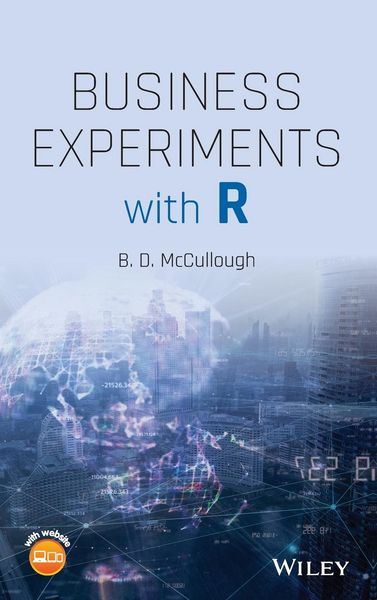
BUSINESS EXPERIMENTS with R
A unique text that simplifies experimental business design and is dedicated to the R language
Business Experiments with R offers a guide to, and explores the fundamentals of experimental business designs. The book fills a gap in the literature to provide a text on the topic of business statistics that addresses issues such as small samples, lack of normality, and data confounding. The author--a noted expert on the topic--puts the focus on the A/B tests (and their variants) that are widely used in industry, but not typically covered in business statistics textbooks.
The text contains the tools needed to design and analyze two-treatment experiments (i.e., A/B tests) to answer business questions. The author highlights the strategic and technical issues involved in designing experiments that will truly affect organizations. The book then builds on the foundation in Part I and expands the multivariable testing. Since today's companies are using experiments to solve a broad range of problems, Business Experiments with R is an essential resource for any business student. This important text:
* Presents the key ideas that business students need to know about experiments
* Offers a series of examples, focusing on a specific business question
* Helps develop the ability to frame ill-defined problems and determine what data and analysis would provide information about that problem
Written for students of general business, marketing, and business analytics, Business Experiments with R is an important text that helps to answer business questions by highlighting the strategic and technical issues involved in designing experiments that will truly affect organizations.
A unique text that simplifies experimental business design and is dedicated to the R language
Business Experiments with R offers a guide to, and explores the fundamentals of experimental business designs. The book fills a gap in the literature to provide a text on the topic of business statistics that addresses issues such as small samples, lack of normality, and data confounding. The author--a noted expert on the topic--puts the focus on the A/B tests (and their variants) that are widely used in industry, but not typically covered in business statistics textbooks.
The text contains the tools needed to design and analyze two-treatment experiments (i.e., A/B tests) to answer business questions. The author highlights the strategic and technical issues involved in designing experiments that will truly affect organizations. The book then builds on the foundation in Part I and expands the multivariable testing. Since today's companies are using experiments to solve a broad range of problems, Business Experiments with R is an essential resource for any business student. This important text:
* Presents the key ideas that business students need to know about experiments
* Offers a series of examples, focusing on a specific business question
* Helps develop the ability to frame ill-defined problems and determine what data and analysis would provide information about that problem
Written for students of general business, marketing, and business analytics, Business Experiments with R is an important text that helps to answer business questions by highlighting the strategic and technical issues involved in designing experiments that will truly affect organizations.
Noch keine Bewertungen vorhanden
Verfassen Sie die erste Bewertung zu diesem Artikel
Helfen Sie anderen Kundinnen und Kunden durch Ihre Meinung.