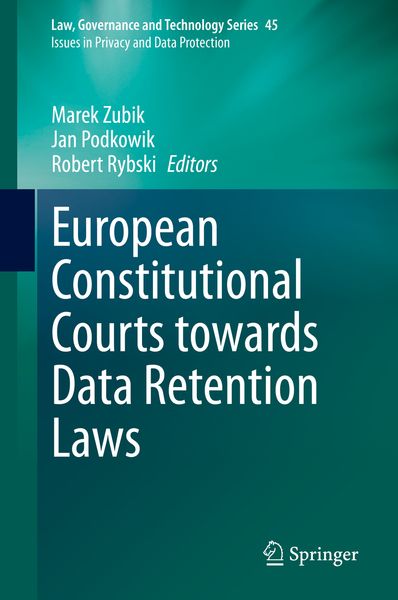
European Constitutional Courts towards Data Retention Laws
-
- Hardcover ausgewählt
- Taschenbuch
- eBook
-
Sprache:Englisch
Fr. 191.00
inkl. gesetzl. MwSt.,
Beschreibung
Produktdetails
Einband
Gebundene Ausgabe
Erscheinungsdatum
31.10.2020
Herausgeber
Marek Zubik + weitereVerlag
SpringerSeitenzahl
384
Maße (L/B/H)
24.1/16/2.7 cm
Gewicht
758 g
Auflage
1st ed. 2021
Sprache
Englisch
ISBN
978-3-030-57188-7
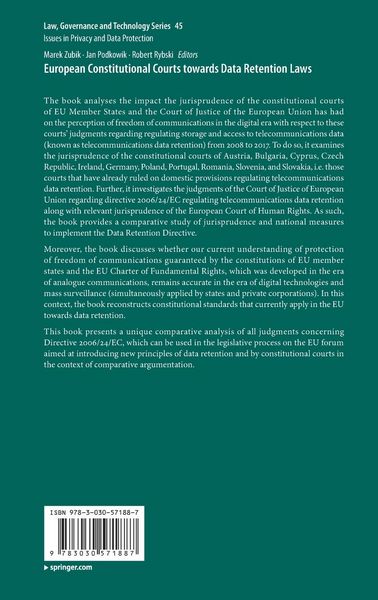
The book analyses the impact the jurisprudence of the constitutional courts of EU Member States and the Court of Justice of the European Union has had on the perception of freedom of communications in the digital era with respect to these courts’ judgments regarding regulating storage and access to telecommunications data (known as telecommunications data retention) from 2008 to 2017. To do so, it examines the jurisprudence of the constitutional courts of Austria, Bulgaria, Cyprus, Czech Republic, Ireland, Germany, Poland, Portugal, Romania, Slovenia, and Slovakia, i.e. those courts that have already ruled on domestic provisions regulating telecommunications data retention. Further, it investigates the judgments of the Court of Justice of European Union regarding directive 2006/24/EC regulating telecommunications data retention along with relevant jurisprudence of the European Court of Human Rights. As such, the book provides a comparative study of jurisprudence and national measures to implement the Data Retention Directive.
Moreover, the book discusses whether our current understanding of protection of freedom of communications guaranteed by the constitutions of EU member states and the EU Charter of Fundamental Rights, which was developed in the era of analogue communications, remains accurate in the era of digital technologies and mass surveillance (simultaneously applied by states and private corporations). In this context, the book reconstructs constitutional standards that currently apply in the EU towards data retention.
This book presents a unique comparative analysis of all judgments concerning Directive 2006/24/EC, which can be used in the legislative process on the EU forum aimed at introducing new principles of data retention and by constitutional courts in the context of comparative argumentation.
Kundinnen und Kunden meinen
Verfassen Sie die erste Bewertung zu diesem Artikel
Helfen Sie anderen Kund*innen durch Ihre Meinung