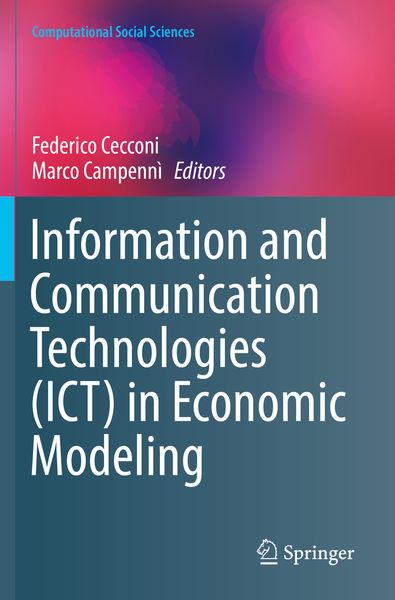
Information and Communication Technologies (ICT) in Economic Modeling
Aus der Reihe
Computational Social Sciences
-
- Hardcover
- Taschenbuch ausgewählt
- eBook
-
Sprache:Englisch
Fr. 112.00
inkl. gesetzl. MwSt.,
Beschreibung
Produktdetails
Einband
Taschenbuch
Erscheinungsdatum
14.08.2020
Herausgeber
Federico Cecconi + weitereVerlag
SpringerSeitenzahl
198
Maße (L/B/H)
23.5/15.5/1.2 cm
Gewicht
318 g
Auflage
1st ed. 2019
Sprache
Englisch
ISBN
978-3-030-22607-7
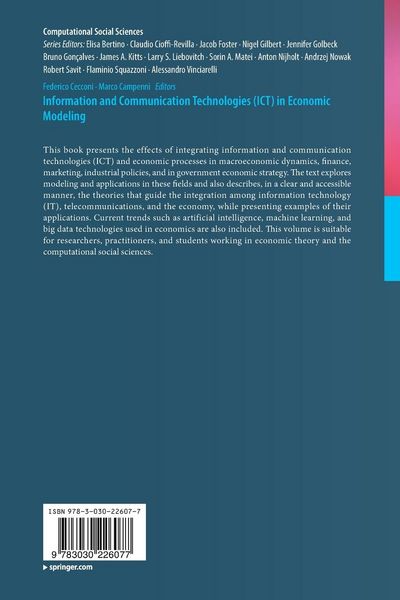
This book presents the effects of integrating information and communication technologies (ICT) and economic processes in macroeconomic dynamics, finance, marketing, industrial policies, and in government economic strategy. The text explores modeling and applications in these fields and also describes, in a clear and accessible manner, the theories that guide the integration among information technology (IT), telecommunications, and the economy, while presenting examples of their applications. Current trends such as artificial intelligence, machine learning, and big data technologies used in economics are also included. This volume is suitable for researchers, practitioners, and students working in economic theory and the computational social sciences.
Kundinnen und Kunden meinen
Verfassen Sie die erste Bewertung zu diesem Artikel
Helfen Sie anderen Kund*innen durch Ihre Meinung