• Produktbild: Effect of Emerging Processing Methods on the Food Quality
  • Produktbild: Effect of Emerging Processing Methods on the Food Quality

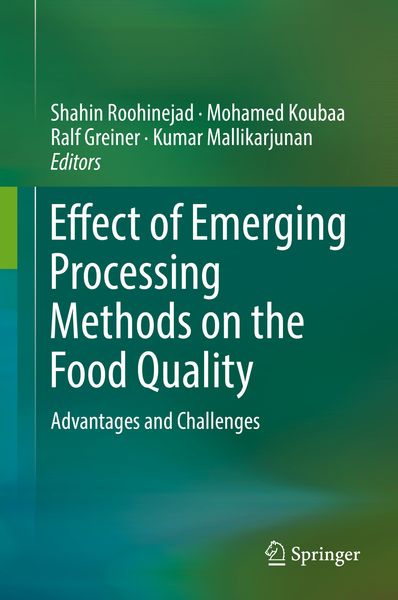
Effect of Emerging Processing Methods on the Food Quality Advantages and Challenges

Fr. 191.00

inkl. gesetzl. MwSt., Versandkostenfrei


Beschreibung

Produktdetails

Einband

Taschenbuch

Erscheinungsdatum

15.08.2020

Herausgeber

Shahin Roohinejad + weitere

Verlag

Springer

Seitenzahl

200

Maße (L/B/H)

23.5/15.5/1.2 cm

Gewicht

335 g

Auflage

1st ed. 2019

Sprache

Englisch

ISBN

978-3-030-18193-2

Beschreibung

Portrait

Shahin Roohinejad is a Research Scientist at Tillamook County Creamery Association, Oregon, USA. Previously, he was a Postdoctoral Research Associate at the Department of Food Science and Nutrition, University of Minnesota, St. Paul, USA.


Mohamed Koubaa is an Assistant Professor in the process and chemical engineering at the Graduate School of Organic and Mineral Chemistry (Ecole Supérieure de Chimie Organique et Minérale) in Compiègne (France). 

Ralf Greiner is a Professor in the Department of Food Technology and Bioprocess Engineering at the Max Rubner-Institut, Federal Research Institute of Nutrition and Food in Karlsruhe, Germany.


Kumar Mallikarjunan is a Professor in the Department of Food Science and Nutrition, University of Minnesota, St. Paul, USA.


Produktdetails

Einband

Taschenbuch

Erscheinungsdatum

15.08.2020

Herausgeber

Verlag

Springer

Seitenzahl

200

Maße (L/B/H)

23.5/15.5/1.2 cm

Gewicht

335 g

Auflage

1st ed. 2019

Sprache

Englisch

ISBN

978-3-030-18193-2

Herstelleradresse

Springer-Verlag KG
Sachsenplatz 4-6
1201 Wien
AT

Email: ProductSafety@springernature.com

Kundinnen und Kunden meinen

0 Bewertungen

Informationen zu Bewertungen

Zur Abgabe einer Bewertung ist eine Anmeldung im Konto notwendig. Die Authentizität der Bewertungen wird von uns nicht überprüft. Wir behalten uns vor, Bewertungstexte, die unseren Richtlinien widersprechen, entsprechend zu kürzen oder zu löschen.

Die Bewertungen sind nach Format, Anzahl Sterne und Datum sortiert.

Verfassen Sie die erste Bewertung zu diesem Artikel

Helfen Sie anderen Kund*innen durch Ihre Meinung

Kundinnen und Kunden meinen

0 Bewertungen filtern

  • Produktbild: Effect of Emerging Processing Methods on the Food Quality
  • Produktbild: Effect of Emerging Processing Methods on the Food Quality
  • Chapter 1. Introduction


    Chapter 2. Assessment of food quality using profiling techniques: Pros and cons aspects


    Chapter 3. Handling the data generated by profiling techniques for evaluation the food quality


    Chapter 4. High pressure processing

    4.1. Introduction

    4.2. Advantageous and challenges of using high pressure processing on food quality

    4.2.1. Nutritional properties<

    4.2.1.1. Fruits and vegetables

    4.2.1.2. Meat products

    4.2.1.3. Dairy products

    4.2.2. Textural properties

    4.2.2.1. Fruits and vegetables

    4.2.2.2. Meat products

    4.2.2.3. Dairy products

    4.2.3. Sensorial properties

    4.2.3.1. Fruits and vegetables

    4.2.3.2. Meat products

    4.2.3.3. Dairy products

    4.3. Conclusions


    Chapter 5. Pulsed electric fields

    5.1. Introduction

    5.2. Advantageous and challenges of using pulsed electric fields on food quality

    5.2.1. Nutritional properties

    5.2.1.1. Fruits and vegetables

    5.2.1.2. Meat products

    5.2.1.3. Dairy products

    5.2.2. Textural properties

    5.2.2.1. Fruits and vegetables

    5.2.2.2. Meat products

    5.2.2.3. Dairy products

    5.2.3. Sensorial properties

    5.2.3.1. Fruits and vegetables

    5.2.3.2. Meat products

    5.2.3.3. Dairy products

    5.3. Conclusions


    Chapter 6. Ultraviolet

    6.1. Introduction

    6.2. Advantageous and challenges of using ultraviolet on food quality

    6.2.1. Nutritional properties

    6.2.1.1. Fruits and vegetables

    6.2.1.2. Meat products

    6.2.1.3. Dairy products

    6.2.2. Textural properties

    6.2.2.1. Fruits and vegetables

    6.2.2.2. Meat products

    6.2.2.3. Dairy products

    6.2.3. Sensorial properties

    6.2.3.1. Fruits and vegetables

    6.2.3.2. Meat products

    6.2.3.3. Dairy products

    6.3. Conclusions


    Chapter 7. Pulsed light

    7.1. Introduction

    7.2. Advantageous and challenges of using pulsed light on food quality

    7.2.1. Nutritional properties

    7.2.1.1. Fruits and vegetables

    7.2.1.2. Meat products

    7.2.1.3. Dairy products

    7.2.2. Textural properties

    7.2.2.1. Fruits and vegetables

    7.2.2.2. Meat products

    7.2.2.3. Dairy products

    7.2.3. Sensorial properties

    7.2.3.1. Fruits and vegetables

    7.2.3.2. Meat products

    7.2.3.3. Dairy products<

    7.3. Conclusions


    Chapter 8. Irradiation

    8.1. Introduction

    8.2. Advantageous and challenges of using pulsed light on food quality

    8.2.1. Nutritional properties

    8.2.1.1. Fruits and vegetables

    8.2.1.2. Meat products

    8.2.1.3. Dairy products

    8.2.2. Textural properties

    8.2.2.1. Fruits and vegetables

    8.2.2.2. Meat products

    8.2.2.3. Dairy products

    8.2.3. Sensorial properties

    8.2.3.1. Fruits and vegetables

    8.2.3.2. Meat products

    8.2.3.3. Dairy products

    8.3. Conclusions


    Chapter 9. Ultrasounds

    9.1. Introduction

    9.2. Advantageous and challenges of using pulsed light on food quality

    9.2.1. Nutritional properties

    9.2.1.1. Fruits and vegetables

    9.2.1.2. Meat products

    9.2.1.3. Dairy products 9.2.2. Textural properties

    9.2.2.1. Fruits and vegetables

    9.2.2.2. Meat products

    9.2.2.3. Dairy products

    9.2.3. Sensorial properties

    9.2.3.1. Fruits and vegetables

    9.2.3.2. Meat products

    9.2.3.3. Dairy products

    9.3. Conclusions


    I