• Produktbild: Biomimicry for Aerospace
  • Produktbild: Biomimicry for Aerospace

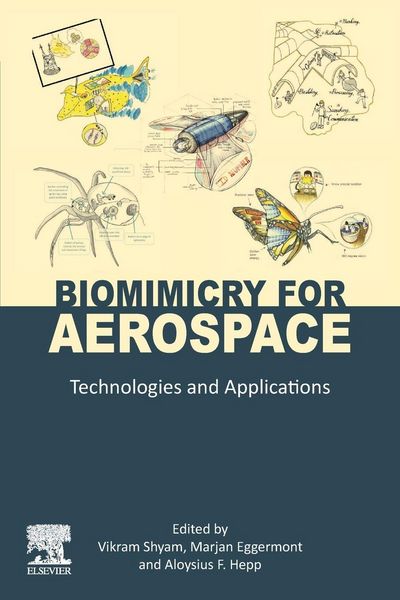
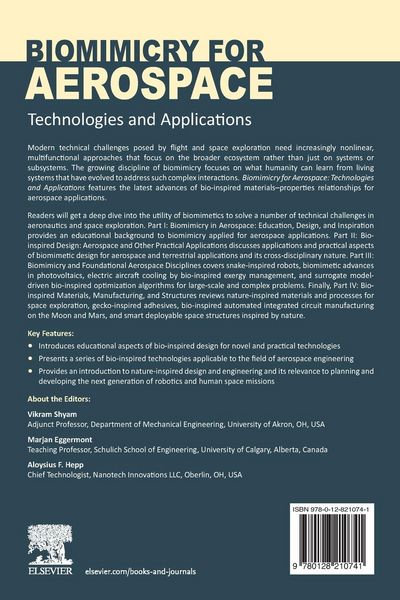
Biomimicry for Aerospace Technologies and Applications

Fr. 256.00

inkl. gesetzl. MwSt., Versandkostenfrei


Beschreibung

Produktdetails

Einband

Taschenbuch

Erscheinungsdatum

01.03.2022

Abbildungen

300 illustrations (50 in full color)

Herausgeber

Vikram Shyam + weitere

Verlag

Elsevier Science & Technology

Seitenzahl

528

Maße (L/B/H)

22.9/15.2/2.7 cm

Gewicht

700 g

Sprache

Englisch

ISBN

978-0-12-821074-1

Beschreibung

Portrait

Dr. Vikram Shyam is an adjunct professor at the University of Akron in the Mechanical Engineering department. He is also a research aerospace engineer who works as a futurist for NASA. He is the founder of the Virtual Interchange for Nature-Inspired Exploration (V.I.N.E.) at NASA's John H. Glenn Research Center. His interests include artificial intelligence, biomimicry, innovation design and futurology. Dr. Shyam is the recipient of NASA’s Presidential Early Career Award for Scientists and Engineers (PECASE).

Dr. Marjan Eggermont is a Teaching Professor and faculty member at the University of Calgary in the Mechanical and Manufacturing department of the Schulich School of Engineering, University of Calgary. She is also the Academic Director for Sustainable Engineering. Dr. Eggermont teaches in the areas of graphics, engineering design, visualization, and biomimicry. She co-founded and designs Zygote Quarterly (ZQ), an online journal to provide a platform to showcase the nexus of science and design using case studies, news, and articles. In 2005, she was one of the recipients of the American Society of Mechanical Engineers Curriculum Innovation Award. She is a former board member of the American Society of Engineering Education.

Aloysius F. Hepp is Chief Technologist at Nanotech Innovations and an independent consultant based in Cleveland, Ohio. He earned a PhD in Inorganic Photochemistry in 1983 from MIT and retired in December 2016 from the Photovoltaic & Electrochemical Systems Branch of the NASA Glenn Research Center (Cleveland). He was a visiting fellow at Harvard University from 1992–3. He was awarded the NASA Exceptional Achievement medal in 1997. He has served as an adjunct faculty member at the University of Albany and Cleveland State University. Dr. Hepp has co-authored nearly 200 publications (including six patents) focused on processing of thin film and nanomaterials for I–III–VI solar cells, Li-ion batteries, integrated power devices and flight experiments, and precursors and spray pyrolysis deposition of sulfides and carbon nanotubes. He has co-edited twelve books on advanced materials processing, energy conversion and electronics, biomimicry, and aerospace technologies. He is Editor-in-Chief Emeritus of Materials Science in Semiconductor Processing (MSSP) and is currently the chair of the International Advisory Board of MSSP, as well as serving on the Editorial Advisory Boards of Mater. Sci. and Engin. B and Heliyon. He has recently been appointed as Series Editor for the Vacuum and Thin-Film Deposition Technologies series and the Aerospace Fundamentals, Applications, and Exploration series.

Produktdetails

Einband

Taschenbuch

Erscheinungsdatum

01.03.2022

Abbildungen

300 illustrations (50 in full color)

Herausgeber

Verlag

Elsevier Science & Technology

Seitenzahl

528

Maße (L/B/H)

22.9/15.2/2.7 cm

Gewicht

700 g

Sprache

Englisch

ISBN

978-0-12-821074-1

EU-Ansprechpartner

Zeitfracht Medien GmbH
Ferdinand-Jühlke-Straße 7|99095|Erfurt|DE
produktsicherheit@zeitfracht.de

Herstelleradresse

Elsevier Science & Technology
125 London Wall|EC2Y 5AS|London|GB
tradeorders@elsevier.com

Kundinnen und Kunden meinen

0 Bewertungen

Informationen zu Bewertungen

Zur Abgabe einer Bewertung ist eine Anmeldung im Konto notwendig. Die Authentizität der Bewertungen wird von uns nicht überprüft. Wir behalten uns vor, Bewertungstexte, die unseren Richtlinien widersprechen, entsprechend zu kürzen oder zu löschen.

Die Bewertungen sind nach Format, Anzahl Sterne und Datum sortiert.

Verfassen Sie die erste Bewertung zu diesem Artikel

Helfen Sie anderen Kund*innen durch Ihre Meinung

Kundinnen und Kunden meinen

0 Bewertungen filtern

Die Leseprobe wird geladen.
  • Produktbild: Biomimicry for Aerospace
  • Produktbild: Biomimicry for Aerospace
  • Part 1: Biomimicry in aerospace: Education, design and inspiration
    1. Biomimicry and bio-design for innovation in future space colonization
    2. A bio-inspired design and space challenges cornerstone project
    3. Periodic table of life: Systematic nature-inspired problem solving for aerospace applications and beyond
    4. Parallels in communication, navigation technology, and natural phenomena
    5. Atacama Desert: Genius of place

    Part 2: Bio-inspired design: Aerospace and practical applications
    6. Bio-inspired design and additive manufacturing of cellular materials
    7. Biomimetic course design exploration for improved NASA zero gravity exercise equipment
    8. Biomimicry of boxfish: Designing an aerodynamically efficient passenger car
    9. Thresholds of nature: How understanding one of nature's penultimate laws led to the PowerCone, a biomimetic energy source

    Part 3: Biomimicry and foundational aerospace disciplines
    10. Slithering across worlds snake-inspired robots for extraterrestrial exploration
    11. Biomimetic advances in photovoltaics with potential aerospace applications
    12. Electric aircraft cooling with bio-inspired exergy management
    13. Surrogate model-driven bio-inspired optimization algorithms for large-scale and high-dimensional problems

    Part 4: Bio-inspired materials, manufacturing and structures
    14. Advancing research efforts in biomimicry to develop nature-inspired materials and processes for space exploration and more efficient aircraft
    15. Space applications for gecko-inspired adhesives
    16. Automated electronic integrated circuit manufacturing on the Moon and Mars: possibilities of the development of bioinspired semiconductor technology for space applications
    17. Smart deployable space structures inspired by nature