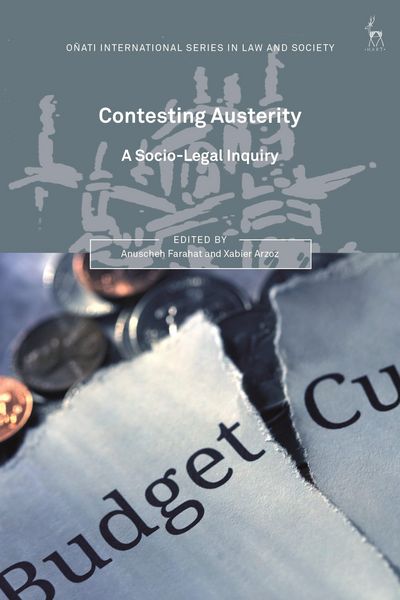
Contesting Austerity A Socio-Legal Inquiry
Aus der Reihe
Oñati International Law and So
-
- Hardcover ausgewählt
- Taschenbuch
- eBook
-
Sprache:Englisch
Fr. 159.00
inkl. gesetzl. MwSt.,
Beschreibung
Produktdetails
Einband
Gebundene Ausgabe
Erscheinungsdatum
29.07.2021
Herausgeber
Anuscheh Farahat + weitereVerlag
Hart PublishingSeitenzahl
368
Maße (L/B/H)
16.3/24.2/2.7 cm
Gewicht
712 g
Sprache
Englisch
ISBN
978-1-5099-4281-7
This book addresses the different forms of austerity, contestation and resistance, in order to understand how they relate to one another and the impact they have on the democratic quality of public debates, the trust in public institutions and the legitimacy of law.
Contestation of austerity includes not only traditional activism strategies such as human rights litigation and direct democracy instruments, but also new forms of collective action and collaborative resistance. Most importantly, many of the new anti-austerity initiatives also aim to renovate existing modes of democratic decision-making on the European, national, regional and local levels. The book focuses on different types of contesting austerity measures and the interaction between institutional and civil society actors. It will enhance understanding of how the various actors frame not only their goal but also the underlying social conflict to contest austerity and through which means they try to achieve political and legal changes.
With 16 chapters written by contributors from Spain, Germany, Greece, Portugal and the UK, the book approaches 3 crucial areas of austerity policies: cuts in payment and pensions, labour law reform, and old and new poverty. In each field, the contributors analyse the processes of decision-making and contestation from 3 perspectives: institutions, democratic theory and societal responses.
Contestation of austerity includes not only traditional activism strategies such as human rights litigation and direct democracy instruments, but also new forms of collective action and collaborative resistance. Most importantly, many of the new anti-austerity initiatives also aim to renovate existing modes of democratic decision-making on the European, national, regional and local levels. The book focuses on different types of contesting austerity measures and the interaction between institutional and civil society actors. It will enhance understanding of how the various actors frame not only their goal but also the underlying social conflict to contest austerity and through which means they try to achieve political and legal changes.
With 16 chapters written by contributors from Spain, Germany, Greece, Portugal and the UK, the book approaches 3 crucial areas of austerity policies: cuts in payment and pensions, labour law reform, and old and new poverty. In each field, the contributors analyse the processes of decision-making and contestation from 3 perspectives: institutions, democratic theory and societal responses.
Kundinnen und Kunden meinen
Verfassen Sie die erste Bewertung zu diesem Artikel
Helfen Sie anderen Kund*innen durch Ihre Meinung