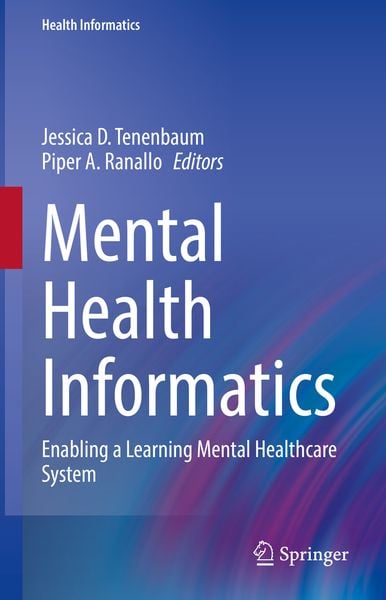
Produktbild: Mental Health Informatics

Mental Health Informatics Enabling a Learning Mental Healthcare System

Aus der Reihe Health Informatics

Fr. 119.00

inkl. gesetzl. MwSt., Versandkostenfrei


Beschreibung

Produktdetails

Einband

Gebundene Ausgabe

Erscheinungsdatum

19.11.2021

Herausgeber

Jessica D. Tenenbaum + weitere

Verlag

Springer

Seitenzahl

534

Maße (L/B/H)

24.1/16/3.5 cm

Gewicht

975 g

Auflage

1st ed. 2021

Sprache

Englisch

ISBN

978-3-030-70557-2

Beschreibung

Portrait

Dr. Tenenbaum is in the Division of Translational Biomedical Informatics within the Department of Biostatistics and Bioinformatics at Duke University. After earning her bachelor’s degree in biology from Harvard, Dr. Tenenbaum worked as a program manager at Microsoft Corporation in Redmond, WA for six years before earning a PhD in biomedical informatics at Stanford University. Her research applies expertise in data standards, electronic health records, and machine learning to stratify mental health disorders to enable precision medicine. She is also the informatics faculty lead for the Alzheimer's Disease Metabolomics Consortium. Nationally, Dr. Tenenbaum has served on the Board of Directors for the American Medical Informatics Association (AMIA) and serves on the Board of Scientific Counselors for the Lister Hill Center at the National Library of Medicine. She is co-founder and past Chair of AMIA's Mental Health Informatics Working Group. She has been an Associate Editor for the Journal of Biomedical Informatics and serves on the advisory panel for Nature Scientific Data. Beginning in 2019, Dr. Tenenbaum took a partial leave of absence from Duke to serve as Chief Data Officer for the North Carolina Department of Health and Human Services. 

Dr. Ranallo is an applied clinical informatician dedicated to formalizing the field of mental health informatics.  She completed her undergraduate training at UCLA where she performed basic laboratory research on the distribution of neuropeptides in the mammalian nervous system, and psychosocial research examining the effects of developmental trauma on children’s self-concept. She completed her PhD at the University of Minnesota where she worked to address gaps in technologies for knowledge representation in mental health.  She has front line experience developing and implementing informatics strategies in a variety of research and clinical settings. She is committed to bringing the quality and safety of mental healthcare on par with that of general medical healthcare.

Produktdetails

Einband

Gebundene Ausgabe

Erscheinungsdatum

19.11.2021

Herausgeber

Verlag

Springer

Seitenzahl

534

Maße (L/B/H)

24.1/16/3.5 cm

Gewicht

975 g

Auflage

1st ed. 2021

Sprache

Englisch

ISBN

978-3-030-70557-2

Herstelleradresse

Springer-Verlag GmbH
Tiergartenstr. 17
69121 Heidelberg
DE

Email: ProductSafety@springernature.com

Kundinnen und Kunden meinen

0 Bewertungen

Informationen zu Bewertungen

Zur Abgabe einer Bewertung ist eine Anmeldung im Konto notwendig. Die Authentizität der Bewertungen wird von uns nicht überprüft. Wir behalten uns vor, Bewertungstexte, die unseren Richtlinien widersprechen, entsprechend zu kürzen oder zu löschen.

Die Bewertungen sind nach Format, Anzahl Sterne und Datum sortiert.

Verfassen Sie die erste Bewertung zu diesem Artikel

Helfen Sie anderen Kund*innen durch Ihre Meinung

Kundinnen und Kunden meinen

0 Bewertungen filtern

  • Produktbild: Mental Health Informatics
  • Precision Medicine and the Learning Health System.- What is Informatics?.- What is Mental Health?.- Epistemological Differences between the Behavioral and Biological Sciences.- What is Mental Health Informatics?.- Big Picture: Process View of Mental Health Care Delivery.- Introduction to Technologies for Data Acquisition in Mental Health.- Informatics Technologies for the Acquisition of Biological Data.- Informatics Technologies for the Acquisition of Psychological and Behavioral Data.- Informatics Technologies for the Acquisition of Interpersonal, Social and Environmental Data: The Exosome.- Informatics Technologies for the Acquisition of Population Level Data.- Introduction to Methods for Extracting Meaningful Information from Data in Mental Health.- Concept and Knowledge Representation to Transform Data into Information in Mental Health.- Bioinformatics Methods in Mental Health Research and Practice.- Psychometric Methods.- Computational Models and Analytic Methods.- Natural Language Processing in Mental Health Research and Practice.- Introduction to Paradigms for Knowledge Discovery in Mental Health.- Paradigms for Knowledge Discovery in Clinical and Research Data Repositories.- Biomarker Discovery.- Data Visualization.- Inferential Analysis and Predictive Modeling.- The Role of Biological Information in Mental Health Research and Practice.- Electronic Health Record (EHR) Systems in Mental Health.- Computerized Clinical Decision Support in Mental Health.- Informatics Technologies in Detection and Diagnosis of Mental Health Conditions.- Informatics Technologies in Prevention and Treatment of Mental Health Conditions.- Informatics Technologies for Care Coordination and Continuity of Care.- Informatics Technologies to Improve Patient Safety in Mental Health.- Registries.- Disseminating Newly Acquired Knowledge.- Ethical Legal and Social Issues (ELSI).- The Future of Mental Health Informatics.