Gutscheinbedingungen

*Gültig bis 20.07.2026 auf alle Bücher. Ausgeschlossen sind Zeitschriften, Prozentbücher und Abos | Einlösbar in allen Buchhandlungen von Orell Füssli, Barth Bücher, Buchladen Rapunzel, Papeterie Köhler, Schuler Orell Füssli, Stauffacher und ZAP unter Vorweisung des Gutscheins, auf www.orellfüssli.ch durch Eingabe des Gutscheincodes. Beim Service „eBooks verschenken“ und bei eBook-Käufen via eReader nicht einlösbar | Mindesteinkaufswert: Fr. 30.- | Nicht mit anderen Rabatten kumulierbar.

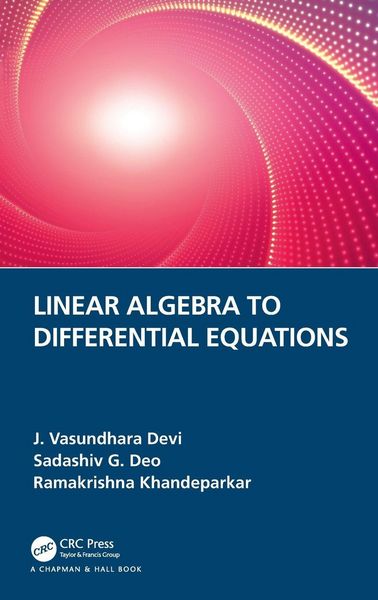
Produktbild: Linear Algebra to Differential Equations

Linear Algebra to Differential Equations

Fr. 229.00

inkl. gesetzl. MwSt., Versandkostenfrei


Beschreibung

Produktdetails

Einband

Gebundene Ausgabe

Erscheinungsdatum

27.09.2021

Abbildungen

schwarz-weiss Illustrationen, Zeichnungen, schwarz-weiss, Tabellen, schwarz-weiss

Verlag

Taylor & Francis

Seitenzahl

412

Maße (L/B/H)

24/16.1/2.7 cm

Gewicht

707 g

Sprache

Englisch

ISBN

978-0-8153-6146-6

Beschreibung

Produktdetails

Einband

Gebundene Ausgabe

Erscheinungsdatum

27.09.2021

Abbildungen

schwarz-weiss Illustrationen, Zeichnungen, schwarz-weiss, Tabellen, schwarz-weiss

Verlag

Taylor & Francis

Seitenzahl

412

Maße (L/B/H)

24/16.1/2.7 cm

Gewicht

707 g

Sprache

Englisch

ISBN

978-0-8153-6146-6

Herstelleradresse

Libri GmbH
Europaallee 1
36244 Bad Hersfeld
DE

Email: gpsr@libri.de

Noch keine Bewertungen vorhanden

Verfassen Sie die erste Bewertung zu diesem Artikel

Helfen Sie anderen Kundinnen und Kunden durch Ihre Meinung.

Kundinnen und Kunden meinen

Bewertungen (0)

Die Leseprobe wird geladen.
  • Produktbild: Linear Algebra to Differential Equations
  • 1. Vectors and Matrices. 1.1. Introduction. 1.2. Scalars and Vectors. 1.3. Introduction to Matrices. 1.4. Types of Matrices. 1.5. Elementary Operations and Elementary Matrices. 1.6. Determinants. 1.7. Inverse of a Matrix. 1.8. Partitioning of Matrices. 1.9. Advanced Topics: Pseudo Inverse and Congruent Inverse. 1.10. Conclusion. 2. Linear System of Equations. 2.1. Introduction. 2.2. Linear System of Equations. 2.3. Rank of a Matrix. 2.4. Echelon Form and Normal Form. 2.4. Echelon Form and Normal Form. 2.5. Solutions of a Linear System of Equations. 2.6. Cayley Hamilton Theorem. 2.7. Eigen Values and Eigen Vectors. 2.8. Singular Values and Singular Vectors. 2.9. Quadratic Forms. 2.10. Conclusion. 3. Vector Spaces. 3.1. Introduction. 3.2. Vector Space and a Subspace. 3.3. Linear Independence, Basis and Dimension. 3.4. Change of Basis – Matrix. 3.5. Linear Transformations. 3.6. Matrices of Linear Transformations. 3.7. Inner Product Space. 3.8. Gram-Schmidt Orthogonalization. 3.9. Linking Linear Algebra to Differential Equations. 3.10. Conclusion. 4. Numerical Methods in Linear Algebra. 4.1. Introduction. 4.2. Elements of Computation and Errors. 4.3. Direct Methods for Solving a Linear System of Equations. 4.4. Iterative Methods. 4.5. Householder Transformation. 4.6. Tridiagonalization of a Symmetric Matrix by Plane Rotation. 4.7. QR Decomposition. 4.8. Eigen Values: Bounds and Power Method. 4.9. Krylov Subspace Methods. 4.10. Conclusion. 5. Applications. 5.1. Introduction. 5.2. Finding Curves through Given Points. 5.3. Markov Chains. 5.4. Leontief's Models. 5.5. Cryptology. 5.6. Application to Computer Graphics. 5.7. Application to Computer Graphics. 5.8. Bioinformatics. 5.9. Principal Component Analysis (PCA). 5.10. Big Data. 5.11. Conclusion. 6. Kronecker Product. 6.1. Introduction. 6.2. Primary Matrices. 6.3. Kronecker Products. 6.4. Further Properties of Kronecker products. 6.5. Kronecker product of two linear transformations. 6.6. Kronecker Product and Vector Operators. 6.7. Permutation Matrices and Kronecker Products. 6.8. Analytical functions and Kronecker Product. 6.9. Kronecker Sum. 6.10. Lyapunov Function. 6.11. Conclusion. 7. Calculus of Matrices. 7.1. Introduction. 7.2. Derivative of a Matrix Valued Function with respect to a Scalar. 7.3. Derivative of a Vector Valued Function w.r.t. a Vector. 7.4. Derivative of a Scalar Valued Function w.r.t. a Matrix. 7.5. Derivative of a Matrix Valued Function w.r.t. its Entries and Vice versa. 7.6. The Matrix Differential. 7.7. Derivative of a Matrix w.r.t. a Matrix. 7.8. Derivative Formula using Kronecker Products. 7.9. Another Definition for Derivative of a Matrix w.r.t. a Matrix. 7.10. Conclusion. 8. Linear Systems of Differential Equations. 8.1. Introduction. 8.2. Linear Systems. 8.3. Fundamental Matrix. 8.4. Method of Successive Approximations. 8.5. Nonhomogeneous Systems. 8.6. Linear Systems with Constant Coefficients. 8.7. Stability Analysis of a System. 8.8. Election Mathematics. 8.9. Conclusion. 9. Linear Matrix Differential Equations. 9.1. Introduction. 9.2. Initial Value Problem (IVP). 9.3. LMDE X’ = A(t)X. 9.4. The LMDE X’ = AXB. 9.5. More General LMDE. 9.6. A Class of LMDE of Higher Order. 9.7. Boundary Value Problem of LMDE. 9.8. Trigonometric and Hyperbolic Matrix Functions. 9.9. Conclusion.