• Produktbild: Innovation Economics, Engineering and Management Handbook 2
  • Produktbild: Innovation Economics, Engineering and Management Handbook 2

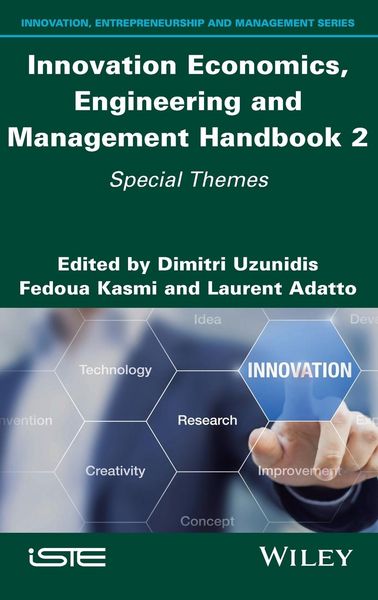
Innovation Economics, Engineering and Management Handbook 2 Special Themes

Fr. 185.00

inkl. gesetzl. MwSt., Versandkostenfrei


Beschreibung

Produktdetails

Einband

Gebundene Ausgabe

Erscheinungsdatum

21.07.2021

Herausgeber

Dimitri Uzunidis + weitere

Verlag

John Wiley & Sons Inc

Seitenzahl

336

Maße (L/B/H)

24/16.1/2.3 cm

Gewicht

668 g

Auflage

1. Auflage

Sprache

Englisch

ISBN

978-1-78630-701-9

Beschreibung

Produktdetails

Einband

Gebundene Ausgabe

Erscheinungsdatum

21.07.2021

Herausgeber

Verlag

John Wiley & Sons Inc

Seitenzahl

336

Maße (L/B/H)

24/16.1/2.3 cm

Gewicht

668 g

Auflage

1. Auflage

Sprache

Englisch

ISBN

978-1-78630-701-9

Herstelleradresse

Libri GmbH
Europaallee 1
36244 Bad Hersfeld
DE

Email: gpsr@libri.de

Noch keine Bewertungen vorhanden

Verfassen Sie die erste Bewertung zu diesem Artikel

Helfen Sie anderen Kundinnen und Kunden durch Ihre Meinung.

Kundinnen und Kunden meinen

Bewertungen (0)

Die Leseprobe wird geladen.
  • Produktbild: Innovation Economics, Engineering and Management Handbook 2
  • Produktbild: Innovation Economics, Engineering and Management Handbook 2
  • Introduction xvii
    Dimitri UZUNIDIS and Fedoua KASMI
     
    Chapter 1. Meaning - The Meaning of Innovation: Theoretical and Practical Perspectives 1
    Joëlle FOREST
     
    1.1. Introduction 1
     
    1.2. Conceptions of the meaning of innovation over time 3
     
    1.3. When innovation, like the phoenix, rises from the ashes 5
     
    1.4. In search of lost meaning 8
     
    1.5. The PSI approach: a philosophy of, and for, action 11
     
    1.6. By way of conclusion 15
     
    1.7. References 15
     
    Chapter 2. Engineering - Innovation Engineering: A Holistic and Operational Approach to the Innovation Process 19
    Laure MOREL and Mauricio CAMARGO
     
    2.1. Introduction 19
     
    2.2. Innovation engineering: a field of research that has struggled to structure itself in France 21
     
    2.3. Practical guide to innovation engineering 32
     
    2.3.1. First bias: there are no good or bad innovative ideas! 33
     
    2.3.2. Second bias: any innovation process requires contextualization of the situation 34
     
    2.3.3. Third bias: there is no innovative project management without collaboration 35
     
    2.3.4. Fourth bias: a universal innovation process does not exist! 35
     
    2.3.5. Fifth bias: the importance of materializing and evaluating ideas as early as possible by including users in the process 36
     
    2.4. Conclusion 37
     
    2.5. Acknowledgments 38
     
    2.6. References 39
     
    Chapter 3. Absorption - Technological Absorptive Capacity and Innovation: The Primacy of Knowledge 43
    Sonia BEN SLIMANE
     
    3.1. Introduction 43
     
    3.2. Technological absorptive capacity: a cognitive process 43
     
    3.3. The multidimensional nature of absorption capacity and innovation 45
     
    3.4. Measuring absorptive capacity 46
     
    3.5. Conclusion 47
     
    3.6. References 48
     
    Chapter 4. Big Data - Artificial Intelligence and Innovation: The Big Data Issue 51
    Laurent DUPONT
     
    4.1. Introduction 51
     
    4.2. Humans and data: diversity and consensus 52
     
    4.3. Big Data: an interdisciplinary approach to technology and its uses 54
     
    4.4. A wide range of applications: promises and fears 55
     
    4.5. Conclusion 56
     
    4.6. References 57
     
    Chapter 5. Blockchain - Blockchain and Co-creation within Management Methods 59
    Eric SEULLIET
     
    5.1. Introduction 59
     
    5.2. The interest of Blockchain in the field of immaterial exchanges 60
     
    5.3. The limits of the co-creation process 61
     
    5.4. Blockchain in mobilizing and organizing co-creation processes 62
     
    5.5. The promises of Blockchain 63
     
    5.5.1. Intellectual property renewal 63
     
    5.5.2. "Empowerment" of individuals 63
     
    5.5.3. Scaling up 64
     
    5.5.4. Collective intelligence 64
     
    5.5.5. New forms of organization and social impact 64
     
    5.5.6. Necessary developments 64
     
    5.6. Conclusion 65
     
    5.7. References 66
     
    Chapter 6. Bricolage - From Improvisation to Innovation: The Key Role of "Bricolage" 67
    Paul BOUVIER-PATRON
     
    6.1. Introduction 67
     
    6.2. Bricolage: new concept, old practice 67
     
    6.3. Current application of the bricolage concept 68
     
    6.4. Bricolage and improvisation 69
     
    6.5. Bricolage and frugal innovation 70
     
    6.6. Conclusion 72
     
    6.7. References 73
     
    Chapter 7. Circularity - The Circular Economy as an Innovative Process 75
    Sonia VEYSSIÈRE
     
    7.1. Introduction 75
     
    7.2. The circular economy: a transformative concept 76
     
    7.3. The circular economy as a source of innovation 77
     
    7.4. Conclusion 81
     
    7.5. References 82
     
    Chapter 8