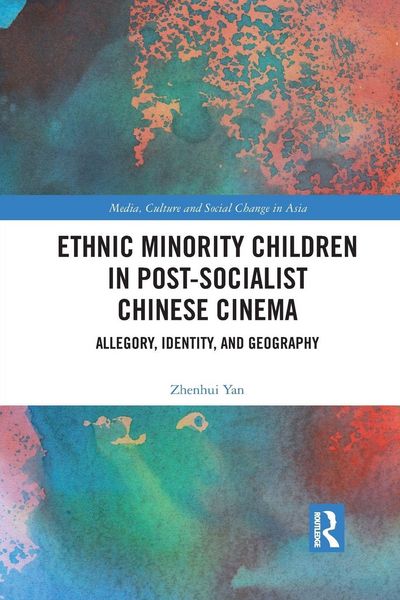

Ethnic Minority Children in Post-Socialist Chinese Cinema Allegory, Identity, and Geography
-
- Taschenbuch ausgewählt
- eBook
-
Sprache:Englisch
Fr. 79.90
inkl. gesetzl. MwSt.,
Beschreibung
Produktdetails
Einband
Taschenbuch
Erscheinungsdatum
30.06.2021
Abbildungen
schwarz-weiss Illustrationen
Verlag
Taylor & FrancisSeitenzahl
160
Maße (L/B/H)
23.4/15.6/0.9 cm
Gewicht
235 g
Sprache
Englisch
ISBN
978-1-03-208471-8
This book examines the surprisingly large number of films about ethnic minority children in China, considering key questions such as Why are ethnic minority children becoming more intriguing to Chinese filmmakers? What are their roles in the films literally and allegorically? And how are they placed on screen geographically and why? It argues that ethnic minority children's appeal lies in their special relationship with childhood, ethnicity, nationalism, and rurality; and that for dominant Han urban adults and elite ethnic minorities they serve as "the other" for these people's construction of themselves as self-conscious modern subjects during China's rapid social-political transformations. This book explores the diversity of ways in which both Han and ethnic minority filmmakers take up the special features of ethnic minority children to facilitate their expression of certain ideas or ideals, as well as the roles of these films in their directing careers.
Noch keine Bewertungen vorhanden
Verfassen Sie die erste Bewertung zu diesem Artikel
Helfen Sie anderen Kundinnen und Kunden durch Ihre Meinung.