
Makers at School, Educational Robotics and Innovative Learning Environments Research and Experiences from FabLearn Italy 2019, in the Italian Schools and Beyond
-
- Englisch ausgewählt
Fr. 72.90
inkl. gesetzl. MwSt.,
Beschreibung
Produktdetails
Einband
Gebundene Ausgabe
Erscheinungsdatum
11.12.2021
Herausgeber
David Scaradozzi + weitereVerlag
SpringerSeitenzahl
376
Maße (L/B/H)
24.1/16/2.7 cm
Gewicht
758 g
Auflage
1st ed. 2021
Sprache
Englisch
ISBN
978-3-030-77039-6
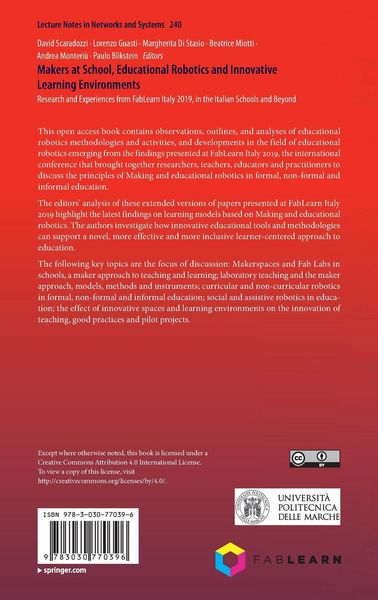
This open access book contains observations, outlines, and analyses of educational robotics methodologies and activities, and developments in the field of educational robotics emerging from the findings presented at FabLearn Italy 2019, the international conference that brought together researchers, teachers, educators and practitioners to discuss the principles of Making and educational robotics in formal, non-formal and informal education.
The editors’ analysis of these extended versions of papers presented at FabLearn Italy 2019 highlight the latest findings on learning models based on Making and educational robotics. The authors investigate how innovative educational tools and methodologies can support a novel, more effective and more inclusive learner-centered approach to education.
The following key topics are the focus of discussion: Makerspaces and Fab Labs in schools, a maker approach to teaching and learning; laboratory teaching and the maker approach,models, methods and instruments; curricular and non-curricular robotics in formal, non-formal and informal education; social and assistive robotics in education; the effect of innovative spaces and learning environments on the innovation of teaching, good practices and pilot projects.
Noch keine Bewertungen vorhanden
Verfassen Sie die erste Bewertung zu diesem Artikel
Helfen Sie anderen Kundinnen und Kunden durch Ihre Meinung.