• Produktbild: Communicating COVID-19
  • Produktbild: Communicating COVID-19

Communicating COVID-19 Interdisciplinary Perspectives

Fr. 201.00

inkl. gesetzl. MwSt., Versandkostenfrei


Beschreibung

Produktdetails

Einband

Gebundene Ausgabe

Erscheinungsdatum

08.10.2021

Herausgeber

Monique Lewis + weitere

Verlag

Springer

Seitenzahl

395

Maße (L/B/H)

21.6/15.3/2.8 cm

Gewicht

658 g

Auflage

1st ed. 2021

Sprache

Englisch

ISBN

978-3-030-79734-8

Beschreibung

Rezension

“While written in the early stages of the pandemic, the wide-ranging Communicating COVID-19: Interdisciplinary Perspectives offers key observations. The volume demonstrates that the rhetoric during the pandemic was largely shaped by each country’s government and tailored to what each saw as their primary goal. … These results are a strong reminder for journalism academics to re-explore the great variety of ways health messages can be brought across to the public and to re-examine critically the effects of news source selection.” (Beate Josephi, Australian Journalism Review, Vol. 44 (1), 2022)

“It is refreshing to read frank accounts of the negatives and difficult challenges of public communication and how these can be addressed, rather than glowing accounts of the importance and success of communication that characterizes many collections of case studies. This is an often raw and provocative collection of studies worthy of the attention of journalism and media studies scholars, health communication researchers and professionals, and public health officials.” (Jim Macnamara, International Journal of Communication, Issue 16, 2022)

Portrait

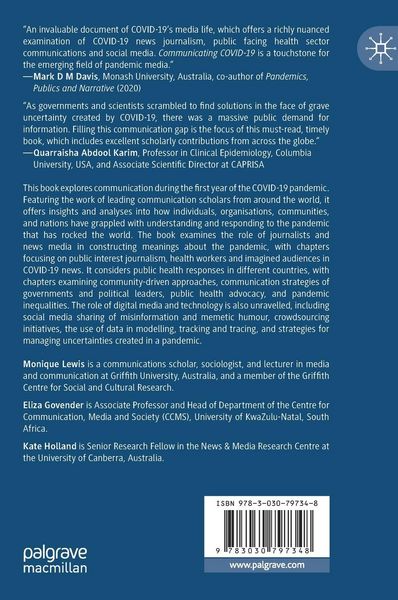
Monique Lewis is a communications scholar, sociologist, and lecturer in media and communication at Griffith University, Australia, and a member of the Griffith Centre for Social and Cultural Research.

Eliza Govender is Associate Professor and Head of Department of the Centre for Communication, Media and Society (CCMS), University of KwaZulu-Natal, South Africa.

Kate Holland is Senior Research Fellow in the News & Media Research Centre at the University of Canberra, Australia. 

Produktdetails

Einband

Gebundene Ausgabe

Erscheinungsdatum

08.10.2021

Herausgeber

Verlag

Springer

Seitenzahl

395

Maße (L/B/H)

21.6/15.3/2.8 cm

Gewicht

658 g

Auflage

1st ed. 2021

Sprache

Englisch

ISBN

978-3-030-79734-8

Herstelleradresse

Springer-Verlag GmbH
Tiergartenstr. 17
69121 Heidelberg
DE

Email: ProductSafety@springernature.com

Kundinnen und Kunden meinen

0 Bewertungen

Informationen zu Bewertungen

Zur Abgabe einer Bewertung ist eine Anmeldung im Konto notwendig. Die Authentizität der Bewertungen wird von uns nicht überprüft. Wir behalten uns vor, Bewertungstexte, die unseren Richtlinien widersprechen, entsprechend zu kürzen oder zu löschen.

Die Bewertungen sind nach Format, Anzahl Sterne und Datum sortiert.

Verfassen Sie die erste Bewertung zu diesem Artikel

Helfen Sie anderen Kund*innen durch Ihre Meinung

Kundinnen und Kunden meinen

0 Bewertungen filtern

  • Produktbild: Communicating COVID-19
  • Produktbild: Communicating COVID-19
  • Chapter 1: Introduction.- SECTION 1: NEWS MEDIA AT THE COALFACE: REPORTING COVID-19.- Chapter 2: The pandemic and public interest journalism: crisis, survival, and rebirth.- Chapter 3: Fast-tracking the cure: Science communication in Latin America Author.- Chapter 4: Reporting from the front line: The role of health workers in UK television news reporting of COVID-19.- Chapter 5: Framing a global pandemic in an age of biomediatisation.- SECTION 2: COMMUNICATING THE PUBLIC HEALTH RESPONSE.- Chapter 6: Communication inequality, structural inequality and COVID-19.- Chapter 7: Mitigating the spread of COVID-19 in Africa: Lessons from HIV/AIDS communication interventions.- Chapter 8: Tailoring COVID-19 communication for local contexts: Challenges, contradictions and complications in a utopian public health response.- Chapter 9: Disentangling science and ideology in a fast-paced global pandemic.- Chapter 10: Communicating Ableism in a Pandemic: Compassion, Vulnerability and the Violence of Care.- Chapter 11: Death Warrants: Argumentation Strategies of Scandinavian Political Leaders during COVID-19.- Chapter 12: Underpinnings of pandemic communication in India: The curious case of COVID-19.- Chapter 13: Analysis of the government of Israel COVID-19 health and risk communication efforts: between a political-constitutional and health crisis.- SECTION 3: CITIZENS, SOCIAL MEDIA, AND DIGITAL TECHNOLOGIES.- Chapter 14: Coronavirus conspiracy theories: Tracing misinformation trajectories from the fringes to the mainstream.- Chapter 15: Smart crowdsourcing to bridge the expert-public knowledge gap in risk communication about COVID-19.- Chapter 16: “South Africa Laughs in the Face of Coronavirus”: Humour, Memetic Media and Nation-Building in South Africa.- Chapter 17: Monitoring the R-citizen in the time of coronavirus.