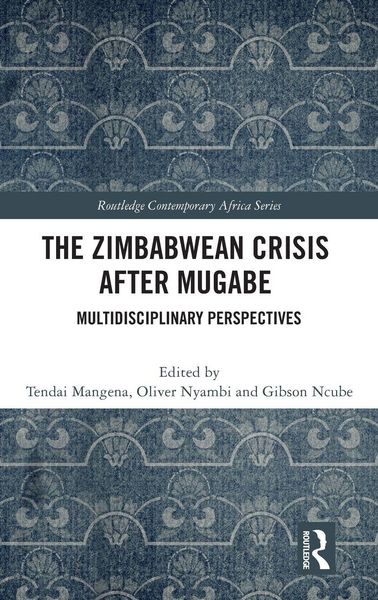
Produktbild: The Zimbabwean Crisis after Mugabe

The Zimbabwean Crisis after Mugabe Multidisciplinary Perspectives

Fr. 253.00

inkl. gesetzl. MwSt., Versandkostenfrei


Beschreibung

Produktdetails

Einband

Gebundene Ausgabe

Erscheinungsdatum

31.12.2021

Abbildungen

schwarz-weiss Illustrationen, Raster, schwarz-weiss, Tabellen, schwarz-weiss

Herausgeber

Tendai Mangena + weitere

Verlag

Taylor and Francis

Seitenzahl

282

Maße (L/B/H)

24/16.1/2.1 cm

Gewicht

640 g

Sprache

Englisch

ISBN

978-1-03-202814-9

Beschreibung

Produktdetails

Einband

Gebundene Ausgabe

Erscheinungsdatum

31.12.2021

Abbildungen

schwarz-weiss Illustrationen, Raster, schwarz-weiss, Tabellen, schwarz-weiss

Herausgeber

Verlag

Taylor and Francis

Seitenzahl

282

Maße (L/B/H)

24/16.1/2.1 cm

Gewicht

640 g

Sprache

Englisch

ISBN

978-1-03-202814-9

Herstelleradresse

Libri GmbH
Europaallee 1
36244 Bad Hersfeld
DE

Email: gpsr@libri.de

Kundinnen und Kunden meinen

0 Bewertungen

Informationen zu Bewertungen

Zur Abgabe einer Bewertung ist eine Anmeldung im Konto notwendig. Die Authentizität der Bewertungen wird von uns nicht überprüft. Wir behalten uns vor, Bewertungstexte, die unseren Richtlinien widersprechen, entsprechend zu kürzen oder zu löschen.

Die Bewertungen sind nach Format, Anzahl Sterne und Datum sortiert.

Verfassen Sie die erste Bewertung zu diesem Artikel

Helfen Sie anderen Kund*innen durch Ihre Meinung

Kundinnen und Kunden meinen

0 Bewertungen filtern

Die Leseprobe wird geladen.
  • Produktbild: The Zimbabwean Crisis after Mugabe
  • Introduction: Negotiating the Zimbabwean crisis post-Mugabe (Gibson Ncube, Oliver Nyambi and Tendai Mangena) Part 1: Negotiating memories of Mugabe and the past Chapter 1: Burying or erasing Mugabe? A crisis of memory in the New Dispensation (Tendai Mangena and Gibson Ncube) Chapter 2: Raising her bones: Contextualising the politicisation of Nehanda’s legacy in the post-Mugabe era (Shingi Mavima) Chapter 3: (Un)settling bones: Abstruse liberations and re-gendered commemorations in Panashe Chigumadzi’s These bones will rise again (Oliver Nyambi) Chapter 4: The toponymic undoing of Grace Mugabe and the G40 narrative in the New Dispensation: A political semiotics exegesis (Zvinashe Mamvura, Mickson Mazuruse and Innocent Mupandasekwa) Chapter 5: Rituals of revolution? Place renaming and the crisis of transition in Zimbabwe (Dorcas Zuvalinyenga) Part 2: Discourses of transition and legitimation in popular spaces Chapter 6: The discursive legitimation of the 2017 coup in Zimbabwe’s mainstream newspapers (Mphathisi Ndlovu and Vimbai B. Chinembiri) Chapter 7: The mediatised image of Robert Mugabe during the 2017 Zimbabwean coup (Hugh Mangeya) Chapter 8: Social media, COVID-19 and the ‘Second Republic’ in Zimbabwe: Memes as instruments of subversion on President Mnangagwa’s Facebook page (Rodwell Makombe) Chapter 9: Song, patriotism and (il)legitimacy: The politics of transition in post-Mugabe Zimbabwe (Tavengwa Gwekwerere) Chapter 10: Politics, protest and music in the Second Republic: The subversive aesthetics of Winky D’s post-coup songs (Doreen R. Tivenga) Part 3: Discursive interventions of political transition Chapter 11: Military-assisted transition, the New Dispensation and the facade of change in Zimbabwe post-Mugabe (Wesley Mwatara and Munyaradzi Nyakudya) Chapter 12: Bounded reasoning and the complexity of change in governance: reflections on post-2017 Zimbabwe (Dennis Masaka) Chapter 13: The New Dispensation and the Second Republic: Discoursing transition in the post-Mugabe era (Tsiidzai Matsika) Chapter 14: Semanticising the ‘new’ in the New Dispensation: Discourse and the politics of nationalist renewal in post-2017 Zimbabwe (Sambulo Ndlovu)