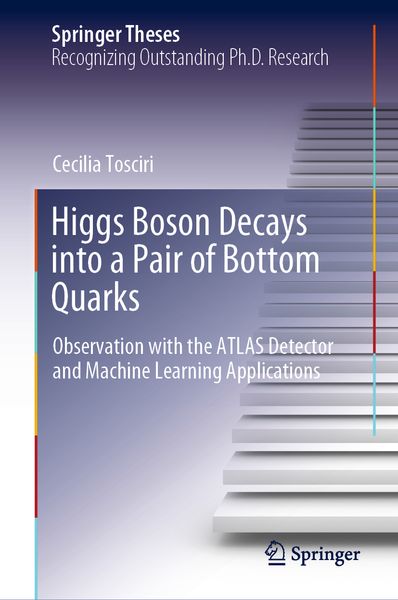
Higgs Boson Decays into a Pair of Bottom Quarks Observation with the ATLAS Detector and Machine Learning Applications
Aus der Reihe
Springer Theses
-
- Hardcover ausgewählt
- Taschenbuch
- eBook
-
Sprache:Englisch
Fr. 201.00
inkl. gesetzl. MwSt.,
Beschreibung
Produktdetails
Einband
Gebundene Ausgabe
Erscheinungsdatum
23.10.2021
Verlag
SpringerSeitenzahl
159
Maße (L/B/H)
24.1/16/1.6 cm
Gewicht
442 g
Auflage
1st ed. 2021
Sprache
Englisch
ISBN
978-3-030-87937-2
The discovery in 2012 of the Higgs boson at the Large Hadron Collider (LHC) represents a milestone for the Standard Model (SM) of particle physics. Most of the SM Higgs production and decay rates have been measured at the LHC with increased precision. However, despite its experimental success, the SM is known to be only an effective manifestation of a more fundamental description of nature. The scientific research at the LHC is strongly focused on extending the SM by searching, directly or indirectly, for indications of New Physics. The extensive physics program requires increasingly advanced computational and algorithmic techniques. In the last decades, Machine Learning (ML) methods have made a prominent appearance in the field of particle physics, and promise to address many challenges faced by the LHC.
This thesis presents the analysis that led to the observation of the SM Higgs boson decay into pairs of bottom quarks. The analysis exploits the production of a Higgs boson associated with a vector boson whose signatures enable efficient triggering and powerful background reduction. The main strategy to maximise the signal sensitivity is based on a multivariate approach. The analysis is performed on a dataset corresponding to a luminosity of 79.8/fb collected by the ATLAS experiment during Run-2 at a centre-of-mass energy of 13 TeV. An excess of events over the expected background is found with an observed (expected) significance of 4.9 (4.3) standard deviation. A combination with results from other \Hbb searches provides an observed (expected) significance of 5.4 (5.5). The corresponding ratio between the signal yield and the SM expectation is 1.01 +- 0.12 (stat.)+ 0.16-0.15(syst.).
The 'observation' analysis was further extended to provide a finer interpretation of the V H(H → bb) signal measurement. The cross sections for the VH production times the H → bb branching ratio have been measured in exclusive regions of phase space. These measurements are used to search for possible deviations from the SM with an effective field theory approach, based on anomalous couplings of the Higgs boson. The results of the cross-section measurements, as well as the constraining of the operators that affect the couplings of the Higgs boson to the vector boson and the bottom quarks, have been documented and discussed in this thesis.
This thesis also describes a novel technique for the fast simulation of the forward calorimeter response, based on similarity search methods. Such techniques constitute a branch of ML and include clustering and indexing methods that enable quick and efficient searches for vectors similar to each other. The new simulation approach provides optimal results in terms of detector resolution response and reduces the computational requirements of a standard particles simulation.
This thesis presents the analysis that led to the observation of the SM Higgs boson decay into pairs of bottom quarks. The analysis exploits the production of a Higgs boson associated with a vector boson whose signatures enable efficient triggering and powerful background reduction. The main strategy to maximise the signal sensitivity is based on a multivariate approach. The analysis is performed on a dataset corresponding to a luminosity of 79.8/fb collected by the ATLAS experiment during Run-2 at a centre-of-mass energy of 13 TeV. An excess of events over the expected background is found with an observed (expected) significance of 4.9 (4.3) standard deviation. A combination with results from other \Hbb searches provides an observed (expected) significance of 5.4 (5.5). The corresponding ratio between the signal yield and the SM expectation is 1.01 +- 0.12 (stat.)+ 0.16-0.15(syst.).
The 'observation' analysis was further extended to provide a finer interpretation of the V H(H → bb) signal measurement. The cross sections for the VH production times the H → bb branching ratio have been measured in exclusive regions of phase space. These measurements are used to search for possible deviations from the SM with an effective field theory approach, based on anomalous couplings of the Higgs boson. The results of the cross-section measurements, as well as the constraining of the operators that affect the couplings of the Higgs boson to the vector boson and the bottom quarks, have been documented and discussed in this thesis.
This thesis also describes a novel technique for the fast simulation of the forward calorimeter response, based on similarity search methods. Such techniques constitute a branch of ML and include clustering and indexing methods that enable quick and efficient searches for vectors similar to each other. The new simulation approach provides optimal results in terms of detector resolution response and reduces the computational requirements of a standard particles simulation.
Kundinnen und Kunden meinen
Verfassen Sie die erste Bewertung zu diesem Artikel
Helfen Sie anderen Kund*innen durch Ihre Meinung