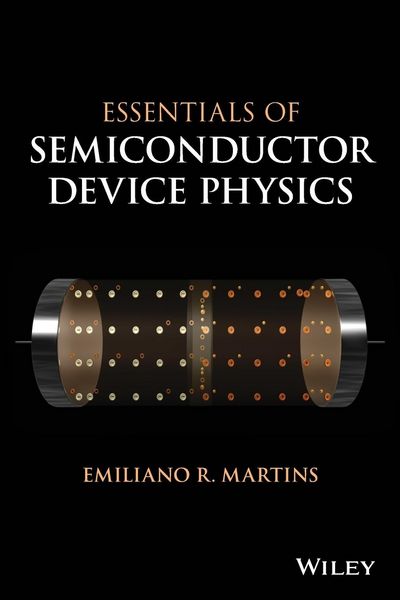
Martins, E: Essentials of Semiconductor Device Physics
-
- Englisch ausgewählt
Fr. 103.00
inkl. gesetzl. MwSt.,
Beschreibung
Produktdetails
Einband
Taschenbuch
Erscheinungsdatum
28.07.2022
Verlag
John Wiley & Sons IncSeitenzahl
240
Maße (L/B/H)
22.9/15.2/1.4 cm
Gewicht
397 g
Auflage
1. Auflage
Sprache
Englisch
ISBN
978-1-119-88411-8
ESSENTIALS OF SEMICONDUCTOR DEVICE PHYSICS
An introductory semiconductor device physics textbook that is accessible to readers without a background in statistical physics
I wish this book had been available when I needed to make a Semiconductor class myself a few years ago [...] A very nice aspect is that some concepts (e.g. density of states) are explained in a way that I have not seen elsewhere. These types of unconventional approaches are very valuable for a teacher. (Bjorn Maes, University of Mons, Belgium)
[...] the author offers an accessible description of statistical analysis and adopts it to explain the core properties of semiconductors. [...] [He] uses interesting metaphors and analogies to exemplify some of the most difficult notions, in an innovative and engaging way. (Andrea di Falco, University of St. Andrews, UK)
The subject of this book is the physics of semiconductor devices, which is an important topic in engineering and physics because it forms the background for electronic and optoelectronic devices, including solar cells. The author aims to provide students and teachers with a concise text that focuses on semiconductor devices and covers the necessary background in statistical physics.
This text introduces the key prerequisite knowledge in a simple, clear, and friendly manner. It distills the key concepts of semiconductor devices down to their essentials, enabling students to master this key subject in engineering, physics, and materials. The subject matter treated in this book is directly connected to the physics of p-n junctions and solar cells, which has become a topic of intense interest in the last decade. Sample topics covered within the text include:
* Chemical potential, Fermi level, Fermi-Dirac distribution, drift current and diffusion current.
* The physics of semiconductors, band theory and intuitive derivations of the concentration of charge carriers.
* The p-n junction, with qualitative analysis preceding the mathematical descriptions.
* A derivation of the current vs voltage relation in p-n junctions (Shockley equation).
* Important applications of p-n junctions, including solar cells
* The two main types of transistors: Bipolar Junction Transistors (BJT) and Metal Oxide Semiconductor Field Effect Transistors (MOSFET)
For students and instructors, it may be used as a primary textbook for an introductory semiconductor device physics course and is suitable for a course of approximately 30-50 hours. Scientists studying and researching semiconductor devices in general, and solar cells in particular, will also benefit from the clear and intuitive explanations found in this book.
An introductory semiconductor device physics textbook that is accessible to readers without a background in statistical physics
I wish this book had been available when I needed to make a Semiconductor class myself a few years ago [...] A very nice aspect is that some concepts (e.g. density of states) are explained in a way that I have not seen elsewhere. These types of unconventional approaches are very valuable for a teacher. (Bjorn Maes, University of Mons, Belgium)
[...] the author offers an accessible description of statistical analysis and adopts it to explain the core properties of semiconductors. [...] [He] uses interesting metaphors and analogies to exemplify some of the most difficult notions, in an innovative and engaging way. (Andrea di Falco, University of St. Andrews, UK)
The subject of this book is the physics of semiconductor devices, which is an important topic in engineering and physics because it forms the background for electronic and optoelectronic devices, including solar cells. The author aims to provide students and teachers with a concise text that focuses on semiconductor devices and covers the necessary background in statistical physics.
This text introduces the key prerequisite knowledge in a simple, clear, and friendly manner. It distills the key concepts of semiconductor devices down to their essentials, enabling students to master this key subject in engineering, physics, and materials. The subject matter treated in this book is directly connected to the physics of p-n junctions and solar cells, which has become a topic of intense interest in the last decade. Sample topics covered within the text include:
* Chemical potential, Fermi level, Fermi-Dirac distribution, drift current and diffusion current.
* The physics of semiconductors, band theory and intuitive derivations of the concentration of charge carriers.
* The p-n junction, with qualitative analysis preceding the mathematical descriptions.
* A derivation of the current vs voltage relation in p-n junctions (Shockley equation).
* Important applications of p-n junctions, including solar cells
* The two main types of transistors: Bipolar Junction Transistors (BJT) and Metal Oxide Semiconductor Field Effect Transistors (MOSFET)
For students and instructors, it may be used as a primary textbook for an introductory semiconductor device physics course and is suitable for a course of approximately 30-50 hours. Scientists studying and researching semiconductor devices in general, and solar cells in particular, will also benefit from the clear and intuitive explanations found in this book.
Kundinnen und Kunden meinen
Verfassen Sie die erste Bewertung zu diesem Artikel
Helfen Sie anderen Kund*innen durch Ihre Meinung