Gutscheinbedingungen

*Gültig bis 21.06.2026 auf (fast) alles. Ausgeschlossen sind Smartboxen, Zeitschriften, Tickets, Lebensmittel, Gaming-Elektroartikel, Tinte/Toner, Gutscheine, Geschenkkarten, Blumen und Abos | Einlösbar in allen Buchhandlungen von Orell Füssli, Barth Bücher, Buchladen Rapunzel, Schuler Orell Füssli, Stauffacher und ZAP unter Vorweisung des Gutscheins, auf www.orellfüssli.ch durch Eingabe des Gutscheincodes. Beim Service „eBooks verschenken“ und bei eBook-Käufen via eReader nicht einlösbar | Mindesteinkaufswert: Fr. 30.- | Nicht mit anderen Rabatten kumulierbar.

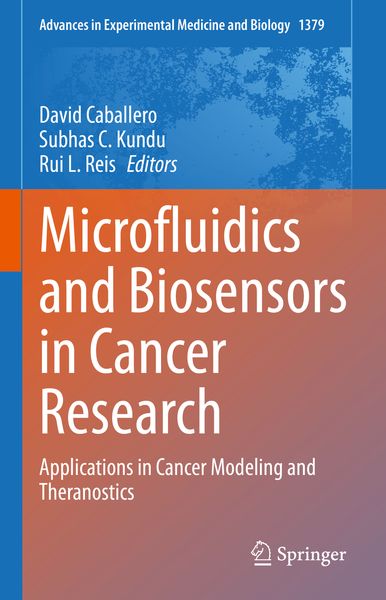
Produktbild: Microfluidics and Biosensors in Cancer Research

Microfluidics and Biosensors in Cancer Research Applications in Cancer Modeling and Theranostics

Fr. 209.00

inkl. gesetzl. MwSt., Versandkostenfrei


Beschreibung

Produktdetails

Einband

Gebundene Ausgabe

Erscheinungsdatum

29.06.2022

Herausgeber

David Caballero + weitere

Verlag

Springer

Seitenzahl

590

Maße (L/B/H)

24.1/16/3.9 cm

Gewicht

1074 g

Auflage

1st ed. 2022

Sprache

Englisch

ISBN

978-3-031-04038-2

Beschreibung

Portrait

David Caballero is an experienced biophysicist with a MSc and PhD in Nanoscience from the University of Barcelona (Spain). Currently, Dr. Caballero is a senior Assistant Researcher at the 3B’s Research Group, I3Bs – Research Institute on Biomaterials, Biodegradables and Biomimetics from the University of Minho (Portugal) working in the field of Physics of Cancer. His research is focused on unraveling the mechano-chemical mechanisms of cancer dissemination. For this, Dr. Caballero is using microfluidics, microfabrication tools, and cutting-edge screening technologies for his experiments that are the interface between cell biology and physics.

Subhas C. Kundu received his PhD in Genetics from Banaras Hindu University (India). His area of interest includes biomaterials for 3D cancer modelling and drug screening. Currently, Prof. Kundu is a Research Coordinator at the 3B’s Research Group, I3Bs – Research Institute on Biomaterials, Biodegradables and Biomimeticsof the University of Minho, where he leads a multidisciplinary team dedicated to developing a new generation of predictive in vitro 3D tumor models using engineered biomaterials.

Rui L. Reis is the Dean/President of I3Bs – Research Institute for Biomaterials, Biodegradables and Biomimetics, founding Director of the 3B’s Research Group at the University of Minho, Full Professor of Tissue Engineering, Regenerative Medicine, Biomaterials and Stem Cells, the CEO of the European Institute of Excellence on Tissue Engineering and Regenerative Medicine, and the Director of the PT Government Associate Laboratory ICVS/3Bs from the University of Minho (Portugal). Prof. Reis was awarded with the IET Harvey Engineering Research Prize to create reliable breakthrough 3D engineered functional cancer disease models for an improved prediction and efficacy of cancer drugs.

Produktdetails

Einband

Gebundene Ausgabe

Erscheinungsdatum

29.06.2022

Herausgeber

Verlag

Springer

Seitenzahl

590

Maße (L/B/H)

24.1/16/3.9 cm

Gewicht

1074 g

Auflage

1st ed. 2022

Sprache

Englisch

ISBN

978-3-031-04038-2

Herstelleradresse

Springer-Verlag KG
Sachsenplatz 4-6
1201 Wien
AT

Email: ProductSafety@springernature.com

Kundinnen und Kunden meinen

0 Bewertungen

Informationen zu Bewertungen

Zur Abgabe einer Bewertung ist eine Anmeldung im Konto notwendig. Die Authentizität der Bewertungen wird von uns nicht überprüft. Wir behalten uns vor, Bewertungstexte, die unseren Richtlinien widersprechen, entsprechend zu kürzen oder zu löschen.

Die Bewertungen sind nach Format, Anzahl Sterne und Datum sortiert.

Verfassen Sie die erste Bewertung zu diesem Artikel

Helfen Sie anderen Kund*innen durch Ihre Meinung

Kundinnen und Kunden meinen

0 Bewertungen filtern

  • Produktbild: Microfluidics and Biosensors in Cancer Research
  • Part 1. Fundamentals of Microfluidics and Biosensors.- Chapter 1. Fundamentals of Biosensors and Detection Methods.- Chapter 2. How to Get Away with Gradients.- Chapter 3. Sensors and Biosensors in Organs-on-a-chip Platforms.- Chapter 4. Current Trends in Microfluidics and Biosensors for Cancer Research Applications.- Part 2. Modelling the Tumor Microenvironment and Its Dynamic Events.- Chapter 5. The Tumor Microenvironment - an Introduction for the Development of Microfluidic Devices.- Chapter 6. Biomaterials for Mimicking and Modelling Tumor Micro-environment.- Chapter 7. Advancing Tumor Microenvironment Research by Combining Organs-on-chips and Biosensors.- Chapter 8. Microfluidic-driven Biofabrication and the Engineering of Cancer-like Microenvironments.- Chapter 9. Advances in 3d Vascularized Tumor-on-a-chip Technology.- Part 3. Cancer Detection and Diagnosis.- Chapter 10. Biosensors Advances: Contributions to Cancer Diagnostics and Treatment.- Chapter 11. Flexible Sensing Systemsfor Cancer Diagnostics.- Chapter 12. Coupling Micro-physiological Systems and Biosensors for Improving Cancer Biomarkers Detection.- Chapter 13. Microfluidic Biosensor-based Devices for Rapid Diagnosis and Effective Anti-cancer Therapeutic Monitoring for Breast Cancer Metastasis.- Chapter 14. Liquid Biopsies: Flowing Biomarkers.- Chapter 15. From Exosomes to Circulating Tumor Cells: Using Microfludics to Detect High Predictive Cancer Biomarkers.- Chapter 16. Microfluidics for the Isolation and Detection of Circulating Tumor Cells.- Chapter 17. Evolution in Automatized Detection of Cancer Cells: Advances in Magnetic Microcytometers.- Chapter 18. Droplet-based Microfluidic Chip Design, Fabrication and Use for Ultrahigh-throughput DNA Analysis and Quantification.- Chapter 19. Emerging Microfluidic and Biosensor Technologies for Improved Cancer Theranostics.- Part 4. Clinical Applications: Towards Personalized Medicine.- Chapter 20. Microfluidics for Cancer Biomarker Discovery, Research and Clinical Application.- Chapter 21. Methods for the Detection of Circulating Biomarkers in Cancer Patients.- Chapter 22. Advances in Microfluidics for the Implementation of Liquid Biopsy in Clinical Routine.