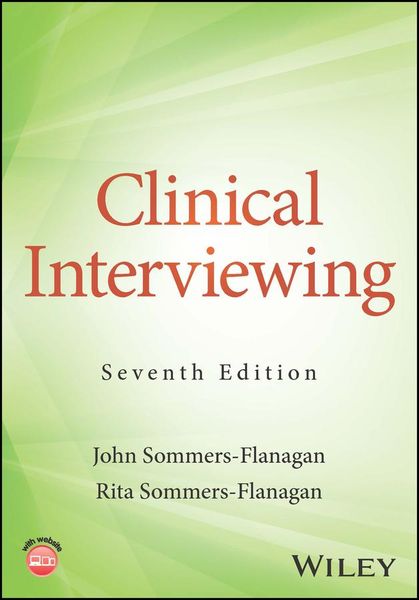
Produktbild: Clinical Interviewing

Clinical Interviewing

Fr. 163.00

inkl. gesetzl. MwSt., Versandkostenfrei


Beschreibung

Produktdetails

Einband

Taschenbuch

Erscheinungsdatum

06.02.2024

Verlag

John Wiley & Sons Inc

Seitenzahl

688

Maße (L/B/H)

18.2/25.3/3.9 cm

Gewicht

998 g

Auflage

7. Auflage

Sprache

Englisch

ISBN

978-1-119-98198-5

Beschreibung

Rezension

I have been using this splendid book for my first-year course in clinical interviewing in our clinical science program. The Sommers-Flanagans have produced another edition of their engaging and lucid textbook infused with that rare combination of clinical wisdom and evidence-based knowledge that embodies the scientist-practitioner model and helps students learn both the practice and scientific basis of clinical assessment via interviewing. I recommend this book both for graduate courses as well as for use by established practitioners who wish to continue honing their skills.
Gerald C. Davison, Ph.D. Professor of Psychology and Gerontology, University of Southern California, and coauthor of Abnormal Psychology and Clinical Behavior Therapy, and featured in the documentary film, Conversion.
 

I am delighted that John & Rita Sommers-Flanagan are continuing to update Clinical Interviewing; now in its 7th edition! I used prior editions in my basic practicum courses and found the text to be perfect for training psychotherapists. The book offers the breadth and depth needed to prepare students for clinical work. Each chapter is filled with state-of-the-art content and clear examples of clinical interactions that illuminate key points. The video demonstrations cover a wide range of skills and make the content come-to-life. The chapters on risk assessment and working with kids and teens are especially helpful. Using this book is like having two more instructors for the course and it's a great way to provide students (and their professor) the support they need to accomplish their mutual goals.
Heidi Zetzer, Ph.D., Teaching Professor and Director, Carol Ackerman Positive Psychology Clinic, University of California Santa Barbara
 
This state-of-the-art text is a must-read for counselors, psychotherapists, and mental health professionals in any role and setting. The authors provide clear and easy-to-understand evidence-based analyses, discussions, and applications of the clinical interview process with a 21st-century lens.
Eddy Fagundo, Eddy Fagundo, Ph.D., CRC, CVE | Senior Manager, Education Content, American Counseling Association
 
I wanted to share my thoughts about the "Clinical Interviewing" book, which I believe is an outstanding resource for Clinical Interview courses in Turkey and worldwide. One particular aspect of this book stands out for me: I've been working as a counselor educator for approximately seven years, and one of the greatest challenges in counselor education is helping students grasp the holistic nature of counseling. They may be well-versed in counseling theories, techniques, and the DSM, but often struggle to integrate this knowledge effectively. That's where this book has proven invaluable. We incorporate this book into our curriculum, especially during the initial weeks of supervision. I particularly admire the chapter titled 'An Overview of the Interview Process.' Starting with this book not only in supervision but also in the early stages of various courses, such as counseling with children and adolescents, provides my students with a solid framework within which to contextualize the information they'll acquire throughout the upcoming weeks. This book provides students with the essential framework for showcasing their counseling skills--where, how, and when to apply them, which makes "Clinical Interviewing" truly unparalleled in its value.
Umit Arslan
 

This textbook has been extremely helpful in highlighting how fundamental listening and reflecting is to the human experience. The insightful examples and invitational writing style help to bridge the gap of insecurity that many early students experience. I highly recommend this textbook for early skills courses and as a resource for counselors who find themselves in need of a professional "tune up."
Carol McGinnis
 
We LOVE this textbook for our Diagnosis course!
Meredith Rausch, Ph.D., NCC (She/Her), Associate Professor at Augusta University
 

One of my favorite textbooks from my graduate program and hands down that liking the two of you from this book and the accompanying videos, that it led me to your Strengths Based Suicide training was such a meaningful shift in my thinking and approach that I remain so grateful for. Excited for those who will continue to learn from the two of you!
Teresa Prince, LPC, Insights Counseling Center, LLC

Produktdetails

Einband

Taschenbuch

Erscheinungsdatum

06.02.2024

Verlag

John Wiley & Sons Inc

Seitenzahl

688

Maße (L/B/H)

18.2/25.3/3.9 cm

Gewicht

998 g

Auflage

7. Auflage

Sprache

Englisch

ISBN

978-1-119-98198-5

Herstelleradresse

Libri GmbH
Europaallee 1
36244 Bad Hersfeld
DE

Email: gpsr@libri.de

Kundinnen und Kunden meinen

0 Bewertungen

Informationen zu Bewertungen

Zur Abgabe einer Bewertung ist eine Anmeldung im Konto notwendig. Die Authentizität der Bewertungen wird von uns nicht überprüft. Wir behalten uns vor, Bewertungstexte, die unseren Richtlinien widersprechen, entsprechend zu kürzen oder zu löschen.

Die Bewertungen sind nach Format, Anzahl Sterne und Datum sortiert.

Verfassen Sie die erste Bewertung zu diesem Artikel

Helfen Sie anderen Kund*innen durch Ihre Meinung

Kundinnen und Kunden meinen

0 Bewertungen filtern

Die Leseprobe wird geladen.
  • Produktbild: Clinical Interviewing
  • Preface xiii

    About the Authors xxi

    Part One: Foundations of Clinical Interviewing 1

    Chapter 1: An Introduction to the Clinical Interview 3

    Learning Objectives 3

    Chapter Orientation 3

    Welcome to the Journey 3

    What Is a Clinical Interview? 5

    Clinical Interviewing versus Counseling and Psychotherapy 7

    Multicultural Competencies 13

    Multicultural Humility 17

    A Learning Model for Clinical Interviewing 25

    Chapter Summary 28

    Chapter 2: Preparation 31

    Learning Objectives 31

    Chapter Orientation 31

    The Physical Setting 31

    Professional and Ethical Issues 38

    Multicultural Preparation 55

    Stress Management and Self-Care 65

    Chapter Summary 68

    Chapter 3: An Overview of the Interview Process 71

    Learning Objectives 71

    Chapter Orientation 71

    Stages of a Clinical Interview 71

    The Introduction 73

    The Opening 84

    The Body 90

    The Closing 95

    Ending the Session (Termination) 104

    Chapter Summary 107

    Part Two: Listening and Relationship Development 111

    Chapter 4: Nondirective Listening Skills 113

    Learning Objectives 113

    Chapter Orientation 113

    Listening Skills 113

    Adopting a Therapeutic Attitude 114

    Why Nondirective Listening Is Also Directive 123

    The Listening Continuum in Three Parts 125

    Skills for Encouraging Client Talk 126

    Ethical and Multicultural Considerations 142

    Not Knowing What to Say 145

    Chapter Summary 146

    Chapter 5: Directive Listening Skills 149

    Learning Objectives 149

    Chapter Orientation 149

    Skills for Encouraging Insight 150

    Ethical and Multicultural Considerations 175

    Chapter Summary 178

    Chapter 6: Skills for Directing Clients Toward Action 181

    Learning Objectives 181

    Chapter Orientation 181

    Readiness to Change 181

    Skills for Encouraging Action 184

    Using Educational and Directive Techniques 192

    Ethical and Multicultural Considerations 204

    Chapter Summary 215

    Chapter 7: Evidence-Based Relationships 217

    Learning Objectives 217

    Chapter Orientation 217

    The Great Psychotherapy Debate 217

    The Core Conditions 218

    Other Evidence-Based Relationship Factors 233

    Evidence-Based Cross-Cultural Relationships 250

    Chapter Summary 253

    Part Three: Structuring and Assessment 255

    Chapter 8: Intake Interviewing and Report Writing 257

    Learning Objectives 257

    Chapter Orientation 257

    What's an Intake Interview? 257

    Exploring Client Problems and Goals 259

    Obtaining Background and Historical Information 267

    Assessment of Current Functioning 276

    Brief Intake Interviewing 280

    The Intake Report 282

    Do's and Don'ts of Intake Interviews with Diverse Clients 298

    Chapter Summary 300

    Chapter 9: The Mental Status Examination 303

    Learning Objectives 303

    Chapter Orientation 303

    What Is a Mental Status Examination? 303

    Individual and Cultural Considerations 305

    The Psychiatric Mental Status Examination 308

    When to Use Mental Status Examinations 340

    Chapter Summary 342

    Chapter 10: Suicide Assessment 345

    Learning Objectives 345

    Chapter Orientation 345

    Facing the Suicide Situation 345

    Suicide Risk Factors, Protective Factors, and Warning Signs 348

    Building a Theoretical and Research-Based Foundation 356

    Suicide Assessment Interviewing 360

    Suicide Interventions 380

    Final Ethical and Professional Issues 385

    Chapter Summary 389

    Chapter 11: Diagnosis and Treatment Planning 393

    Learning Objectives 393

    Chapter Orientation 393

    Modern Diagnostic Classification Systems 393

    Defining Mental Disorders 396

    Diagnostic Interviewing 404

    The Science of Clinical Interviewing 406

    Less Structured Diagnostic Clinical Interviews 409

    Case Formulation and Treatment Planning 415

    Extended Case Example 423

    Additional Cultural Modifications and Adaptations 427

    Chapter Summary 428

    Part Four: Diverse Populations and Situations 431

    Chapter 12: Challenging Client Behaviors and Demanding Situations 433

    Learning Objectives 433

    Chapter Orientation 433

    Challenging Clients 433

    Motivational Interviewing and Other Strategies 436

    Violence Risk Assessment (VRA) and Prediction 451

    Demanding Situations: Crisis and Trauma 456

    Cultural Competencies in Disaster Mental Health 468

    Chapter Summary 470

    Chapter 13: Interviewing Young Clients 473

    Learning Objectives 473

    Chapter Orientation 473

    Considerations in Working With Young Clients 473

    The Introduction 475

    The Opening 479

    The Body of the Interview 490

    Closing and Termination 503

    Culture in Young Client Interviews 506

    Chapter Summary 508

    Chapter 14: Online and Distance Clinical Interviewing** 553

    Learning Objectives 533

    Chapter Orientation 553

    Technology as an Extension of the Self 554

    Definition of Terms and Communication Modalities 557

    Distance and Online Assessment and Intervention Research 561

    Ethical and Practical Issues: Problems and Solutions 565

    Conducting Online or Distance Interviews 573

    Culture and Online Culture 575

    Chapter Summary 576

    Epilogue

    References 589

    Author Index 639

    Subject Index 655