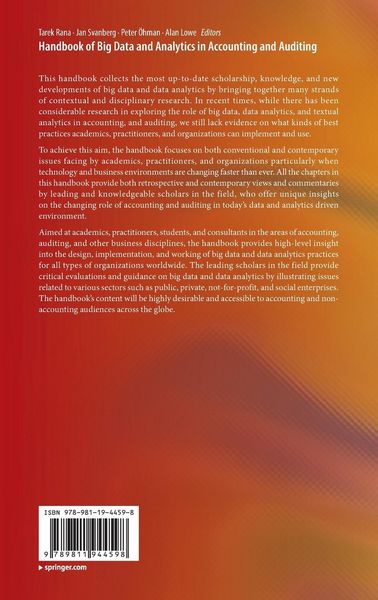
• Produktbild: Handbook of Big Data and Analytics in Accounting and Auditing
  • Produktbild: Handbook of Big Data and Analytics in Accounting and Auditing

Handbook of Big Data and Analytics in Accounting and Auditing

Fr. 218.00

inkl. gesetzl. MwSt., Versandkostenfrei


Beschreibung

Produktdetails

Einband

Gebundene Ausgabe

Erscheinungsdatum

04.02.2023

Herausgeber

Tarek Rana + weitere

Verlag

Springer Singapore

Seitenzahl

564

Maße (L/B/H)

24.1/16/3.7 cm

Auflage

1st ed. 2023

Sprache

Englisch

ISBN

978-981-19-4459-8

Beschreibung

Portrait

Tarek Rana is an Associate Professor of Management Accounting and Analytics at RMIT University, Melbourne, Australia. He earned a PhD in Management Accounting at the University of New South Wales (UNSW) Australia. He has considerable professional and industry experience in the areas of business services, taxation, auditing, and financial planning as well as consulting services including performance measurement and risk management. He has formed many industry partnerships and undertaken practice focused research projects to deliver long-term social and organizational impact. His current research focuses on the intersection of accounting and data analytics including the implications of data analytics on management control systems, performance measurement, risk management, and sustainability where he draws on textual analytics, machine learning and artificial intelligence theories and practices. His research papers appeared in international and interdisciplinary scholarly journals such as The British Accounting Review, Accounting Auditing and Accountability Journal, Financial Accountability & Management, Intelligent Systems in Accounting, Finance & Management, Business Strategy and the Environment, Public Money & Management, Journal of Accounting & Organisational Change, Journal of Cleaner Production, and Journal of Intellectual Capital .

Jan Svanberg is an Associate Professor of Business Administration at University of Gävle, and associated with Centre for research on Economic Relations (CER), Sweden. He earned his PhD in Business Administration at Stockholm University, Sweden, and was recently a research fellow at RMIT University, Melbourne, Australia, for a period of two years. In addition to these studies, he has a diverse education with degrees in engineering, mathematics, and physics (M.Sc.) and law (LL.M). His current research focuses on how core problems in accounting, auditing and finance can be solved by interdisciplinary approaches with tools made available by advances in data science, especially machine learning. His work has been published in scholarly journals such as The British Accounting Review, Behavioral Research in Accounting, Accounting Auditing and Accountability Journal, Journal of Cleaner Production, and Intelligent Systems in Accounting, Finance and Management.

Peter Öhman is a Professor and Head of Business Administration at Mid Sweden University in Sundsvall, and director of Centre for research on Economic Relations (CER), Sweden. His research focuses on behavioral issues, primarily in accounting and auditing, but also in the banking and property industries. He has published a significant number of scholarly articles, published books, book chapters and reports, and presented papers at international conferences. He has received international awards for excellent research, is a member of Editorial Boards, and a reviewer of several well-known international journals. His work has been published in leading scholarly journals such as Contemporary Accounting Research, Behavioral Research in Accounting, Accounting Auditing and Accountability Journal, European Accounting Review, and The British Accounting Review.

Alan Lowe is an Honorary Professor of Management Accounting at RMIT University, Melbourne, Australia. He served as joint Editor of the British Accounting Review . His research interest has included management controls, ERP, technologies, and internet reporting using case studies and interpretive methodology. Recent projects include ethical identity and financial innovation in Islamic financial institutions, ICT service provision in health care sector, and governing climate change.


Produktdetails

Einband

Gebundene Ausgabe

Erscheinungsdatum

04.02.2023

Herausgeber

Verlag

Springer Singapore

Seitenzahl

564

Maße (L/B/H)

24.1/16/3.7 cm

Auflage

1st ed. 2023

Sprache

Englisch

ISBN

978-981-19-4459-8

Herstelleradresse

Springer-Verlag KG
Sachsenplatz 4-6
1201 Wien
AT

Email: ProductSafety@springernature.com

Kundinnen und Kunden meinen

0 Bewertungen

Informationen zu Bewertungen

Zur Abgabe einer Bewertung ist eine Anmeldung im Konto notwendig. Die Authentizität der Bewertungen wird von uns nicht überprüft. Wir behalten uns vor, Bewertungstexte, die unseren Richtlinien widersprechen, entsprechend zu kürzen oder zu löschen.

Die Bewertungen sind nach Format, Anzahl Sterne und Datum sortiert.

Verfassen Sie die erste Bewertung zu diesem Artikel

Helfen Sie anderen Kund*innen durch Ihre Meinung

Kundinnen und Kunden meinen

0 Bewertungen filtern

  • Produktbild: Handbook of Big Data and Analytics in Accounting and Auditing
  • Produktbild: Handbook of Big Data and Analytics in Accounting and Auditing
  • Chapter 1. Introduction.- Part 1 - Emerging Technologies, and Accounting and Auditing Challenges.- Chapter 2. A picture is worth a thousand words: Audit efficiency and risk management through data visualization.- Chapter 3. The Challenges Facing Vietnamese Accountants and Auditors with the Adoption of Emerging Technologies.- Chapter 4. Prediction of Controversies and Estimation of ESG Performance An Experimental Investigation using Machine Learning.- Chapter 5. Artificial Intelligence and Environmental, Social and Governmental Issues a Current Perspective.- Chapter 6. Sweet Spots or Dark Corners? An Environmental Sustainability view of Big Data and Artificial Intelligence in ESG.- Chapter 7. Digitalization of Bookkeeping in Small Organizations: The Case of Sweden.- Chapter 8. Cloud Accounting: A New Business Model in Challenging Context of China.- Chapter 9. Exemplifying the Opportunities and Limitations of Blockchain Technology through Corporate Tax Losses.- Chapter 10. Data Sources for Predictive Analytics and Decision Making: A Management Perspective.- Chapter 11. The Use of Internet of Things, Big Data Analytics and Artificial Intelligence for Attaining UN's SDGs.- Chapter 12. Integrating ESG Risks into Control and Reporting: Evidence from Practice in Sweden.- Chapter 13. Digitalization and Management Control in the Public Sector: What is Next?.- Chapter 14. Applying Text Mining to Understand Customer Perception of Mobile Banking App.- Chapter 15. Integrating Blockchain Technology into Accounting Curricula: A Template for Accounting Educators.- Chapter 16. Digitized Simulation and Gamified Pedagogy in a First Year Accounting Core Subject.- Chapter 17. Roleplay and Interpersonal Skills Self-Efficacy in a Financial Analytics Course.- Chapter 18. Data Analytics in an Undergraduate Accountancy Programme: The Spaced Retrieval Method. Chapter 19. Learning Analytics in Informal, Participatory Collaborative Learning.- Chapter 20. A Research on Digitalization and Performance in Higher Education between Hybridity and Algorithms.- Chapter 21. Online Household Waste Management (HWM): Measurement, Reporting and Awareness Education.- Chapter 22. Does Virtual Reality Enhance Taxation (Capital Allowances) Learning? - An International Study.