
Revealing Media Bias in News Articles NLP Techniques for Automated Frame Analysis
-
- Englisch ausgewählt
Fr. 58.90
inkl. gesetzl. MwSt.,
Beschreibung
Produktdetails
Einband
Taschenbuch
Erscheinungsdatum
26.02.2023
Verlag
SpringerSeitenzahl
238
Maße (L/B/H)
23.5/15.5/1.4 cm
Gewicht
388 g
Auflage
1st ed. 2023
Sprache
Englisch
ISBN
978-3-031-17695-1
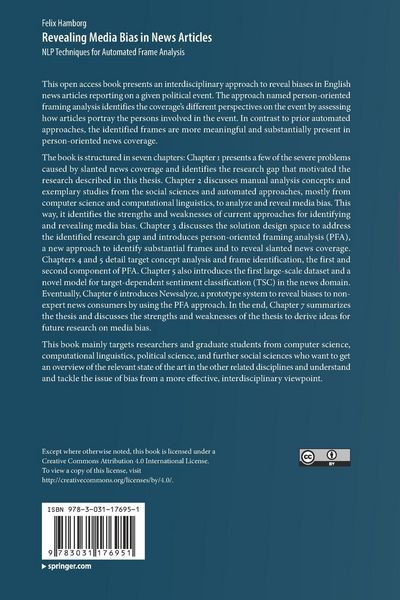
This open access book presents an interdisciplinary approach to reveal biases in English news articles reporting on a given political event. The approach named person-oriented framing analysis identifies the coverage’s different perspectives on the event by assessing how articles portray the persons involved in the event. In contrast to prior automated approaches, the identified frames are more meaningful and substantially present in person-oriented news coverage.
The book is structured in seven chapters: Chapter 1 presents a few of the severe problems caused by slanted news coverage and identifies the research gap that motivated the research described in this thesis. Chapter 2 discusses manual analysis concepts and exemplary studies from the social sciences and automated approaches, mostly from computer science and computational linguistics, to analyze and reveal media bias. This way, it identifies the strengths and weaknesses of current approaches for identifying and revealing media bias. Chapter 3 discusses the solution design space to address the identified research gap and introduces person-oriented framing analysis (PFA), a new approach to identify substantial frames and to reveal slanted news coverage. Chapters 4 and 5 detail target concept analysis and frame identification, the first and second component of PFA. Chapter 5 also introduces the first large-scale dataset and a novel model for target-dependent sentiment classification (TSC) in the news domain. Eventually, Chapter 6 introduces Newsalyze, a prototype system to reveal biases to non-expert news consumers by using the PFA approach. In the end, Chapter 7 summarizes the thesis and discusses the strengths and weaknesses of the thesis to derive ideas for future research on media bias.
This book mainly targets researchers and graduate students from computer science, computational linguistics, political science, and further social sciences who want to get an overview of the relevant state of the art in the other related disciplines and understand and tackle the issue of bias from a more effective, interdisciplinary viewpoint.Kundinnen und Kunden meinen
Verfassen Sie die erste Bewertung zu diesem Artikel
Helfen Sie anderen Kund*innen durch Ihre Meinung