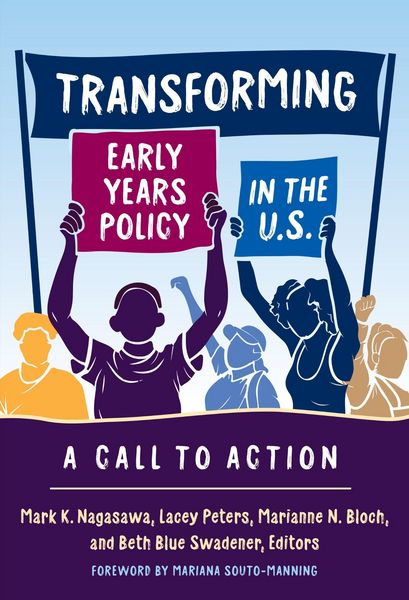
Produktbild: Transforming Early Years Policy in the U.S.

Transforming Early Years Policy in the U.S. A Call to Action

Fr. 62.90

inkl. gesetzl. MwSt., Versandkostenfrei


Beschreibung

Produktdetails

Einband

Taschenbuch

Erscheinungsdatum

24.02.2023

Herausgeber

Mark K. Nagasawa + weitere

Verlag

Teachers College Press

Seitenzahl

224

Maße (L/B/H)

22.6/15.2/1.5 cm

Gewicht

272 g

Sprache

Englisch

ISBN

978-0-8077-6814-3

Beschreibung

Portrait

Mark K. Nagasawa is director of the Straus Center for Young Children & Families at Bank Street College of Education.

Lacey Peters is an assistant professor and graduate program co-coordinator for early childhood care and education at Hunter College, City University of New York.

Marianne N. Bloch is professor emerita in the Departments of Curriculum and Instruction and Gender and Women's Studies at the University of Wisconsin-Madison.

Beth Blue Swadener is professor emerita of justice studies and of social and cultural pedagogy in the School of Social Transformation at Arizona State University.

Produktdetails

Einband

Taschenbuch

Erscheinungsdatum

24.02.2023

Herausgeber

Verlag

Teachers College Press

Seitenzahl

224

Maße (L/B/H)

22.6/15.2/1.5 cm

Gewicht

272 g

Sprache

Englisch

ISBN

978-0-8077-6814-3

Herstelleradresse

Libri GmbH
Europaallee 1
36244 Bad Hersfeld
DE

Email: gpsr@libri.de

Kundinnen und Kunden meinen

0 Bewertungen

Informationen zu Bewertungen

Zur Abgabe einer Bewertung ist eine Anmeldung im Konto notwendig. Die Authentizität der Bewertungen wird von uns nicht überprüft. Wir behalten uns vor, Bewertungstexte, die unseren Richtlinien widersprechen, entsprechend zu kürzen oder zu löschen.

Die Bewertungen sind nach Format, Anzahl Sterne und Datum sortiert.

Verfassen Sie die erste Bewertung zu diesem Artikel

Helfen Sie anderen Kund*innen durch Ihre Meinung

Kundinnen und Kunden meinen

0 Bewertungen filtern

  • Produktbild: Transforming Early Years Policy in the U.S.
    • Contents (Tentative)
    • Foreword
    • Mariana Souto-Manning
    • Acknowledgments
    • Introduction
    • Mark K. Nagasawa, Lacey E. Peters, Marianne N. Bloch, and Beth Blue Swadener
    • Part I: EARLY YEARS SYSTEMS FRAGMENTATION AND INEQUALITY
    • 1. In This Moment . . . We Are Essential
    • Lucinda Heimer
    • 2. One Center, Two Programs: Finding Promise Within a Fragmented and Unequal Non-System
    • Louis Hamlyn-Harris
    • 3. Toward Transforming Fragmented and Unequal Early Years Systems-Recommendations
    • Jacqueline Jones
    • Part II: CENTERING ANTI-RACISM IN EARLY YEARS CONTEXTS
    • 4. Constellations of Care: Black Kith and Kin Home/Place Making Beyond the State Gaze
    • Ashley J. May
    • 5. Proactive, Not Reactive: Creating Anti-Racist Policies for Child Care Centers and Preschools
    • Kerry-Ann Escayg and Flóra Faragó
    • 6. Short- and Long-Term Policy Solutions Are Necessary to Address Inequities in Access and Affordability in the Early Years
    • Chrishana M. Lloyd and Julianna Carlson
    • Part III: FELT IN/EQUITIES IN THE EARLY YEARS: INFANT/TODDLER CARE AND EDUCATION
    • 7. Felt (In)equities: The Status of Infant-Toddler Care
    • Barbara Milner
    • 8. Felt (In)equities: The Status of Infant-Toddler Teachers
    • Emmanuelle N. Fincham
    • 9. Recognizing the Birth to Three Workforce as Educators
    • Emily Sharrock and Annie Schaeffing
    • Part IV: DE/PROFESSIONALIZATION
    • 10. Grounding Educators' Experiences, Perspectives, and Intellect in De/Professionalization Debates
    • Lea J. E. Austin
    • 11. Toward Equity in Professionalization Through Community and Coalition Building
    • Juliana Pinto McKeen, Fabiola Santos-Gaerlan, Alice Tse, and Wendy Jo Cole
    • 12. Toward Professionalization BY the People
    • Betzaida Vera-Heredia
    • Part V: SUPPORTING THRIVING TEACHERS
    • 13. Don't Train Me to Serve! Supporting Thriving Teachers Through Identity Development
    • Vanessa Rodriguez
    • 14. "I Want to Be Treated Like I'm Valuable": Advocating for Teachers' Humanity
    • Abbi Kruse
    • 15. Talking the Talk, Walking the Walk With Teachers
    • Lorraine Falchi and Cristina Medellin
    • Part VI: Whose Standards?
    • 16. Being Held to Whose Standards? Considering the Unique Experiences of Racially and Ethnically Diverse Children
    • Alexandra Figueras-Daniel and Stephanie M. Curenton
    • 17. Using Aesthetic Approaches to Meet and Challenge the National Standards: A Both/And Approach
    • Margarita G. Ruiz Guerrero and Carolyn Brennan
    • 18. "John Adams Didn't Own Slaves": Culturally Affirming Standards, Assessments, and Curriculum
    • Evandra Catherin
    • Part VII: HONORING COMMUNITY CULTURAL WEALTH
    • 19. Elevating the Cultural Wealth in Communities of Color: The RICHER Framework-Intersectionality Between Race and Place
    • Iheoma U. Iruka
    • 20. It Really Does Take a Village: Why Educators Need to Be Involved in Community Initiatives
    • Jaclyn Vasquez and Mark Nagasawa
    • 21. Mi Casita: How a School Can Exist to Meet the Needs of Children and Adults Alike
    • Eva Ruiz and Rafa Pérez-Segura
    • 22. Sustaining Our Futures Through