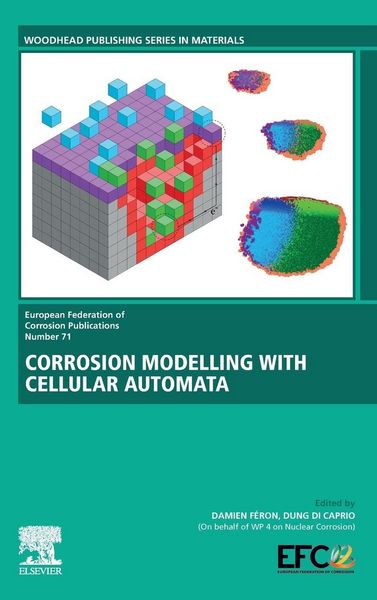
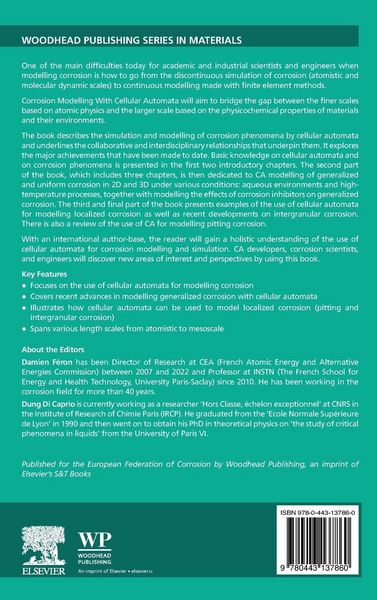
• Produktbild: Corrosion Modelling with Cellular Automata
  • Produktbild: Corrosion Modelling with Cellular Automata

Corrosion Modelling with Cellular Automata

Fr. 222.00

inkl. gesetzl. MwSt., Versandkostenfrei


Beschreibung

Produktdetails

Einband

Gebundene Ausgabe

Erscheinungsdatum

22.03.2024

Herausgeber

Damien Feron + weitere

Verlag

Elsevier

Seitenzahl

210

Maße (L/B/H)

22.9/15.2/1.3 cm

Gewicht

452 g

Sprache

Englisch

ISBN

978-0-443-13786-0

Beschreibung

Portrait

Damien Féron has been Director of Research at CEA (French Atomic and Alternative Energies Commission) since 2007 and Professor at INSTN (The French School for Energy and Health Technology, University Paris-Saclay) since 2010. He has been working in the corrosion field for more than 40 years. He chaired the Working Party on Nuclear Corrosion (2003-2016) of the European Federation of Corrosion (EFC) and the Science and Technology Advisory Committee (STAC). He has been President of the EFC (2017-18) and the WCO (World Corrosion Organization) which is a non-governmental organization recognized by the United Nations (2019-2022). He has published more than 70 scientific papers and is editor or co-editor of 22 books or special issues in journals, mainly in the field of microbial corrosion, seawater corrosion and nuclear corrosion. During his career, he has received several national and international honors, including appointment as an Honorary Fellow from both NACE (USA) and the EFC, and the Lee Hsun Lecture Award in China. He was also nominated for the “Chevalier dans l’ordre des Palmes Académiques” (French National Honor) in 2017.

DI CAPRIO Dung is currently working as a researcher “Hors Classe” at CNRS in the Institute of Research of Chimie Paris (IRCP). He graduated from the “Ecole Normale Supe´rieure de Lyon” in 1990 and then went on to obtain his Ph.D in Theoretical Physics on “the study of critical phenomena in liquids” from the University of Paris VI. His research interests include modelling of complex systems at interfaces: electrical double layer, and nematic fluids using a statistical mechanics-based approach.

He also develops numerical simulations to study electrodeposition, corrosion and passivation phenomena using a cellular automata approach. He has published over 80 scientific papers

Produktdetails

Einband

Gebundene Ausgabe

Erscheinungsdatum

22.03.2024

Herausgeber

Verlag

Elsevier

Seitenzahl

210

Maße (L/B/H)

22.9/15.2/1.3 cm

Gewicht

452 g

Sprache

Englisch

ISBN

978-0-443-13786-0

Herstelleradresse

Libri GmbH
Europaallee 1
36244 Bad Hersfeld
DE

Email: gpsr@libri.de

Noch keine Bewertungen vorhanden

Verfassen Sie die erste Bewertung zu diesem Artikel

Helfen Sie anderen Kundinnen und Kunden durch Ihre Meinung.

Kundinnen und Kunden meinen

Bewertungen (0)

Die Leseprobe wird geladen.
  • Produktbild: Corrosion Modelling with Cellular Automata
  • Produktbild: Corrosion Modelling with Cellular Automata
  • Part I INTRODUCTION
    1. Corrosion Basis
    2. Cellular automata modelling applied to corrosion

    Part II GENERALIZED CORROSION
    3. 2D and 3D Numerical Simulation of High-Temperature Corrosion Processes by Means of the Cellular Automata Approach
    4. Cellular automata model of aqueous corrosion
    5. A cellular automaton paint to study the release of active corrosion inhibitors from primers

    PART III LOCALIZED CORROSION
    6. Cellular automaton modelling of intergranular corrosion of non-sensitized austenitic stainless steels
    7. Estimation of Intergranular Corrosion Rate of Stainless Steel Using Cellular Automata Considering Stochastic Process
    8. Cellular automata simulation of pitting corrosion of metals: A review