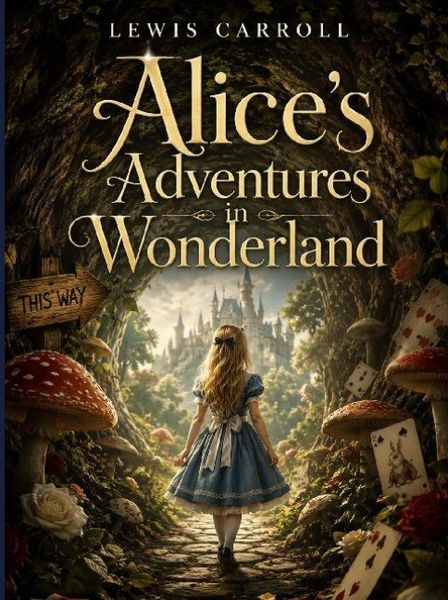
Alice's Adventures in Wonderland - Original English Version by Lewis Carroll
-
- Englisch ausgewählt
Fr. 26.90
inkl. gesetzl. MwSt.,
-
Kostenlose Lieferung ab Fr. 30 Einkaufswert
Schweiz & Liechtenstein:
Versandkostenfrei ab Fr. 30.00
Versandkosten bis Fr. 30.00: Fr. 3.50Andere Lieferländer
Fr. 18.00 unabhängig vom Warenwert
Beschreibung
Produktdetails
Einband
Taschenbuch
Erscheinungsdatum
07.02.2023
Verlag
CultureaSeitenzahl
136
Maße (L/B/H)
22/17/0.8 cm
Gewicht
224 g
Auflage
1. Tirage
Sprache
Englisch
ISBN
979-10-419-2400-4
Alice's Adventures in Wonderland is a novel written by English author Lewis Carroll (the pseudonym of Charles Lutwidge Dodgson), first published in 1865 by Macmillan and Co. The story centres on a young girl named Alice who falls through a rabbit hole into a subterranean fantasy world populated by peculiar, anthropomorphic creatures. The book is considered a prime example of the literary nonsense genre, playing heavily with logic, language, and mathematics. The original English version is structured into twelve distinct chapters, each introducing scenarios and characters that have become deeply ingrained in global literature. The narrative begins with "Down the Rabbit-Hole", where Alice, sitting bored by a riverbank, spots a White Rabbit with a pocket watch. Following him, she falls into a strange hall with locked doors, setting the stage for a series of size-altering transformations after consuming mysterious foods and drinks. In "The Pool of Tears", she shrinks and interacts with a Mouse and other animals, leading to "A Caucus-Race and a Long Tale", a satirical take on politics where everyone wins and receives prizes. The subsequent chapters---"The Rabbit Sends in a Little Bill", "Advice from a Caterpillar", and "Pig and Pepper"---introduce encounters with the hookah-smoking Caterpillar who advises her on mushroom consumption to control her size, and the Duchess, whose baby turns into a pig amidst a chaotic kitchen involving a pepper-heavy soup and the grinning Cheshire Cat. The seventh chapter, "A Mad Tea-Party", features Alice engaging in frustrating, riddle-filled conversations with the March Hare, the Hatter, and the Dormouse. This leads to "The Queen's Croquet-Ground", where Alice meets the tyrannical Queen of Hearts, who frequently sentences characters to beheading. The croquet game itself is absurd, played with live flamingos as mallets and hedgehogs as balls. In "The Mock Turtle's Story" and "The Lobster Quadrille", Alice is introduced to the Gryphon and the weeping Mock Turtle, who share melancholic songs and memories of their underwater schooling. The climax occurs in chapters eleven and twelve, "Who Stole the Tarts?" and "Alice's Evidence", depicting a nonsensical trial over stolen pastries, which ultimately ends with Alice realizing the characters are merely a pack of cards, awakening back on the riverbank. The text integrates poems and parodies of contemporary Victorian songs, such as "How Doth the Little Crocodile", "You Are Old, Father William", and "Twinkle, Twinkle, Little Bat". John Tenniel's original illustrations have remained intrinsically linked to Carroll's text. The work holds historical value, marking a transition in children's literature from purely didactic and moralistic tales to literature intended for entertainment and imaginative engagement. The book remains a foundational text in the fantasy genre. The origins of Alice's Adventures in Wonderland trace back to a boat trip taken on July 4, 1862, by Dodgson, Reverend Robinson Duckworth, and the three Liddell sisters: Lorina, Alice, and Edith. During the journey on the River Thames from Oxford to Godstow, Dodgson entertained the children with a story about a girl seeking adventure. Alice Liddell requested that he write it down, leading to the creation of the manuscript titled 'Alice's Adventures Under Ground', which Dodgson eventually expanded and prepared for publication as the widely known 1865 version.
Noch keine Bewertungen vorhanden
Verfassen Sie die erste Bewertung zu diesem Artikel
Helfen Sie anderen Kundinnen und Kunden durch Ihre Meinung.