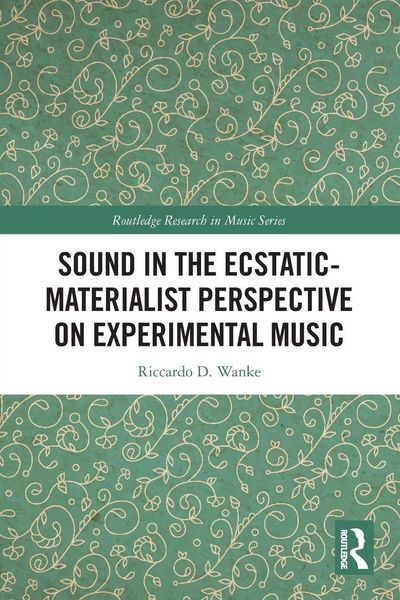

• Produktbild: Sound in the Ecstatic-Materialist Perspective on Experimental Music
  • Produktbild: Sound in the Ecstatic-Materialist Perspective on Experimental Music

Sound in the Ecstatic-Materialist Perspective on Experimental Music

Fr. 73.90

inkl. gesetzl. MwSt., Versandkostenfrei


Beschreibung

Produktdetails

Einband

Taschenbuch

Erscheinungsdatum

31.05.2023

Abbildungen

schwarz-weiss Illustrationen, Raster, schwarz-weiss, Zeichnungen, schwarz-weiss

Verlag

Taylor & Francis

Seitenzahl

176

Maße (L/B/H)

23.4/15.6/1 cm

Gewicht

260 g

Sprache

Englisch

ISBN

978-0-367-67700-8

Beschreibung

Produktdetails

Einband

Taschenbuch

Erscheinungsdatum

31.05.2023

Abbildungen

schwarz-weiss Illustrationen, Raster, schwarz-weiss, Zeichnungen, schwarz-weiss

Verlag

Taylor & Francis

Seitenzahl

176

Maße (L/B/H)

23.4/15.6/1 cm

Gewicht

260 g

Sprache

Englisch

ISBN

978-0-367-67700-8

Herstelleradresse

Libri GmbH
Europaallee 1
36244 Bad Hersfeld
DE

Email: gpsr@libri.de

Kundinnen und Kunden meinen

0 Bewertungen

Informationen zu Bewertungen

Zur Abgabe einer Bewertung ist eine Anmeldung im Konto notwendig. Die Authentizität der Bewertungen wird von uns nicht überprüft. Wir behalten uns vor, Bewertungstexte, die unseren Richtlinien widersprechen, entsprechend zu kürzen oder zu löschen.

Die Bewertungen sind nach Format, Anzahl Sterne und Datum sortiert.

Verfassen Sie die erste Bewertung zu diesem Artikel

Helfen Sie anderen Kund*innen durch Ihre Meinung

Kundinnen und Kunden meinen

0 Bewertungen filtern

Die Leseprobe wird geladen.
  • Produktbild: Sound in the Ecstatic-Materialist Perspective on Experimental Music
  • Produktbild: Sound in the Ecstatic-Materialist Perspective on Experimental Music
  • Introduction

    A multifaceted approach

    Overview

    Remarks and limitations

    Notes

    1 Sound in 20th-century music

    Scelsi and the centrality of sound

    Key aspects of sound in the ecstatic-materialist perspective

    From music to sound

    From the beginning of the century up to 1980: a plural emancipation

    Spectral line

    Minimalist line

    Musique concrète and avant-garde lines

    From the 1980s onwards: a non-linear expansion

    Sonic map

    Case studies: selection of pieces

    Closing remarks

    Notes

    2 Morphology and structure of musical works

    Starting points of the analysis

    Sequential method

    Step 1: Identification of common characteristics and morphologies

    Step 2: Identification of common developments (unfolding structures)

    Results

    Low-level attributes

    (A) An expanded spectrum

    (B) Microtonal variations

    (C) Systematic glissandi

    (D) Rhythmic development

    (E) Static masses

    (F) Repetitive clusters

    (G) Dynamic and timbric contrasts

    High-level attributes

    (H) Hypnotic reiterations

    (I) A plastic and sculptural arrangement of sound

    (J) Restricted number of elements conceived globally

    (K) Limited dialectic among elements

    (L) Sonic challenges

    (M) Micro-/macroconstructions

    Specific piece: in vain

    Perceptual grammar

    Closing remarks

    Notes

    3 Listening

    Listening to experimental music

    The experimental music blind spot in studies on musical perception

    The auditory process of E-M music

    Early-stage perception

    Late-stage perception

    Listening survey

    Results

    Music training discrimination

    Cross-genre connections

    Modes of listening

    The internal-external immanent domain

    Towards a multifaceted listening mode

    The aesthetic attitude

    Closing remarks

    Notes

    4 Composers and performers

    Dialogues

    Musical contexts and genres

    Perception and the space of listening

    Compositional practice

    Sound and time

    Closing remarks

    Notes

    5 The ecstatic-materialist perspective

    The ecstatic and the materialist

    Phenomenological materiality: the imprint of sound

    Ecstatic potential: sound-as-trace

    External-internal

    Sound in the ecstatic-materialist perspective

    Unity

    Unstable presence

    Coherence and convergence

    Personality and intention

    Intimate temporality and repetition

    Space-matter: the materiality of space in sound

    Vertical time: the ecstatic potential of space-matter

    Musical communication

    Closing remarks

    Notes

    6 Going beyond sound-in-itself

    The conceptual and the sensorial-perceptual paradigms

    Sonic materialism and the philosophical debate around sound

    The materiality of the ecstatic-materialist perspective

    The proximal hypothesis: the material presence of space-matter

    The embodied cognitive level

    Going beyond sound through sound

    Notes

    7 Epilogue: The ecstatic-materialist perspective in context

    The ecstatic-materialist context

    Empowered listening

    Closing remarks

    Notes

    Discography

    Bibliography

    Glossary

    Index