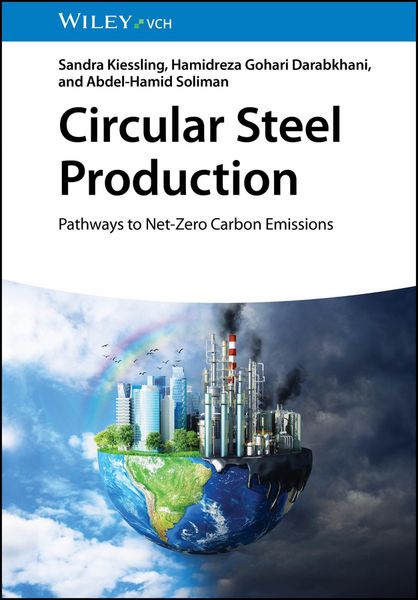
Circular Steel Production Pathways to Net-Zero Carbon Emissions
-
- Englisch ausgewählt
Fr. 190.00
inkl. gesetzl. MwSt.,
Beschreibung
Produktdetails
Einband
Gebundene Ausgabe
Erscheinungsdatum
04.03.2026
Abbildungen
farbige Illustrationen
Verlag
Wiley-VCHSeitenzahl
512
Maße (L/B/H)
25.1/17.9/3.2 cm
Gewicht
1127 g
Auflage
1. Auflage
Sprache
Englisch
ISBN
978-3-527-35315-6
State-of-the-art, multidisciplinary guide delivering pathways to net-zero carbon emissions in steel production and circular resource flow through the Bio Steel Cycle
Circular Steel Production introduces the concept of the Bio Steel Cycle, exploring several innovative research directions in the field of carbon avoidance, utilization, and sequestration of carbon emissions in steel manufacturing. Carbon emission avoidance and reduction processes and projects are investigated in great detail within the workings of the Bio Steel Cycle model, covering technologies such as Geomimetic, GrInHy2.0, H2Future, HYBRIT, ULCOWIN, DAC, CEPS, COREX, MIDREX, TGRBF, HISARNA, Everest, ReclaMet, Athos, HDR/HDRI, and many others.
The circular flow of various resources as one of the key elements of the Bio Steel Cycle are explained in detail, with approximately 50 different methods summarized, along with skill sets required for effective implementation of these methods. Most of the green steel projects within the EU and beyond which are currently underway are also commented upon. The opportunities for green steel (by country) are discussed in some detail, as well as the nationally determined contributions, the effects of implemented policy and decarbonisation efforts.
Written by a team of experts with many years of industry experience, Circular Steel Production provides in-depth coverage of topics including:
* Raw materials including iron ore, coal, and lime, and blast furnace, oxygen furnace, and electric arc furnace operation and the level of CO2 emissions along the production pathway for each resource required for the steelmaking process
* Anaerobic digestion, sewage treatment, and geothermal units, CO2 avoidance, capture, and utilisation mechanisms, and renewable energy technology utilization
* Wind, solar, and hydro power, biogas, biomass, and hydrogen, and the opportunities of greater energy independence via sustainable steel production
* The future of green steel in various countries including the UK, the USA, Brazil, and India
* Ideal timeline of possible adoption of the Bio Steel Cycle model and strategy in the realms of politics, investments, and infrastructure
Circular Steel Production is an essential forward-thinking reference on the subject for professionals in the steel and manufacturing industries, academia, materials scientists, environmental chemists, engineers and engineering students, and metallurgists.
Circular Steel Production introduces the concept of the Bio Steel Cycle, exploring several innovative research directions in the field of carbon avoidance, utilization, and sequestration of carbon emissions in steel manufacturing. Carbon emission avoidance and reduction processes and projects are investigated in great detail within the workings of the Bio Steel Cycle model, covering technologies such as Geomimetic, GrInHy2.0, H2Future, HYBRIT, ULCOWIN, DAC, CEPS, COREX, MIDREX, TGRBF, HISARNA, Everest, ReclaMet, Athos, HDR/HDRI, and many others.
The circular flow of various resources as one of the key elements of the Bio Steel Cycle are explained in detail, with approximately 50 different methods summarized, along with skill sets required for effective implementation of these methods. Most of the green steel projects within the EU and beyond which are currently underway are also commented upon. The opportunities for green steel (by country) are discussed in some detail, as well as the nationally determined contributions, the effects of implemented policy and decarbonisation efforts.
Written by a team of experts with many years of industry experience, Circular Steel Production provides in-depth coverage of topics including:
* Raw materials including iron ore, coal, and lime, and blast furnace, oxygen furnace, and electric arc furnace operation and the level of CO2 emissions along the production pathway for each resource required for the steelmaking process
* Anaerobic digestion, sewage treatment, and geothermal units, CO2 avoidance, capture, and utilisation mechanisms, and renewable energy technology utilization
* Wind, solar, and hydro power, biogas, biomass, and hydrogen, and the opportunities of greater energy independence via sustainable steel production
* The future of green steel in various countries including the UK, the USA, Brazil, and India
* Ideal timeline of possible adoption of the Bio Steel Cycle model and strategy in the realms of politics, investments, and infrastructure
Circular Steel Production is an essential forward-thinking reference on the subject for professionals in the steel and manufacturing industries, academia, materials scientists, environmental chemists, engineers and engineering students, and metallurgists.
Noch keine Bewertungen vorhanden
Verfassen Sie die erste Bewertung zu diesem Artikel
Helfen Sie anderen Kundinnen und Kunden durch Ihre Meinung.