Band 12
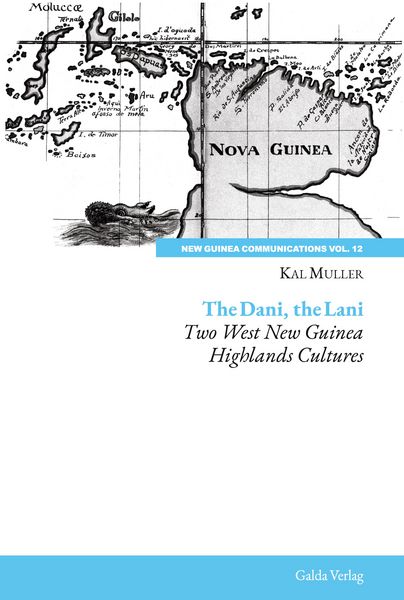
The Dani, the Lani Two West Guinea Highlands Cultures
Aus der Reihe
New Guinea Communications
-
- Taschenbuch ausgewählt
- eBook
-
Sprache:Englisch
Fr. 67.90
inkl. gesetzl. MwSt.,
Beschreibung
Produktdetails
Einband
Taschenbuch
Erscheinungsdatum
20.03.2023
Verlag
Galda VerlagSeitenzahl
264
Maße (L/B/H)
23/15.5/1.7 cm
Gewicht
444 g
Auflage
1. Auflage
Sprache
Englisch
ISBN
978-3-96203-263-0
The Dani group, centered in the Baliem Valley, has long taken the world’s attention. It is by far the best-known ethnic group in West New Guinea, ever since its discovery by the aptly named American explorer Richard Archbold in 1938. While some Dutch groups had passed close by during previous nears, none had seen the valley itself with its high population of 50,000 to 100,000. The flat, fertile valley bottom was expertly farmed with irrigation and drainage in geometrically laid out fields of raised mounds that produced bumper crops of sweet potatoes. The Dani group was discovered when Archbold flew his hydroplane overhead and was suitably impressed by the gardens beautiful, orderly layout. He also saw some mysterious tall erections dispersed in several areas on the flat land.
These structures turned out to be watchtowers, ready to alert the nearby inhabitants of the approach of a hostile group. For large-scale warfare was the way of life in the Baliem. Divided into several large alliances, hostilities were never-ending, punctured by short periods of relative peace. After the Archbold Expedition left the valley, the next visitors were American Evangelical missionaries who landed on the Baliem River in their new hydroplane. They established a base there and began proselytizing a full two years before the Dutch opened their first post there. A few years later, an American filming expedition from Harvard University was able to film the daily life as well as some actual battles, fought with spears, bows and arrows. The film, Dead Birds, was screened to many audiences in the US and elsewhere.
The missionaries among the Dani were not very successful. This was in stark contrast with the Lani (also called Western Dani) who lived in the northernmost part of the Baliem Valley and spread far toward the east in West New Guinea’s central highlands. They had been successfully proselytized by American Evangelicals based in Enarotali, on the shore of Lake Paniai. The Lani had migrated from the east towards the west probably due to population pressures and thinly inhabited lands. They had not been satisfied by their traditional religion that did not provide material goods such as those enjoyed by the missionaries. After only a few years, they became Christians and burned their old fetiches to show their commitment to the new religion.
These structures turned out to be watchtowers, ready to alert the nearby inhabitants of the approach of a hostile group. For large-scale warfare was the way of life in the Baliem. Divided into several large alliances, hostilities were never-ending, punctured by short periods of relative peace. After the Archbold Expedition left the valley, the next visitors were American Evangelical missionaries who landed on the Baliem River in their new hydroplane. They established a base there and began proselytizing a full two years before the Dutch opened their first post there. A few years later, an American filming expedition from Harvard University was able to film the daily life as well as some actual battles, fought with spears, bows and arrows. The film, Dead Birds, was screened to many audiences in the US and elsewhere.
The missionaries among the Dani were not very successful. This was in stark contrast with the Lani (also called Western Dani) who lived in the northernmost part of the Baliem Valley and spread far toward the east in West New Guinea’s central highlands. They had been successfully proselytized by American Evangelicals based in Enarotali, on the shore of Lake Paniai. The Lani had migrated from the east towards the west probably due to population pressures and thinly inhabited lands. They had not been satisfied by their traditional religion that did not provide material goods such as those enjoyed by the missionaries. After only a few years, they became Christians and burned their old fetiches to show their commitment to the new religion.
Kundinnen und Kunden meinen
Verfassen Sie die erste Bewertung zu diesem Artikel
Helfen Sie anderen Kund*innen durch Ihre Meinung