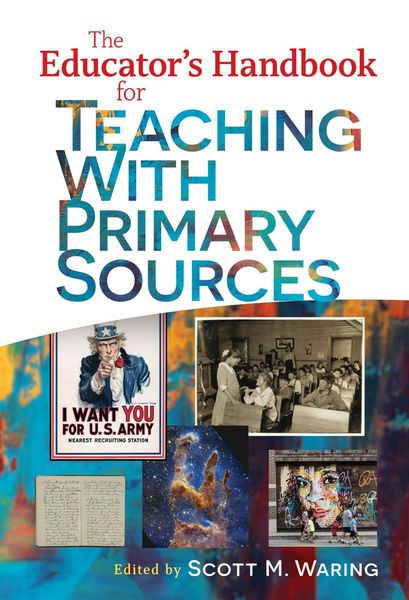
The Educator's Handbook for Teaching with Primary Sources
-
- Englisch ausgewählt
Fr. 68.90
inkl. gesetzl. MwSt.,
Beschreibung
Produktdetails
Einband
Taschenbuch
Erscheinungsdatum
27.10.2023
Herausgeber
Scott M. WaringVerlag
Teachers College PressSeitenzahl
256
Maße (L/B/H)
27.7/21.3/1.5 cm
Gewicht
612 g
Sprache
Englisch
ISBN
978-0-8077-6908-9
Educators across subject areas are striving to integrate primary sources into their pedagogy and teaching. Yet, despite their importance to authentic disciplined inquiry, the implementation of primary source activities in the pre-K-12 classroom has been limited. This lack of utilization can largely be attributed to the perception that these activities are too complex to design, implement, and grade. Many teachers also feel that primary source analysis and the construction of evidence-based narratives is too difficult for students to complete in the traditional classroom. Waring argues that this is not the case and, with this handbook, provides teacher candidates and inservice teachers with detailed and specific perspectives, activities, approaches, and resources to help them effectively and authentically use primary sources in their classrooms.
Book Features:
- Introduces teaching with primary sources, including detailed examples of authentic and tested instructional ideas and approaches.
- Designed to meet the needs of classroom teachers and teacher candidates in social studies, English and language arts, mathematics, science, and other fields.
- Offers dozens of primary sources and links to resources throughout the book.
- Aligns to national standards, frameworks, and the C3 framework for social studies.
- Can be used to meet the needs of emerging English learners and students with special needs.
- Focuses on ways in which educators are utilizing a variety of emerging technologies to engage students in deeper and more authentic ways of learning.
Noch keine Bewertungen vorhanden
Verfassen Sie die erste Bewertung zu diesem Artikel
Helfen Sie anderen Kundinnen und Kunden durch Ihre Meinung.