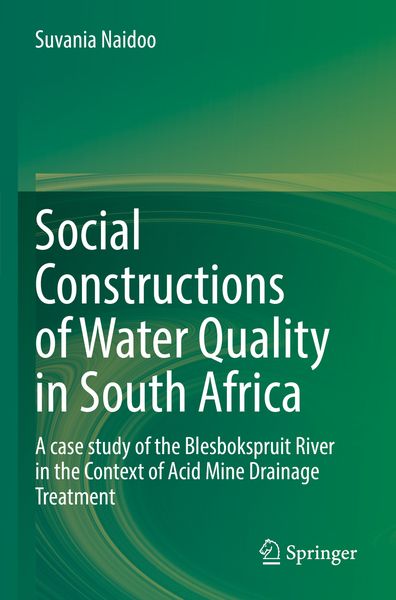
Social Constructions of Water Quality in South Africa A case study of the Blesbokspruit River in the Context of Acid Mine Drainage Treatment
-
- Hardcover
- Taschenbuch ausgewählt
- eBook
-
Sprache:Englisch
Fr. 181.00
inkl. gesetzl. MwSt.,
Beschreibung
Produktdetails
Einband
Taschenbuch
Erscheinungsdatum
06.05.2023
Verlag
SpringerSeitenzahl
219
Maße (L/B/H)
23.5/15.5/1.4 cm
Gewicht
371 g
Auflage
1st ed. 2022
Sprache
Englisch
ISBN
978-3-030-98239-3
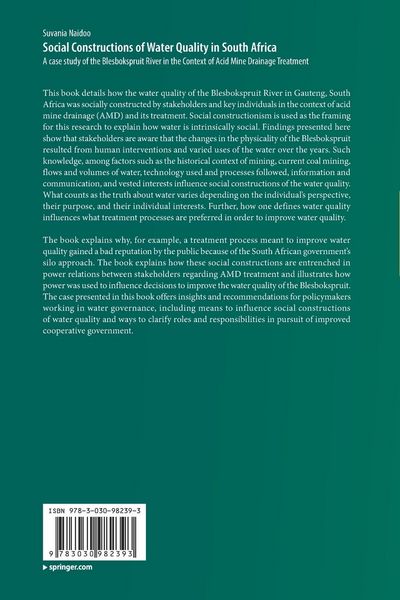
This book details how the water quality of the Blesbokspruit River in Gauteng, South Africa was socially constructed by stakeholders and key individuals in the context of acid mine drainage (AMD) and its treatment. Social constructionism is used as the framing for this research to explain how water is intrinsically social. Findings presented here show that stakeholders are aware that the changes in the physicality of the Blesbokspruit resulted from human interventions and varied uses of the water over the years. Such knowledge, among factors such as the historical context of mining, current coal mining, flows and volumes of water, technology used and processes followed, information and communication, and vested interests influence social constructions of the water quality. What counts as the truth about water varies depending on the individual’s perspective, their purpose, and their individual interests. Further, how one defines water quality influences what treatment processes arepreferred in order to improve water quality.
The book explains why, for example, a treatment process meant to improve water quality gained a bad reputation by the public because of the South African government’s silo approach. The book explains how these social constructions are entrenched in power relations between stakeholders regarding AMD treatment and illustrates how power was used to influence decisions to improve the water quality of the Blesbokspruit. The case presented in this book offers insights and recommendations for policymakers working in water governance, including means to influence social constructions of water quality and ways to clarify roles and responsibilities in pursuit of improved cooperative government.
Noch keine Bewertungen vorhanden
Verfassen Sie die erste Bewertung zu diesem Artikel
Helfen Sie anderen Kundinnen und Kunden durch Ihre Meinung.