
Distributed Coordination Theory for Robot Teams
-
- Hardcover
- Taschenbuch ausgewählt
- eBook
-
Sprache:Englisch
Fr. 171.00
inkl. gesetzl. MwSt.,
Beschreibung
Produktdetails
Einband
Taschenbuch
Erscheinungsdatum
17.05.2023
Verlag
SpringerSeitenzahl
149
Maße (L/B/H)
23.5/15.5/1 cm
Gewicht
260 g
Auflage
1st ed. 2022
Sprache
Englisch
ISBN
978-3-030-96089-6
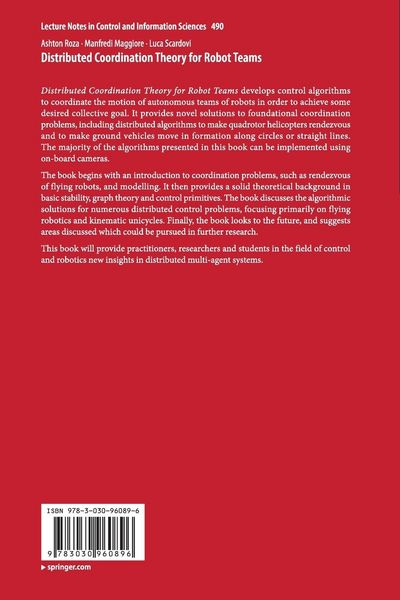
Distributed Coordination Theory for Robot Teams develops control algorithms to coordinate the motion of autonomous teams of robots in order to achieve some desired collective goal. It provides novel solutions to foundational coordination problems, including distributed algorithms to make quadrotor helicopters rendezvous and to make ground vehicles move in formation along circles or straight lines. The majority of the algorithms presented in this book can be implemented using on-board cameras.
The book begins with an introduction to coordination problems, such as rendezvous of flying robots, and modelling. It then provides a solid theoretical background in basic stability, graph theory and control primitives. The book discusses the algorithmic solutions for numerous distributed control problems, focusing primarily on flying robotics and kinematic unicycles. Finally, the book looks to the future, and suggests areas discussed which could be pursued in further research.This book will provide practitioners, researchers and students in the field of control and robotics new insights in distributed multi-agent systems.
Kundinnen und Kunden meinen
Verfassen Sie die erste Bewertung zu diesem Artikel
Helfen Sie anderen Kund*innen durch Ihre Meinung