Produktbild: Ultra-Weak Photon Emission from Biological Systems

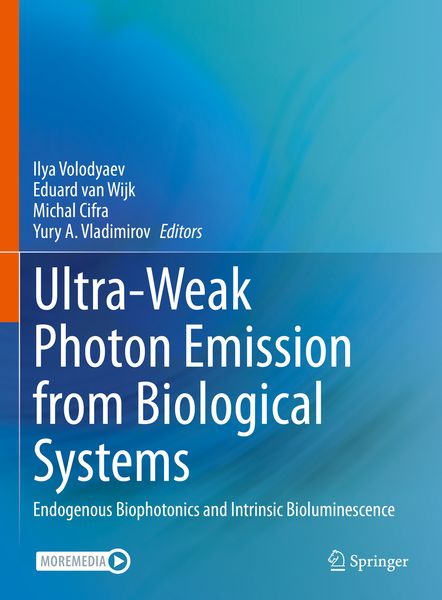
Ultra-Weak Photon Emission from Biological Systems Endogenous Biophotonics and Intrinsic Bioluminescence

Fr. 419.00

inkl. gesetzl. MwSt., Versandkostenfrei


Beschreibung

Produktdetails

Einband

Gebundene Ausgabe

Erscheinungsdatum

14.12.2023

Herausgeber

Ilya Volodyaev + weitere

Verlag

Springer

Seitenzahl

521

Maße (L/B/H)

28.5/21.5/3.5 cm

Gewicht

1545 g

Sprache

Englisch

ISBN

978-3-031-39077-7

Beschreibung

Portrait

Ilya Volodyaev is a senior researcher at the Embryology Department, Faculty of Biology, Moscow State University, Russia. He earned his Master’s degree in biophysics (2004) and PhD in embryology (2007) at Moscow State University and continued research in embryo development biophysics, combining it with clinical work. The current book relates to his interests in the field of biophysical research: biological autoluminescence, free radical processes and the hypothesis of non-chemical biological interactions.

Eduard van Wijk is senior scientist and co-founder of MeLuNa Research, Wageningen, The Netherlands. He did his PhD at the Institute for Cognition and Information, Radboud University Nijmegen. Following completion of this degree he was affiliated as senior researcher at the International Institute of Biophysics and later at the Leiden University. His research is on the application of biophotonics in predicting organism quality both in human and agricultural issues.

Michal Cifra is a senior scientist and Bioelectrodynamics research team leader at the Institute of Photonics and Electronics of the Czech Academy of Sciences. With his team, he explores the interactions between electromagnetic field and biosystems, which includes also generation of electromagnetic field by biosystems.

Yury A. Vladimirov is Professor of Moscow State University, Academician of the Russian Academy of Medical Sciences (since 1988), and Russian Academy of Sciences (since 2013). In 1959 he discovered biochemiluminescence from animal tissues and became an originator of ultraweak photon emission research in the present sense. He investigated lipid peroxidation mechanisms and kinetics, its role in pathological conditions and triggering apoptosis. Acad. Vladimirov has founded departments of medical biophysics in Russian National Research Medical University (1966) and Moscow State University (1992) and is frequently referred to as the founder of medical biophysics in Russia.

Produktdetails

Einband

Gebundene Ausgabe

Erscheinungsdatum

14.12.2023

Herausgeber

Verlag

Springer

Seitenzahl

521

Maße (L/B/H)

28.5/21.5/3.5 cm

Gewicht

1545 g

Sprache

Englisch

ISBN

978-3-031-39077-7

Herstelleradresse

Springer-Verlag GmbH
Tiergartenstr. 17
69121 Heidelberg
DE

Email: ProductSafety@springernature.com

Kundinnen und Kunden meinen

0 Bewertungen

Informationen zu Bewertungen

Zur Abgabe einer Bewertung ist eine Anmeldung im Konto notwendig. Die Authentizität der Bewertungen wird von uns nicht überprüft. Wir behalten uns vor, Bewertungstexte, die unseren Richtlinien widersprechen, entsprechend zu kürzen oder zu löschen.

Die Bewertungen sind nach Format, Anzahl Sterne und Datum sortiert.

Verfassen Sie die erste Bewertung zu diesem Artikel

Helfen Sie anderen Kund*innen durch Ihre Meinung

Kundinnen und Kunden meinen

0 Bewertungen filtern

  • Produktbild: Ultra-Weak Photon Emission from Biological Systems
  • Introduction.- Part 1. History of UPE research.- Mitogenetic rays.- Oxidation, free-radicals and ultraweak luminescence.- Biophotons and the International Institute of Biophysics (IIB).- Part 2. Physics of light and light research.- Physics of photon emission.- Chemiluminescence as a tool for free radical research.- Highly sensitive imaging and spectral analysis of UPE from biological systems and their application.- Part 3. Molecular mechnisms of UPE.- Free radicals in biology.- Ultraweak luminescence from aqueous systems.- Chemiluminescence in oxidation of hydrocarbons: mechanistic fundamentals.- Chemiluminescence in oxidation of fatty acids and lipids.- Chemiluminescence in protein oxidation.- Emitters of endogenous biological chemiluminescence: quantum chemical modeling insights.- Enzymatic sources of free radicals.- Part 4. UPE research in life science.- Luminescence of animal tissues and vegetable oils.- Ultraweak photon emission from human body in relation to anatomy and histology.- Chronobiological aspects of spontaneous ultra-weak photon emission in humans: Ultradian, circadian and infradian rhythms.- Autoluminescence in seedlings: applications.- Application potentiality of Delayed Luminescence in Medicine, Biology and Food Quality researches.- Part 5. Mitogenetic effect and related phenomena: unresolved problems of UPE.- Mitogenetic effect: preface.- Mitogenetic effect in biological systems.- Physical properties of mitogenetic radiation.- Secondary, degradation and necrobiotic radiation.- Mitogenetic research in medicine: radiation of blood and cancer diagnostics.- Part 6. Non-chemical distant interaction hypothesis - pro et contra.- Non-chemical distant interaction: preface.- The possible functions of electromagnetic cell communication.- Understanding of Fritz-Albert Popp's biophoton theory from the viewpoint of a biologist.- Limits to the information transfer through UPE.- Quantum nonlocality and biological coherence.- Part 7. Perspectives.- Integrating ultraweak photon emission in mitochondrial research.- Selected biophysical methods for enhancing biological autoluminescence.- Upconverting nanoparticles as sources of singlet oxygen.- Upconverting nanoparticles as sources of singlet oxygen.- Delayed Luminescence as a tool to study the structures of systems of biological interest and their collective long-living excited states.- Index.