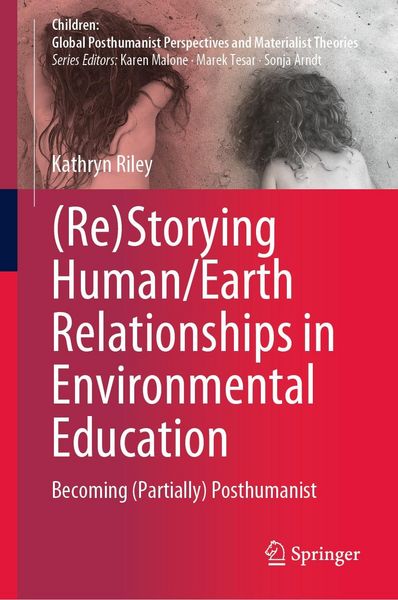
(Re)Storying Human/Earth Relationships in Environmental Education Becoming (Partially) Posthumanist
-
- Hardcover
- Taschenbuch
- eBook ausgewählt
-
Form:Einzelkauf Download
-
Sprache:Englisch
Fr. 175.90
inkl. gesetzl. MwSt.Beschreibung
Produktdetails
Format
Kopierschutz
Nein
Family Sharing
Nein
Text-to-Speech
Nein
Erscheinungsdatum
21.06.2023
Verlag
Springer Nature SingaporeSeitenzahl
124 (Printausgabe)
Dateigröße
4501 KB
Sprache
Englisch
EAN
9789819925872
This book is situated in the simultaneous thinking (theory) and doing (action) of posthumanist performativity and new materialist methodologies to bring forth a multitude of stories that demonstrate co-constituted and co-implicated worldmaking practices.
It is written in response to the fact that our Earth is at a critical juncture. As atmospheric temperatures rise and cast unprecedented and wide-spread social and ecological crises across the planet, social and ecological injustices and threats cannot be separated from globalising, neoliberal, capitalist, and colonial discourses that proliferate through anthropocentric and humancentric logics. Manifesting in binary classifications that position the human as separate from the Earth, and dominant categories of the human in hierarchies of power, such logics homogenise and institutionalise the field of environmental education and result in an over-emphasis on instrumentalist, technicist, and mechanistic teaching and learning practices.
Exploring the affects emerging within, and between, an assemblage comprising Researcher/Teacher/Environmental Education Worldings, this book seeks to understand how the researcher makes sense of herself with/in the broader ecologies of the world; collaborative processes with an elementary-school teacher in Saskatchewan, Canada, as actualised through four co-created and co-implemented multisensory researcher/teacher enactments (Mindful Walking, Mapping Worlds, Eco-art Installation, and Photographic Encounters); and how the researcher/teacher organises themselves with Land-based pedagogies, environmental education curriculum policy, and wider discourses of Western education. This book does not propose a better way of teaching and learning in environmental education. Rather, showing how difference between categories is relationally bound, this book offers a conceptual (re)storying of human/Earth relationships in environmental education for social and ecologicaljustice in these times of the Anthropocene.
Kundinnen und Kunden meinen
Verfassen Sie die erste Bewertung zu diesem Artikel
Helfen Sie anderen Kund*innen durch Ihre Meinung