• Produktbild: Authoritarian Practices and Humanitarian Negotiations
  • Produktbild: Authoritarian Practices and Humanitarian Negotiations

Authoritarian Practices and Humanitarian Negotiations

Fr. 73.90

inkl. gesetzl. MwSt., Versandkostenfrei


Beschreibung

Produktdetails

Einband

Taschenbuch

Erscheinungsdatum

07.12.2023

Abbildungen

schwarz-weiss Illustrationen, Raster, schwarz-weiss, Tabellen, schwarz-weiss

Herausgeber

Andrew J. Cunningham

Verlag

Taylor & Francis

Seitenzahl

274

Maße (L/B/H)

23.4/15.6/1.5 cm

Gewicht

340 g

Sprache

Englisch

ISBN

978-1-03-232679-5

Beschreibung

Rezension

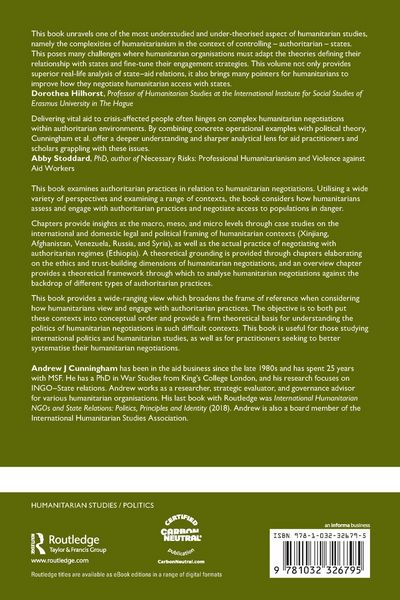
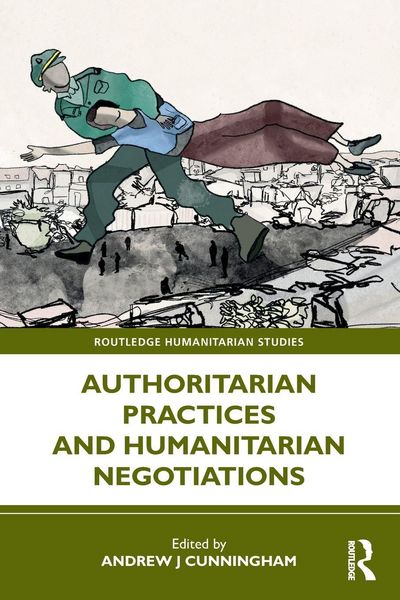
This book unravels one of the most understudied and under-theorised aspect of humanitarian studies, namely the complexities of humanitarianism in the context of controlling - authoritarian - states. This poses many challenges where humanitarian organisations must adapt the theories defining their relationship with states and fine-tune their engagement strategies. This volume not only provides superior real-life analysis of state-aid relations, it also brings many pointers for humanitarians to improve how they negotiate humanitarian access with states.

Dorothea Hilhorst, Professor of Humanitarian Studies at the International Institute for Social Studies of Erasmus University in The Hague

Delivering vital aid to crisis-affected people often hinges on complex humanitarian negotiations within authoritarian environments. By combining concrete operational examples with political theory, Cunningham et al. offer a deeper understanding and sharper analytical lens for aid practitioners and scholars grappling with these issues.

Abby Stoddard, PhD, author of Necessary Risks: Professional Humanitarianism and Violence against Aid Workers

Charged with urgently saving in extremis, international humanitarian actors are often criticised as 'state avoiding' as they so often substitute, and undermine, state responsibilities. Yet, the reality is that the very presence, access and actions of aid actors in any country is predicated on challenging negotiations with often difficult authorities. This book offers an extraordinary insight into state-INGO negotiations to access communities at risk in some of the world's most hard-to-reach contexts: Afghanistan, Ethiopia, China, Russia and Syria. Pairing insights from international experts with critical insights from academics, this book spans conceptual theory, real-world experience and ethical dilemmas in some of the toughest places. It's a must read for practitioners, policy makers and academics working on humanitarian action today.

Sorcha O'Callaghan, Director, Humanitarian Policy Group, ODI


This book is designed to help humanitarian workers who are active in authoritarian states as they navigate ethical dilemmas, negotiate amidst uncertainty and make difficult choices on behalf of those they serve.  Its case studies will be especially valued.   

Sir David Nabarro, Strategic Director 4SD Foundation, Geneva Switzerland
Produktdetails

Einband

Taschenbuch

Erscheinungsdatum

07.12.2023

Abbildungen

schwarz-weiss Illustrationen, Raster, schwarz-weiss, Tabellen, schwarz-weiss

Herausgeber

Andrew J. Cunningham

Verlag

Taylor & Francis

Seitenzahl

274

Maße (L/B/H)

23.4/15.6/1.5 cm

Gewicht

340 g

Sprache

Englisch

ISBN

978-1-03-232679-5

Herstelleradresse

Libri GmbH
Europaallee 1
36244 Bad Hersfeld
DE

Email: gpsr@libri.de

Kundinnen und Kunden meinen

0 Bewertungen

Informationen zu Bewertungen

Zur Abgabe einer Bewertung ist eine Anmeldung im Konto notwendig. Die Authentizität der Bewertungen wird von uns nicht überprüft. Wir behalten uns vor, Bewertungstexte, die unseren Richtlinien widersprechen, entsprechend zu kürzen oder zu löschen.

Die Bewertungen sind nach Format, Anzahl Sterne und Datum sortiert.

Verfassen Sie die erste Bewertung zu diesem Artikel

Helfen Sie anderen Kund*innen durch Ihre Meinung

Kundinnen und Kunden meinen

0 Bewertungen filtern

Die Leseprobe wird geladen.
  • Produktbild: Authoritarian Practices and Humanitarian Negotiations
  • Produktbild: Authoritarian Practices and Humanitarian Negotiations
  • Introduction: Authoritarian practices and humanitarian negotiations 1. The friction of practice – reflecting on the Médecins Sans Frontières experience with ‘authoritarian regimes’ Commentary: Reflections on discourse 2. Humanitarian negotiation: Challenges and compromise in hard-to-reach areas Commentary: ‘Security reasons’ 3. The vocabulary of negotiations: Sovereignty and authoritarian arguments in the Security Council Commentary: A critique 4. The Xinjiang case and its implication for the rights debate in China: What role for NGOs and humanitarian negotiations? Commentary: A personal reflection on working in China 5. Daily negotiations with state agencies in the field – reflections from refugee camps in Western Ethiopia Commentary: Independence 6. Dilemmas of humanitarian negotiations with the rise of the Taliban in Afghanistan Commentary: A brief critical reflection on Afghanistan 7. Roma structural discrimination in contemporary Russia: Institutions involved and measures (not) taken Commentary: Different types, different responses 8. Humanitarian apparatus of silence: Authoritarian denial and aid assemblage in Venezuela Commentary: Between instrumentalisation, depoliticisation, and legitimation of humanitarian action in Venezuela 9. Mopping up, keeping down, and propping up: Ethical dilemmas in humanitarian negotiations with authoritarian regimes Conclusion: Theory and praxis – constructing the relationship between authoritarian practices and humanitarian negotiations