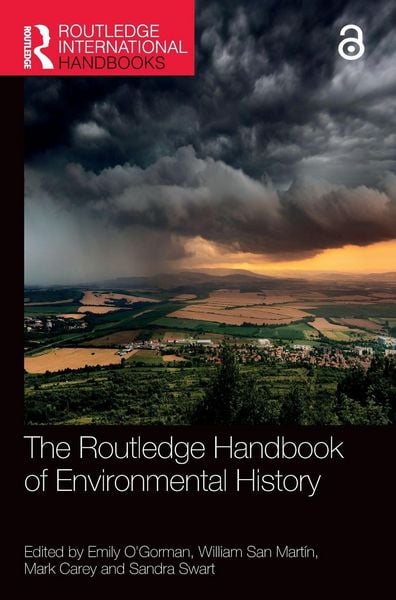
The Routledge Handbook of Environmental History
-
- Hardcover ausgewählt
- Taschenbuch
- eBook
-
Sprache:Englisch
Fr. 408.00
inkl. gesetzl. MwSt.,
Beschreibung
Produktdetails
Einband
Gebundene Ausgabe
Erscheinungsdatum
06.12.2023
Abbildungen
31 SW-Abb., 26 SW-Fotos, 5 SW-Zeichn., 2 Tabellen
Herausgeber
O'Gorman Emily + weitereVerlag
Taylor & FrancisSeitenzahl
480
Maße (L/B/H)
25/17.5/3 cm
Gewicht
1000 g
Sprache
Englisch
ISBN
978-1-03-200359-7
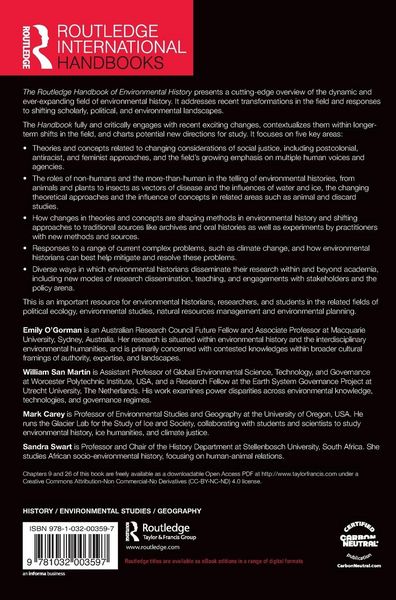
The Routledge Handbook of Environmental History presents a cutting-edge overview of the dynamic and ever-expanding field of environmental history. It addresses recent transformations in the field and responses to shifting scholarly, political, and environmental landscapes.
The handbook fully and critically engages with recent exciting changes, contextualizes them within longer-term shifts in the field, and charts potential new directions for study. It focuses on five key areas:
- Theories and concepts related to changing considerations of social justice, including postcolonial, antiracist, and feminist approaches, and the field's growing emphasis on multiple human voices and agencies.
- The roles of non-humans and the more-than-human in the telling of environmental histories, from animals and plants to insects as vectors of disease and the influences of water and ice, the changing theoretical approaches and the influence of concepts in related areas such as animal and discard studies.
- How changes in theories and concepts are shaping methods in environmental history and shifting approaches to traditional sources like archives and oral histories as well as experiments by practitioners with new methods and sources.
- Responses to a range of current complex problems, such as climate change, and how environmental historians can best help mitigate and resolve these problems.
- Diverse ways in which environmental historians disseminate their research within and beyond academia, including new modes of research dissemination, teaching, and engagements with stakeholders and the policy arena.
This is an important resource for environmental historians, researchers and students in the related fields of political ecology, environmental studies, natural resources management and environmental planning.
Noch keine Bewertungen vorhanden
Verfassen Sie die erste Bewertung zu diesem Artikel
Helfen Sie anderen Kundinnen und Kunden durch Ihre Meinung.