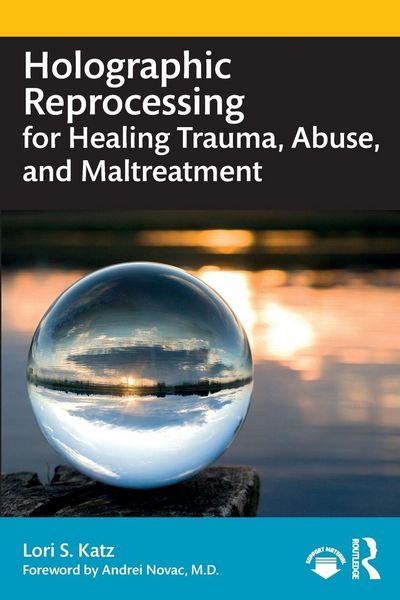
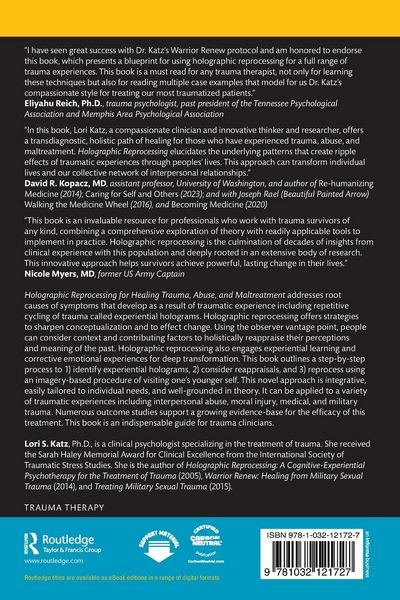
• Produktbild: Holographic Reprocessing for Healing Trauma, Abuse, and Maltreatment
  • Produktbild: Holographic Reprocessing for Healing Trauma, Abuse, and Maltreatment

Holographic Reprocessing for Healing Trauma, Abuse, and Maltreatment

Fr. 61.90

inkl. gesetzl. MwSt., Versandkostenfrei


Beschreibung

Produktdetails

Einband

Taschenbuch

Erscheinungsdatum

24.10.2023

Abbildungen

schwarz-weiss Illustrationen, Zeichnungen, schwarz-weiss, Tabellen, schwarz-weiss

Verlag

Taylor & Francis

Seitenzahl

258

Maße (L/B/H)

22.9/15.2/1.4 cm

Gewicht

360 g

Sprache

Englisch

ISBN

978-1-03-212172-7

Beschreibung

Rezension

"I have seen great success with Dr. Katz's Warrior Renew protocol and am honored to endorse this book, which presents a blueprint for using holographic reprocessing for a full range of trauma experiences. This book is a must read for any trauma therapist, not only for learning these techniques but also for reading multiple case examples that model for us Dr. Katz's compassionate style for treating our most traumatized patients."

Eliyahu Reich, PhD, trauma psychologist, past president of the Tennessee Psychological Association and Memphis Area Psychological Association

"In this book, Lori Katz, a compassionate clinician and innovative thinker and researcher, offers a transdiagnostic, holistic path of healing for those who have experienced trauma, abuse, and maltreatment. Holographic Reprocessing elucidates the underlying patterns that create ripple effects of traumatic experiences through peoples' lives. This approach can transform individual lives and our collective network of interpersonal relationships."

David R. Kopacz, MD, assistant professor, University of Washington, and author of Re-humanizing Medicine (2014); Caring for Self and Others (2023); and with Joseph Rael (Beautiful Painted Arrow) Walking the Medicine Wheel (2016), and Becoming Medicine (2020)

"This book is an invaluable resource for professionals who work with trauma survivors of any kind, combining a comprehensive exploration of theory with readily applicable tools to implement in practice. Holographic reprocessing is the culmination of decades of insights from clinical experience with this population and deeply rooted in an extensive body of research. This innovative approach helps survivors achieve powerful, lasting change in their lives."

Nicole Myers, MD, former US Army Captain

Produktdetails

Einband

Taschenbuch

Erscheinungsdatum

24.10.2023

Abbildungen

schwarz-weiss Illustrationen, Zeichnungen, schwarz-weiss, Tabellen, schwarz-weiss

Verlag

Taylor & Francis

Seitenzahl

258

Maße (L/B/H)

22.9/15.2/1.4 cm

Gewicht

360 g

Sprache

Englisch

ISBN

978-1-03-212172-7

Herstelleradresse

Libri GmbH
Europaallee 1
36244 Bad Hersfeld
DE

Email: gpsr@libri.de

Kundinnen und Kunden meinen

0 Bewertungen

Informationen zu Bewertungen

Zur Abgabe einer Bewertung ist eine Anmeldung im Konto notwendig. Die Authentizität der Bewertungen wird von uns nicht überprüft. Wir behalten uns vor, Bewertungstexte, die unseren Richtlinien widersprechen, entsprechend zu kürzen oder zu löschen.

Die Bewertungen sind nach Format, Anzahl Sterne und Datum sortiert.

Verfassen Sie die erste Bewertung zu diesem Artikel

Helfen Sie anderen Kund*innen durch Ihre Meinung

Kundinnen und Kunden meinen

0 Bewertungen filtern

Die Leseprobe wird geladen.
  • Produktbild: Holographic Reprocessing for Healing Trauma, Abuse, and Maltreatment
  • Produktbild: Holographic Reprocessing for Healing Trauma, Abuse, and Maltreatment
  • Section 1: Foundation for holographic reprocessing  1. Introduction to holographic reprocessing  2. Theoretical foundation  3. Neural networks and associative learning  4. Holograms and experiential holograms Section 2: Implementing holographic reprocessing  5. Initial session and preparation for treatment  6. Emotion regulation skills 7. Experiential discovery  8. Interpersonal experiential holograms  9. Other trauma-based experiential holograms  10. Considering context  11. Imagery reprocessing  12. Integration and moving forward  Section 3: Status in the field  13. Comparison to other trauma therapies  14. Current outcome research