Gutscheinbedingungen

*Gültig bis 07.06.2026 auf (fast) alles. Ausgeschlossen sind Smartboxen, Zeitschriften, Tickets, Lebensmittel, Gaming-Elektroartikel, Tinte/Toner, Gutscheine, Geschenkkarten, Blumen und Abos | Einlösbar in allen Buchhandlungen von Orell Füssli, Barth Bücher, Buchladen Rapunzel, Schuler Orell Füssli, Stauffacher und ZAP unter Vorweisung des Gutscheins, auf www.orellfüssli.ch durch Eingabe des Gutscheincodes. Beim Service „eBooks verschenken“ und bei eBook-Käufen via eReader nicht einlösbar | Mindesteinkaufswert: Fr. 100.- | Nicht mit anderen Rabatten kumulierbar.

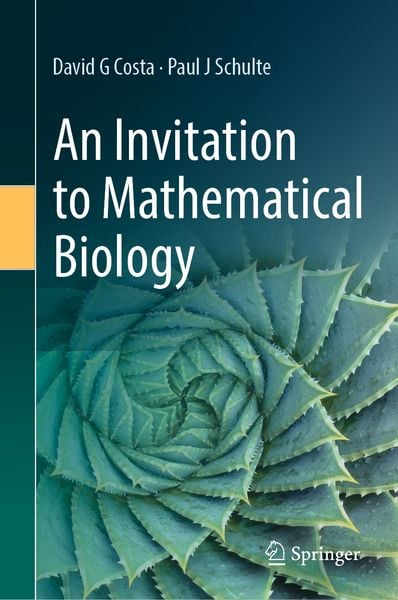
Produktbild: An Invitation to Mathematical Biology

An Invitation to Mathematical Biology

Fr. 137.00

inkl. gesetzl. MwSt., Versandkostenfrei


Beschreibung

Produktdetails

Einband

Gebundene Ausgabe

Erscheinungsdatum

02.10.2023

Verlag

Springer

Seitenzahl

124

Maße (L/B/H)

24.1/16/1.4 cm

Gewicht

377 g

Sprache

Englisch

ISBN

978-3-031-40257-9

Beschreibung

Rezension

“This very brief volume is designed for biology undergraduates with only a basic calculus background. … it is very self contained, with the appendixes providing the basics of standard numerical packages.” (Louis J. Gross, The Quarterly Review of Biology, Vol. 100 (1), March, 2025) 


“I think the authors have succeeded in their goal of providing an ‘invitation’ to mathematical biology. Not only can this book serve as a stepping stone to more comprehensive mathematical biology books, it also offers the reader a glimpse into a variety of topics that they can pursue in deeper detail later on if they are interested.” (Anita T. Layton, SIAM Review, Vol. 66 (3), August, 2024)

Produktdetails

Einband

Gebundene Ausgabe

Erscheinungsdatum

02.10.2023

Verlag

Springer

Seitenzahl

124

Maße (L/B/H)

24.1/16/1.4 cm

Gewicht

377 g

Sprache

Englisch

ISBN

978-3-031-40257-9

Herstelleradresse

Springer-Verlag GmbH
Tiergartenstr. 17
69121 Heidelberg
DE

Email: ProductSafety@springernature.com

Kundinnen und Kunden meinen

0 Bewertungen

Informationen zu Bewertungen

Zur Abgabe einer Bewertung ist eine Anmeldung im Konto notwendig. Die Authentizität der Bewertungen wird von uns nicht überprüft. Wir behalten uns vor, Bewertungstexte, die unseren Richtlinien widersprechen, entsprechend zu kürzen oder zu löschen.

Die Bewertungen sind nach Format, Anzahl Sterne und Datum sortiert.

Verfassen Sie die erste Bewertung zu diesem Artikel

Helfen Sie anderen Kund*innen durch Ihre Meinung

Kundinnen und Kunden meinen

0 Bewertungen filtern

  • Produktbild: An Invitation to Mathematical Biology
  • Preface.- 1 Introduction.- 2 Exponential Growth and Decay.- 2.1 Exponential Growth.- 2.2 Exponential Decay.- 2.3 Summary.- 2.4 Exercises.- 2.5 References- 3 Discrete Time Models.- 3.1 Solutions of the discrete logistic.- 3.2 Enhancements to the Discrete Logistic Function.- 3.3 Summary.- 3.4 Exercises.- 3.5 References- 4 Fixed Points, Stability, and Cobwebbing.- 4.1 Fixed Points and Cobwebbing.- 4.2 Linear Stability Analysis.- 4.3 Summary.- 4.4 Exercises.- 4.5 References- 5 Population Genetics Models.- 5.1 Two Phenotypes Case.- 5.2 Three Phenotypes Case.- 5.3 Summary.- 5.4 Exercises.- 5.5 References- 6 Chaotic Systems.- 6.1 Robert May’s Model.- 6.2 Solving the Model.- 6.3 Model Fixed Points.- 6.4 Summary.- 6.5 Exercises.- 6.6 References- 7 Continuous Time Models.- 7.1 The Continuous Logistic Equation.- 7.2 Equilibrium States and their Stability.- 7.3 Continuous Logistic Equation with Harvesting.- 7.4 Summary.- 7.5 Exercises.- 7.6 References-.- 8 Organism-Organism Interaction Models.-8.1 Interaction Models Introduction.- 8.2 Competition.- 8.3 Predator-Prey.- 8.4 Mutualism.- 8.5 Summary.- 8.6 Exercises.- 8.7 References- 9 Host-Parasitoid Models.- 9.1 Beddington Model.- 9.2 Some Solutions of the Beddington Model.- 9.3 MATLAB Solution for the Host-Parasitoid Model.- 9.4 Python Solution for the Host-Parasitoid Model.- 9.5 Summary.- 9.6 Exercises.- 9.7 References- 10 Competition Models with Logistic Term.- 10.1Addition of Logistic Term to Competition Models.- 10.2 Predator-Prey-Prey Three Species Model.- 10.3Predator-Prey-Prey Model Solutions.- 10.4 Summary.- 10.5Exercises.- 10.6References- 11 Infectious Disease Models.- 11.1 Basic Compartment Modeling Approaches.- 11.2SI Model.- 11.3SI model with Growth in S.- 11.4 Applications using Mathematica.- 11.5 Applications using MATLAB.- 11.6 Summary.- 11.7 Exercises.- 11.8 References- 12 Organism Environment Interactions.- 12.1 Introduction to Energy Budgets.- 12.2 Radiation.- 12.3 Convection.- 12.4 Transpiration.- 12.5 Total Energy Budget.- 12.6 Solving the Budget: Newton’s Method for Root Finding.- 12.7 Experimenting with the Leaf Energy Budget.- 12.8 Summary.- 12.9 Exercises.- 12.10 References- 13 Appendix 1: Brief Review of Differential Equations in Calculus- 14 Appendix 2: Numerical Solutions of ODEs- 15 Appendix 3: Tutorial on Mathematica- 16 Appendix 4: Tutorial on MATLAB- 17 Appendix 5: Tutorial on Python Programming- Index