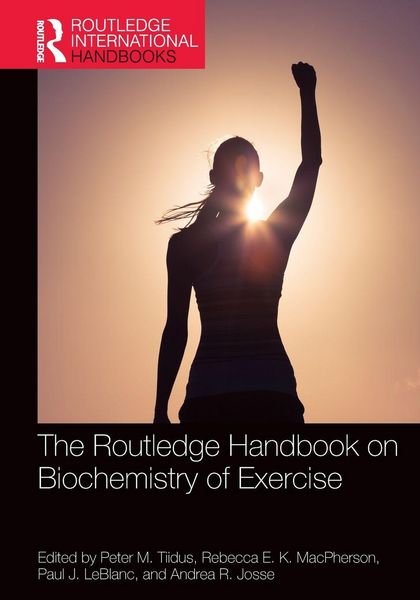
The Routledge Handbook on Biochemistry of Exercise
-
- Hardcover
- Taschenbuch ausgewählt
- eBook
-
Sprache:Englisch
Fr. 89.90
inkl. gesetzl. MwSt.,
Beschreibung
Produktdetails
Einband
Taschenbuch
Erscheinungsdatum
25.09.2023
Abbildungen
schwarz-weiss Illustrationen, Raster, schwarz-weiss, Zeichnungen, schwarz-weiss, Tabellen, schwarz-weiss
Herausgeber
Peter M. Tiidus + weitereVerlag
Taylor & FrancisSeitenzahl
584
Maße (L/B/H)
25.4/17.8/3.1 cm
Gewicht
1080 g
Sprache
Englisch
ISBN
978-0-367-64294-5
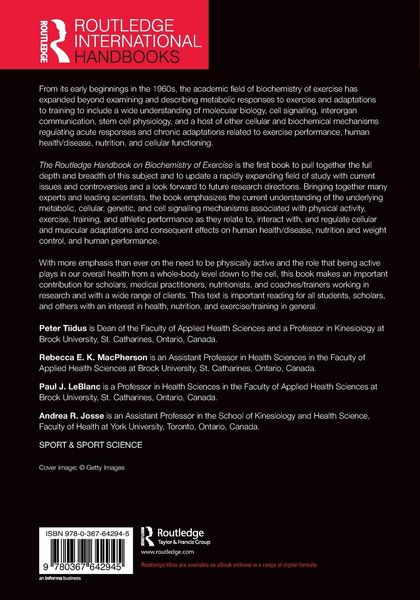
From its early beginnings in the 1960s, the academic field of biochemistry of exercise has expanded beyond examining and describing metabolic responses to exercise and adaptations to training to include a wide understanding of molecular biology, cell signalling, interorgan communication, stem cell physiology, and a host of other cellular and biochemical mechanisms regulating acute responses and chronic adaptations related to exercise performance, human health/disease, nutrition, and cellular functioning.
The Routledge Handbook on Biochemistry of Exercise is the first book to pull together the full depth and breadth of this subject and to update a rapidly expanding field of study with current issues and controversies and a look forward to future research directions. Bringing together many experts and leading scientists, the book emphasizes the current understanding of the underlying metabolic, cellular, genetic, and cell signalling mechanisms associated with physical activity, exercise, training, and athletic performance as they relate to, interact with, and regulate cellular and muscular adaptations and consequent effects on human health/disease, nutrition and weight control, and human performance.
With more emphasis than ever on the need to be physically active and the role that being active plays in our overall health from a whole-body level down to the cell, this book makes an important contribution for scholars, medical practitioners, nutritionists, and coaches/trainers working in research and with a wide range of clients. This text is important reading for all students, scholars, and others with an interest in health, nutrition, and exercise/training in general.
Noch keine Bewertungen vorhanden
Verfassen Sie die erste Bewertung zu diesem Artikel
Helfen Sie anderen Kundinnen und Kunden durch Ihre Meinung.