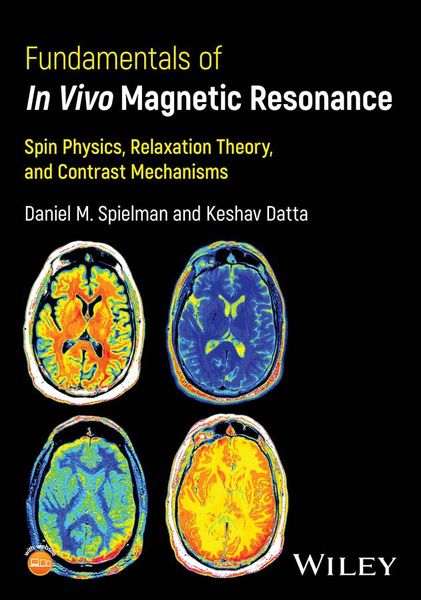
Produktbild: Spielman, D: Fundamentals of In Vivo Magnetic Resonance

Spielman, D: Fundamentals of In Vivo Magnetic Resonance Spin Physics, Relaxation Theory, and Contrast Mechanisms

Fr. 163.00

inkl. gesetzl. MwSt., Versandkostenfrei


Beschreibung

Produktdetails

Einband

Taschenbuch

Erscheinungsdatum

19.03.2024

Verlag

Wiley

Seitenzahl

288

Maße (L/B/H)

25.4/17.7/1.7 cm

Gewicht

636 g

Sprache

Englisch

ISBN

978-1-394-23309-0

Beschreibung

Produktdetails

Einband

Taschenbuch

Erscheinungsdatum

19.03.2024

Verlag

Wiley

Seitenzahl

288

Maße (L/B/H)

25.4/17.7/1.7 cm

Gewicht

636 g

Sprache

Englisch

ISBN

978-1-394-23309-0

Kundinnen und Kunden meinen

0 Bewertungen

Informationen zu Bewertungen

Zur Abgabe einer Bewertung ist eine Anmeldung im Konto notwendig. Die Authentizität der Bewertungen wird von uns nicht überprüft. Wir behalten uns vor, Bewertungstexte, die unseren Richtlinien widersprechen, entsprechend zu kürzen oder zu löschen.

Die Bewertungen sind nach Format, Anzahl Sterne und Datum sortiert.

Verfassen Sie die erste Bewertung zu diesem Artikel

Helfen Sie anderen Kund*innen durch Ihre Meinung

Kundinnen und Kunden meinen

0 Bewertungen filtern

  • Produktbild: Spielman, D: Fundamentals of In Vivo Magnetic Resonance
  • Preface xi

    About the Companion Website xv

    1 Introduction 1

    1.1 A Brief History of MR 1

    1.2 NMR versus MRI 3

    1.3 The Roadmap 5

    2 Classical Description of MR 11

    2.1 Nuclear Magnetism 11

    2.2 Net Magnetization and the Bloch Equations 13

    2.3 Rf Excitation and Reception 14

    2.4 Spatial Localization 15

    2.5 The MRI Signal Equation 16

    2.6 Summary 19

    Exercises 20

    Historical Notes 23

    3 Quantum Mechanical Description of MR 27

    3.1 Introduction 27

    3.1.1 Why Quantum Mechanics for Magnetic Resonance? 27

    3.1.2 Historical Developments 27

    3.1.3 Wave Functions 29

    3.2 Mathematics of QM 32

    3.2.1 Linear Vector Spaces 32

    3.2.2 Dirac Notation and Hilbert Space 33

    3.2.3 Liouville Space 36

    3.3 The Six Postulates of QM 38

    3.3.1 Postulate 1 38

    3.3.2 Postulate 2 38

    3.3.3 Postulate 3 39

    3.3.4 Postulate 4 39

    3.3.5 Postulate 5 39

    3.3.6 Postulate 6 40

    3.4 MR in Hilbert Space 44

    3.4.1 Review of Spin Operators 44

    3.4.2 Single Spin in a Magnetic Field 44

    3.4.3 Ensemble of Spins in a Magnetic Field 46

    3.5 MR in Liouville Space 49

    3.5.1 Statistical Mixture of Quantum States 50

    3.5.2 The Density Operator 51

    3.5.3 The Spin-lattice Disconnect 52

    3.5.4 Hilbert Space versus Liouville Space 52

    3.5.5 Observations About the Spin Density Operator 53

    3.5.6 Solving the Liouville von Neuman Equation 55

    3.6 Summary 57

    Exercises 58

    Historical Notes 61

    4 Nuclear Spins 67

    4.1 Review of the Spin Density Operator and the Hamiltonian 67

    4.2 External Interactions 68

    4.3 Internal Interactions 69

    4.3.1 Chemical Shift 71

    4.3.2 Dipolar Coupling 72

    4.3.3 J Coupling 72

    4.4 Summary 75

    Exercises 75

    Historical Notes 78

    5 Product Operator Formalism 81

    5.1 The Density Operator, Populations, and Coherences 81

    5.1.1 Spin Systems and Associated Density Operators 81

    5.1.2 Density Matrix Calculations 85

    5.2 POF for Single-Spin Coherence Space 88

    5.3 POF for Two-Spin Coherence Space 90

    5.4 Branch Diagrams 94

    5.5 Multiple Quantum Coherences and 2D NMR 97

    5.6 Polarization Transfer 100

    5.7 Spectral Editing 103

    5.7.1 J-difference Editing 103

    5.7.2 Multiple-quantum Filtering 104

    5.8 Summary 105

    Exercises 106

    Historical Notes 111

    6 In vivo MRS 113

    6.1 1H MRS 113

    6.1.1 Acquisition Methods 113

    6.1.2 Detectable Metabolites and Applications 120

    6.2 31P-MRS 126

    6.3 13C-MRS 127

    6.3.1 Acquisition Methods 127

    6.3.2 13C Infusion Studies 132

    6.3.3 Hyperpolarized 13 c 132

    6.4 Deuterium Metabolic Imaging 138

    6.5 23Na-MRI 140

    6.6 Summary 140

    Exercises 141

    7 Relaxation Fundamentals 145

    7.1 Basic Principles 145

    7.1.1 Molecular Motion 145

    7.1.2 Stochastic Processes 147

    7.1.3 A Simple Model of Relaxation 150

    7.2 Dipolar Coupling 153

    7.2.1 The Solomon Equations 153

    7.2.2 Calculating Transition Rates 155

    7.2.3 Nuclear Overhauser Effect 158

    7.3 Chemical Exchange 160

    7.3.1 Introduction 160

    7.3.2 Effects on Longitudinal Magnetization 161

    7.3.3 Effects on Transverse Magnetization 162

    7.3.4 Examples 164

    7.4 In Vivo Water 167

    7.4.1 Hydration Layers 167

    7.4.2 Tissue Relaxation Times 168

    7.4.3 Magic Angle Effects 169

    7.4.4 Magnetization Transfer Contrast (MTC) 170

    7.4.5 Chemical Exchange Saturation Transfer (CEST) 172

    7.4.5.1 Amide Proton (-NH) Transfer (APT) 173

    7.4.5.2 Hydroxyl (-OH) CEST 173

    7.4.5.3 Amine (-NH2) CEST 173

    7.5 Summary 174

    Exercises 174

    Historical Notes 179

    8 Redfield Theory of Relaxation 181

    8.1 Perturbation Theory and the Interaction Frame of Reference 181

    8.2 The Master Equation of NMR 182

    8.3 Calculating Relaxation Times 185

    8.4 Relaxation Mechanisms 187

    8.4.1 Dipolar Coupling Revisited 187

    8.4.2 Scalar Relaxation of the 1 st Kind and 2 nd Kind 189

    8.4.3 Chemical Shift Anisotropy (CSA) 191

    8.5 Relaxation in the Rotating Frame 191

    8.5.1 Physics of T1¿ 192

    8.5.2 The Spin-Lock Experiment 194

    8.5.3 Choosing the Optimum Spin-Lock Frequency 195

    8.5.4 Rf Power Considerations 200

    8.5.5 Adiabatic Spin-Lock 201

    8.5.6 Applications 202

    8.6 Illustrative Redfield Theory Examples 202

    8.6.1 Hyperpolarized 13C-urea 202

    8.6.2 Hyperpolarized 13C-Pyr 203

    8.7 Summary 207

    Exercises 208

    Historical Notes 210

    9 MRI Contrast Agents 213

    9.1 Paramagnetic Relaxation Enhancement 213

    9.1.1 Solomon-Bloembergen-Morgan Theory 215

    9.1.2 Gd3+-Based T1 Contrast Agents 218

    9.2 T2and T¿2Contrast Agents 219

    9.2.1 T2, Diffusion, and Outer-Sphere Relaxation 219

    9.2.2 SPIOs and USPIOs 219

    9.3 PARACEST Contrast Agents 220

    9.4 Contrast Agents in the Clinic 221

    9.4.1 Gd-Based Agents 222

    9.4.2 Iron-Based Agents 223

    9.5 Summary 225

    Exercises 225

    10 In vivo Examples 229

    10.1 Relaxation Properties of the Brain 229

    10.1.1 Morphological Imaging 229

    10.1.2 Perfusion Imaging 229

    10.1.3 Diffusion-weighted Imaging (DWI) 230

    10.1.4 Imaging Myelin 232

    10.1.5 Susceptibility-weighted Imaging (SWI) 232

    10.2 Relaxation Properties of Blood 233

    10.2.1 Hemoglobin and Red Blood Cells 233

    10.2.2 MRI Blood Oximetry 235

    10.2.3 Functional Magnetic Resonance Imaging (fMRI) 236

    10.2.4 MRI of Hemorrhage 238

    10.3 Relaxation Properties of Cartilage 241

    10.3.1 T2Mapping 243

    10.3.2 DWI 244

    10.3.3 T1¿ Mapping and Dispersion 244

    10.3.4 gagCEST 245

    10.3.5 dGEMRIC 245

    10.3.6 Ultrashort TE (UTE) Imaging 246

    10.3.7 Sodium MRI 246

    10.3.8 Summary 248

    10.4 Synopsis 248

    Exercises 249

    Further Readings 251

    Quantum Mechanics 251

    Spin Physics 251

    Magnetic Resonance Imaging (MRI) 251

    In vivo Magnetic Resonance Spectroscopy 251

    Relaxation Theory 252

    Clinical MRI 252

    References 253

    Index 265