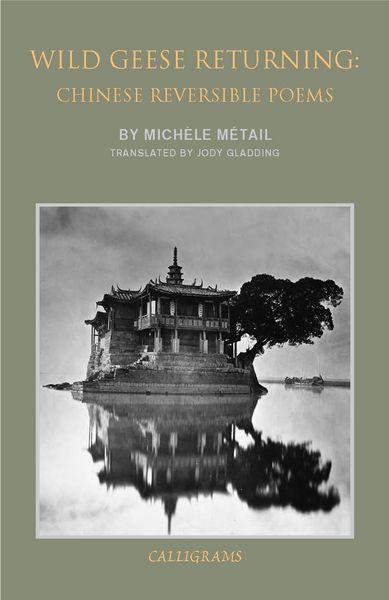
Wild Geese Returning Chinese Reversible Poems
-
- Taschenbuch
- eBook ausgewählt
-
Form:Einzelkauf Download
-
Sprache:Englisch
Fr. 19.90
inkl. gesetzl. MwSt.Beschreibung
Produktdetails
Format
ePUB 3
Kopierschutz
Ja
Family Sharing
Ja
Text-to-Speech
Ja
Erscheinungsdatum
28.03.2017
Verlag
New York Review BooksSeitenzahl
312 (Printausgabe)
Dateigröße
133846 KB
Sprache
Englisch
EAN
9789629968168
A breathtaking introduction to Chinese multidirectional poems, told through the story of Su Hui, the greatest writer of these poems who embroidered a silk with 840 characters--equaling as many as 12,000 multidirectional poems--for her distant husband.
For nearly two thousand years, the condensed language of classical Chinese has offered the possibility of writing poems that may be read both forward and backward, producing entirely different creations. The genre was known as the "flight of wild geese," and the poems were often symbolically or literally sent to a distant lover, in the hope that he or she, like the migrating birds, would return.
Its greatest practitioner, and the focus of this critical anthology, is Su Hui, a woman who, in the fourth century, embroidered a silk for her distant husband consisting of a grid of 840 characters. No one has ever fully explored all of its possibilities, but it is estimated that the poem-and the poems within the poem-may be read as many as twelve thousand ways. Su Hui herself said, "As it lingers aimlessly, twisting and turning, it takes on a pattern of its own. No one but my beloved can be sure of comprehending it."
With examples ranging from the third to the nineteenth centuries, Michèle Métail brings the scholarship of a Sinologist and the playfulness of an avant-gardist to this unique collection of perhaps the most ancient of experimental poems.
For nearly two thousand years, the condensed language of classical Chinese has offered the possibility of writing poems that may be read both forward and backward, producing entirely different creations. The genre was known as the "flight of wild geese," and the poems were often symbolically or literally sent to a distant lover, in the hope that he or she, like the migrating birds, would return.
Its greatest practitioner, and the focus of this critical anthology, is Su Hui, a woman who, in the fourth century, embroidered a silk for her distant husband consisting of a grid of 840 characters. No one has ever fully explored all of its possibilities, but it is estimated that the poem-and the poems within the poem-may be read as many as twelve thousand ways. Su Hui herself said, "As it lingers aimlessly, twisting and turning, it takes on a pattern of its own. No one but my beloved can be sure of comprehending it."
With examples ranging from the third to the nineteenth centuries, Michèle Métail brings the scholarship of a Sinologist and the playfulness of an avant-gardist to this unique collection of perhaps the most ancient of experimental poems.
Kundinnen und Kunden meinen
Verfassen Sie die erste Bewertung zu diesem Artikel
Helfen Sie anderen Kund*innen durch Ihre Meinung