• Produktbild: Routledge Handbook of Urban Biodiversity
  • Produktbild: Routledge Handbook of Urban Biodiversity

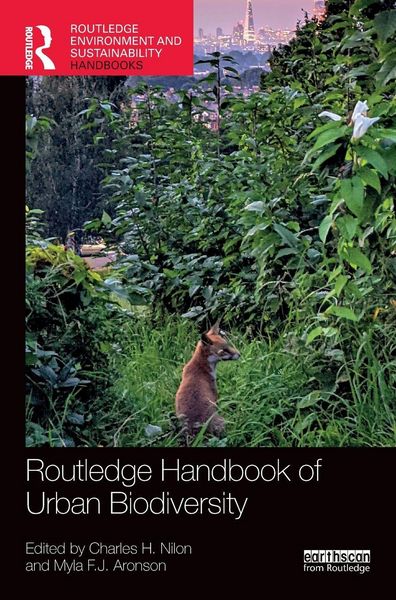
Routledge Handbook of Urban Biodiversity

Fr. 363.00

inkl. gesetzl. MwSt., Versandkostenfrei


Beschreibung

Produktdetails

Einband

Gebundene Ausgabe

Erscheinungsdatum

16.10.2023

Abbildungen

schwarz-weiss Illustrationen, Raster, schwarz-weiss, Zeichnungen, schwarz-weiss, Tabellen, schwarz-weiss

Herausgeber

Charles H. Nilon + weitere

Verlag

Taylor & Francis

Seitenzahl

468

Maße (L/B/H)

25/17.5/3 cm

Gewicht

1000 g

Sprache

Englisch

ISBN

978-0-367-44454-9

Beschreibung

Rezension

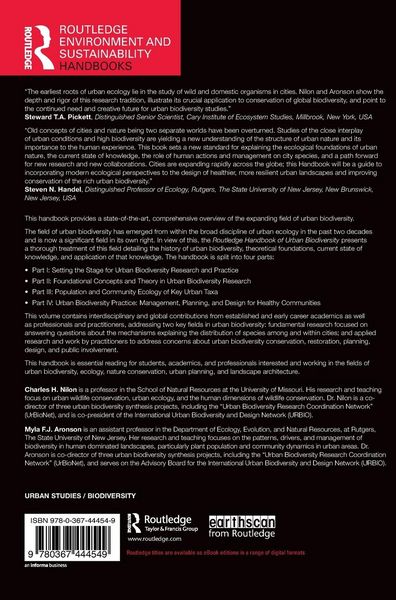
"The earliest roots of urban ecology lie in the study of wild and domestic organisms in cities. Nilon

and Aronson show the depth and rigor of this research tradition, illustrate its crucial application

to conservation of global biodiversity, and point to the continued need and creative future for urban

biodiversity studies."

Steward T.A. Pickett, Distinguished Senior Scientist, Cary Institute of

Ecosystem Studies, Millbrook, New York , USA


"This is a blockbuster book for the urban century. From the fundamentals, science and theory of

urban biodiversity to practical management issues, Nilon and Aronson have produced a must-have

that should be on the bookshelf of every urban professional."

Karen C. Seto , Frederick C. Hixon Professor of Geography &

Urbanization Science, Yale University, New Haven, Connecticut, USA


"Rapid urbanization at global scale exerts serious threats to urban biodiversity which is of great

importance for conservation in terms of implementing the Kunming-Montreal Global Biodiversity

Framework; Urban development can not be successful unless its biodiversity is sustainably

utilized. The book offers readers opportunities to understand concepts and theory for urban biodiversity

and learn best practices in using and conserving it."

Keping Ma , Vice Chair and Secretary General, Biodiversity Committee,

Chinese Academy of Sciences, Beijing, China


"Old concepts of cities and nature being two separate worlds have been overturned. Studies of the

close interplay of urban conditions and high biodiversity are yielding a new understanding of the

structure of urban nature and its importance to the human experience. This book sets a new standard

for explaining the ecological foundations of urban nature, the current state of knowledge, the

role of human actions and management on city species, and a path forward for new research and

new collaborations. Cities are expanding rapidly across the globe; this Handbook will be a guide

to incorporating modern ecological perspectives to the design of healthier, more resilient urban

landscapes and improving conservation of the rich urban biodiversity."

Steven N. Handel , Distinguished Professor of Ecology, Rutgers,

The State University of New Jersey, New Brunswick, New Jersey , USA
Produktdetails

Einband

Gebundene Ausgabe

Erscheinungsdatum

16.10.2023

Abbildungen

schwarz-weiss Illustrationen, Raster, schwarz-weiss, Zeichnungen, schwarz-weiss, Tabellen, schwarz-weiss

Herausgeber

Verlag

Taylor & Francis

Seitenzahl

468

Maße (L/B/H)

25/17.5/3 cm

Gewicht

1000 g

Sprache

Englisch

ISBN

978-0-367-44454-9

Kundinnen und Kunden meinen

0 Bewertungen

Informationen zu Bewertungen

Zur Abgabe einer Bewertung ist eine Anmeldung im Konto notwendig. Die Authentizität der Bewertungen wird von uns nicht überprüft. Wir behalten uns vor, Bewertungstexte, die unseren Richtlinien widersprechen, entsprechend zu kürzen oder zu löschen.

Die Bewertungen sind nach Format, Anzahl Sterne und Datum sortiert.

Verfassen Sie die erste Bewertung zu diesem Artikel

Helfen Sie anderen Kund*innen durch Ihre Meinung

Kundinnen und Kunden meinen

0 Bewertungen filtern

Weitere Artikel finden Sie in

Die Leseprobe wird geladen.
  • Produktbild: Routledge Handbook of Urban Biodiversity
  • Produktbild: Routledge Handbook of Urban Biodiversity
    1. Introduction to the Routledge Handbook of Urban Biodiversity
    2. Charles H. Nilon and Myla F.J. Aronson

      PART 1: Setting the stage for urban biodiversity research and practice

    3. History of urban biodiversity research and practice
    4. Charles H. Nilon

    5. Comparative urban ecology and the gradient approach: extending knowledge by acknowledging the diversity of cities around the world
    6. Amy K. Hahs

    7. Urban climate and the biophysical environment
    8. Peter Ibsen, Dion Kucera, Stephanie Piper, and G. Darrel Jenerette

    9. Understanding land use, land cover, and landscape patterns of the world's cities for sustainable biodiversity planning
    10. Cynnamon Dobbs, Dagmar Haase, and Ulla Mörtberg

      PART 2: Foundational concepts and theory in urban biodiversity research

    11. The application of landscape ecology and biogeography in the study of urban biodiversity
    12. Christopher A. Lepczyk and Frank A. La Sorte

    13. Community assembly and filtering of urban ecosystems
    14. Myla F.J. Aronson, Christopher A. Lepczyk, and Karl L. Evans

    15. From filters to feedbacks: how do people influence biodiversity across scales?
    16. Riley Andrade, Paige S. Warren, and Sarel S. Cilliers

    17. People's decisions shape urban habitats
    18. Dave Kendal, Emily Minor, and Monika Egerer

    19. Scaling-up the management and conservation of urban biodiversity
    20. Susannah B. Lerman, Josep Padullés Cubino, and Mark A. Goddard

    21. Connecting biodiversity and human wellbeing
    22. Jessica C. Fisher, Maximilian Nawrath, Martin Dallimer, Katherine N. Irvine, and Zoe G. Davies

    23. Multidimensionality of biodiversity in urban social-ecological soil systems
    24. Loren B. Byrne and Katalin Szlavecz

    25. Plant invasions in cities: patterns, processes, consequences, and management
    26. Mirijam Gaertner and Ingo Kowarik

    27. The importance of citizen science for understanding urban biodiversity
    28. Christopher A. Lepczyk and Timothy Vargo

      PART 3: Population and community ecology of key urban taxa

    29. Patterns and drivers of plant biodiversity in urban and urbanizing landscapes
    30. Sonja Knapp and Wayne Zipperer

    31. Urbanization shapes insect diversity
    32. Emily K. Meineke, Elsa Youngsteadt, Mia K. Lippey, and Katherine C.R. Baldock

    33. Birds in an urban world: community patterns across cities
    34. Christine Rega-Brodsky and Ian MacGregor-Fors

    35. A cross-continental synthesis of urban insectivorous bat research and future directions
    36. Caragh G. Threlfall and Kirsten Jung

    37. Impacts of urbanization on amphibians and opportunities for their conservation in cities
    38. Kirsten M. Parris

    39. Freshwater biodiversity in urban ecosystems
    40. Augustin C. Engman and Allison H. Roy

      PART 4: Urban biodiversity practice: management, planning, and design for healthy communities

    41. Urban green infrastructure, biodiversity, poverty, and equity
    42. Charlie M. Shackleton

    43. Managing vegetation for urban biodiversity
    44. Jun Yang, Sonja Knapp, and Wayne Zipperer

    45. The role of engineered green infrastructure in supporting urban biodiversity
    46. J. Scott MacIvor, Nicholas S.G. Williams, and Jeremy Lundholm

    47. Global biodiversity requires integrating social and ecological goals for urban biodiversity: insights from ecological restoration

    48. Lea R. Johnson

    49. Cities are planning for biodiversity: a global survey of city plans
    50. Karen M. O'Neill, Myla F.J. Aronson, Charles H. Nilon, Sarel S. Cilliers, Cynnamon Dobbs, Laren J. Frazee, Mark A. Goddard, Debra Roberts, Emilie K. Stander, Peter Werner, and Ken P. Yocom

    51. Development and evolution of urban biodiversity indicators and assessment tools
    52. Yuta Uchiyama and Ryo Kohsaka

    53. Urban biodiversity: opportunities and challenges in the Paris Region
    54. Marc Barra

    55. Regeneration of urban nature: from planning to action
    56. Diana Wiesner

    57. Design for urban biodiversity: applying research on biodiversity of urban lawns into landscape design practice

    Maria Ignatieva