Gutscheinbedingungen

*Gültig bis 07.06.2026 auf (fast) alles. Ausgeschlossen sind Smartboxen, Zeitschriften, Tickets, Lebensmittel, Gaming-Elektroartikel, Tinte/Toner, Gutscheine, Geschenkkarten, Blumen und Abos | Einlösbar in allen Buchhandlungen von Orell Füssli, Barth Bücher, Buchladen Rapunzel, Schuler Orell Füssli, Stauffacher und ZAP unter Vorweisung des Gutscheins, auf www.orellfüssli.ch durch Eingabe des Gutscheincodes. Beim Service „eBooks verschenken“ und bei eBook-Käufen via eReader nicht einlösbar | Mindesteinkaufswert: Fr. 100.- | Nicht mit anderen Rabatten kumulierbar.

Produktbild: Emerging Nanodielectric Materials for Energy Storage

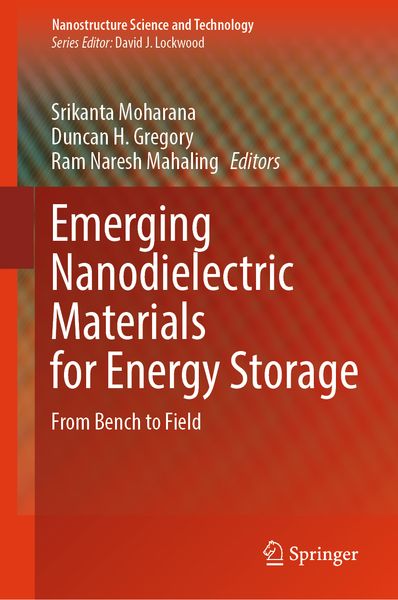
Emerging Nanodielectric Materials for Energy Storage From Bench to Field

Fr. 218.00

inkl. gesetzl. MwSt., Versandkostenfrei


Beschreibung

Produktdetails

Einband

Gebundene Ausgabe

Erscheinungsdatum

31.10.2023

Herausgeber

Srikanta Moharana + weitere

Verlag

Springer

Seitenzahl

436

Maße (L/B/H)

24.1/16/3 cm

Gewicht

840 g

Sprache

Englisch

ISBN

978-3-031-40937-0

Beschreibung

Portrait

Dr. Srikanta Moharana is currently working as Assistant Professor, Department of Chemistry, School of Applied Sciences, Centurion University of Technology and Management, Odisha, India. He received his M.Sc degree in Chemistry (2012) from the National Institute of Technology (NIT), Rourkela, and his M.Phil (2013) & Ph.D. (2019) degrees in Chemistry from the School of Chemistry, Sambalpur University, Odisha, India. He was awarded by Prof. GB Behera the Best Ph.D. Thesis award under the banner of the Orissa chemical society. Dr. Moharana has published more than 35 research papers in international peer-reviewed journals, seventeen book chapters and edited one book with Elsevier. He has delivered 02 invited talks and presented his work at various National and International Conferences. His research experience as well as research interests, lies in graphene, carbon nanotubes and ceramic based polymer nanocomposites synthesis and fabrication of flexible thin film capacitors for advanced energy storage applications. He is a life member of Orissa Chemical Society.

Prof. Duncan H. Gregory is the West CHEM chair of Inorganic Materials, University of Glasgow. He was previously an EPSRC Advanced Fellow, Lecturer then Reader in Materials Chemistry at the University of Nottingham. He is currently a Visiting Professor at Kyushu University and was Vice President of the Royal Society of Chemistry (RSC) Materials Chemistry Division Council (2009-2014). His research interests focus on the discovery of new solids including sustainable energy materials (e.g. Li batteries, fuel storage, thermoelectrics), inorganic nanomaterials and the solid state chemistry of non-oxides. His research also embraces the sustainable production of materials including the microwave synthesis and processing of solids. He has published more than 180 papers in peer reviewed journals, is the Editor in Chief of the journal Inorganics and an Associate Editor of Materials for Renewable and Sustainable Energy . He was the winner of the RSC Sustainable Energy Award in 2009 and was awarded the Institute of Materials, Minerals and Mining (IOM3) Kroll Medal in 2019. 

Dr. Ram Naresh Mahaling is continuing as an Associate Professor in the School of Chemistry, Sambalpur University since 2017. He has more than 12 years of teaching and 14 years of research experience and has published more than 55 research papers in peer-reviewed journals and authored seven book chapters. His current areas of research include the synthesis of perovskite-type metal oxide based polymer composite materials for electronic applications and energy storage, nanostructed composite and their structure-properties relationship. He has visited the Institute of Polymer Research (IPF), Dresden, Germany, and University of Orleans, France for two-and-half years as a Postdoctoral Fellow. He has received research grants from different funding agency, such as UGC New Delhi, DST SERB, New Delhi & Government of Odisha. So far he has guided Fourteen (14) M.Phil students and two (03) students have been awarded doctoral degree under his guidance. He has delivers 14 invited talks in different National and International conferences.

Produktdetails

Einband

Gebundene Ausgabe

Erscheinungsdatum

31.10.2023

Herausgeber

Verlag

Springer

Seitenzahl

436

Maße (L/B/H)

24.1/16/3 cm

Gewicht

840 g

Sprache

Englisch

ISBN

978-3-031-40937-0

Herstelleradresse

Springer-Verlag KG
Sachsenplatz 4-6
1201 Wien
AT

Email: ProductSafety@springernature.com

Kundinnen und Kunden meinen

0 Bewertungen

Informationen zu Bewertungen

Zur Abgabe einer Bewertung ist eine Anmeldung im Konto notwendig. Die Authentizität der Bewertungen wird von uns nicht überprüft. Wir behalten uns vor, Bewertungstexte, die unseren Richtlinien widersprechen, entsprechend zu kürzen oder zu löschen.

Die Bewertungen sind nach Format, Anzahl Sterne und Datum sortiert.

Verfassen Sie die erste Bewertung zu diesem Artikel

Helfen Sie anderen Kund*innen durch Ihre Meinung

Kundinnen und Kunden meinen

0 Bewertungen filtern

  • Produktbild: Emerging Nanodielectric Materials for Energy Storage
  • The Past, Present and Potential Future of Dielectric Nanomaterials.- Synthesis Approaches of Nanodielectric Materials.- Synthesis, Microstructural and Dielectric characterization of Nanodielectrics.- Role and Prospects of Polymer based Nanomaterials in the Dielectric World.- Recent Progress in Nanodielectric Composites and Their Applications.- Effect of Nanofillers Reinforced Polymer Blends For Dielectric Applications.- Metal and Metal Oxides Based Polymeric Nanodielectrics For Energy Storage: Opportunities and Challenges.- Fabrication and Properties of Dielectric Elastomer based Nanocomposites.- Physical and Chemical Properties of Inorganic-Polymer Nanodielectrics  and Their Applications.- Surface Engineering of Graphene Based Polymeric Composites For Energy Storage Devices.- Core-Shell Structured Nanomaterials For High Performance Dielectric Applications.- Transition Metal Oxide Based Nanomaterial For Advanced Energy Storage.- Fluoropolymer based Nanodielectrics for Energy Storage Application.- Application of Organic-Inorganic Nanodielectrics for energy storage.- Metal Oxide nanofiller introduced  polymer  based Nanocomposite dielectrics for Advanced Energy Storage Devices.